


Yugen
Yugen
Couldn't load pickup availability
Toyohiko Satoh: Songs and instrumental music for soprano, recorder and lute, inspired by western and eastern mysticism
About the album
The Japanese word YUGEN is usually defined as “an awareness of the universe that triggers emotional responses too deep and mysterious for words.”
Toyohiko Satoh chose this title for his new recording of his own compositions, which he created mostly in the last years, living in Japan and being involved in traditional Japanese arts and tea ceremony.
As a perfoming musican and composer, he spent most of his life in Europe. Now, towards the end of his career, he shows his own understanding of cross-cultural connection between east and west as well as between classical and traditional music.
YUGEN contains songs and instrumental pieces that are hard to classify, but all the more beautiful and inspiring to listen to.
The musicians
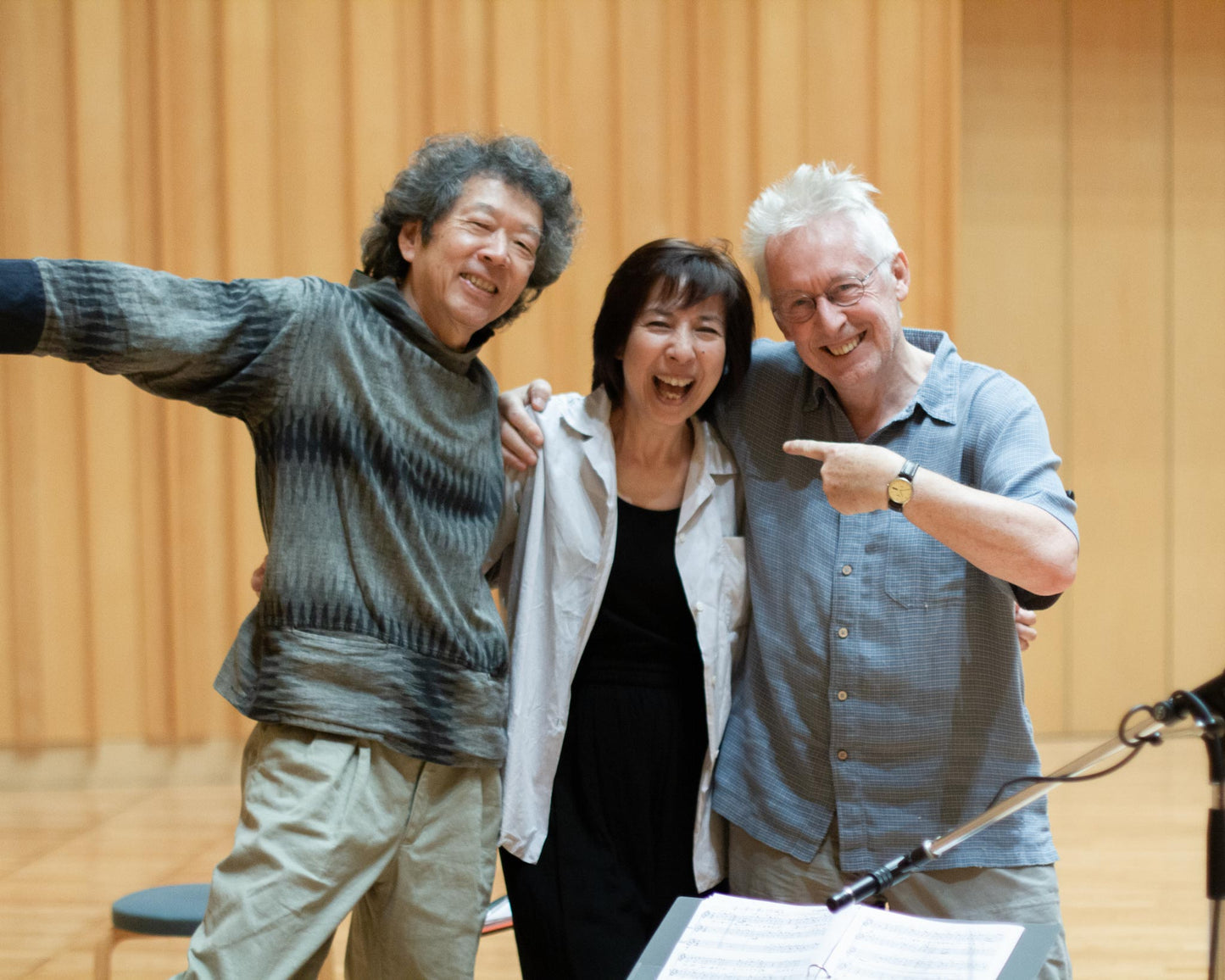
Chiyomi Yamada – soprano
Walter van Hauwe – recorder
Toyohiko Satoh – lute
Release date:
Catalogue number: CD-16311
Share


More album information
tracklist
Tracklist of "Yugen"
1. Nen-ne koroichi lullaby from the Nara district (2012) 3:44
ねんね ころいち - 奈良地方の子守唄
02. Zuizui zukkorobashi nursery rhyme from the Tokyo district (2013) 1:19
ずいずいずっころばし - 東京地方のわらべうた
03. Nen-nyako korochako lullaby (instrumental) (2012) 3:43
ねんにゃこ コロチャコ - 秋田地方の子守唄 / 器楽曲
04. Sendo no yanma lullaby from the Yamagata district (2007) 2:40
せんどのやんま - 山形地方の子守唄
05. If music and sweet poetry agree W. Shakespeare: ‘The Passionate Pilgrim’ (2004) 4:25
もし音楽と甘美なる詩が一つのものであるならば… - シェイクスピア~情熱の巡礼者
06. Utsuroi bushi / Floating mind (instrumental) (2015) 3:23
うつろい節 / 器楽曲
07. Take all my loves W. Shakespeare: Sonnet No. 40 (2012) 2:58
わたしの愛も愛人もことごとく - シェイクスピア~ソネット40番
08. Aka to bai New Year’s song from Nagasaki (2013)1:55
赤とバイ - 長崎の正月唄
09. Variations in Rondo upon an old dance (lute solo) (2012)3:29
古代舞曲によるロンド風変奏曲 / リュート・ソロ
10. Fuki no kyoku Japanese traditional tune (1982) 3:59
蕗の曲 - 古謡
11. Antagata dokosa Children’s song from the Kumamoto district (2012) 1:18
あんたがたどこさ - 熊本地方のわらべうた
12. Shall I compare thee to a summer’s day? W. Shakespeare: Sonnet No. 18 (2012) 2:25
君を夏の一日に譬えようか - シェイクスピア~ソネット18番
13. Kokiriko bushi kagura dance from the Toyama district (2011) 2:56
コキリコ節 - 富山地方の神楽踊
14. Yôkai old tune from Tanegashima (2009) 3:10
ようかい - 種子島古調
15. Kochae bushi Edo-minyo (2008) 2:23
コチャエ節 - 江戸民謡
16. Tadayoi / Drifting (lute solo) (2015) 4:50
漂(ただよい) リュート・ソロ
Total time 48:47
booklet text
Works by Toyohiko Satoh – Yugen
Historically, it was very common among lute players to perform their own compositions. Between the 16th and the 18th centuries, they created a significant amount of music for solo lute, as well as chamber music works including lute parts. Therefore, one might wonder if it is really still necessary to create new lute music today. But every now and then, you might wonder what would happen if you composed an entirely new piece. In that music, you could then express your very own ideas and grant yourself the space to let your dreams become a reality.
Yugen (幽玄) is an underlying notion within the Japanese arts that speaks of the ‘singing heart’ (歌う心). It can describe a profound yet unfathomable atmosphere, a graceful elegance of style, the beauty of deep and subtle suggestiveness. By way of an early example, these aspects can be found in the foreword of ‘Kokin Wakashu (‘a collection of Japanese poems from ancient and modern times’), issued by Ki no Tsurayuki at the beginning of the 10th century. In the 12/13th centuries, the famous poet Fujiwara no Teika (1162–1241), who is known as the publisher of the ‘Hyakunin Isshu’, also referred to the notion of Yugen. Zeami (1363–1443), a well-renowned Noh theatre actor and dramatist of the 14th and 15th centuries, in many ways represented the culmination and high point of Yugen.
Already in his early work, Zeami used the term Yugen to depict a delicate and fragile quality. He declared that Waka (a Japanese poetry form) constitutes the voice of the cosmos. According to him, even the sounds of birds and insects express Waka, as well as animals and plants. From this understanding, he created many an outstanding Noh theatre works and theoretical treatises on art, continuously seeking the spirit of aesthetics and beauty.
In the 17th century, when European lute players were searching for corresponding artistic expression, the Japanese master Haiku poet Bashō (1644–94) observed a frog jumping into a little pond and suddenly realized the nature of Yugen. – What would a goldfish swimming in a fish bowl, that is even smaller than a pond, think? I believe that, depending on how you look at it, you might perceive a small expression of Yugen in this image as well.
For a long time, I have been interested in the ancient cultures of both east and west. As time passes by, I acquire a deeper, yet vague understanding of their origins. I cannot help but wonder about some sort of remote spiritual connection between mankind of the past and myself. In 16th-century Europe, the lute had a reputation similar to the
piano today. Then it held a unique position until its decline in the course of the 18th century. As the musical mainstream developed into the baroque era in the 17th century, becoming faster and more glamorous and extravagant, the soft-sounding lute slowly withdrew from the public domain, silently retreating into its own world. But still, when you look at this world more closely, a little universe unfolds.
The Japanese Chadô (tea ceremony) is not only about making tea: It is a total work of art that comprises elements of Shodô (Japanese calligraphy), Sumi-e (Japanese ink painting), Kadô (flower arrangement) and Kôdô (incense burning). The lute similarly engages in many different forms of music: playing solo, accompanying songs and stories or playing in ensembles, thus offering a wide range of musical and sonic variations.
The works on this recording come in four different configurations: lute solo, songs with lute, songs with recorder and lute, and recorder with lute. As parents singing lullabies to their children is considered natural in all cultures, I see song as mankind’s most basic and precious form of making music. Recorders are, as their name (from the Latin ‘recordare’= recollect) suggests, instruments to imitate or recollect the song of birds. They provide a means of representing the song of nature which is not of human origin. The lute, on the other hand, is a string instrument, whose sounds fade away after being plucked by the finger. Still, one can manipulate the tone, pitch and dynamics of the plucked note while it dies away, which allows the musician intuitively to show his inspiration. At the same time, it has many more strings than the player has fingers, making it an instrument with clear technical constraints. One could draw a connection between these limitations and the strict form of the Japanese Haiku, which has to be composed within the pattern of 5–7–5 syllables. The fun of being creative within these constraints is the starting point from which I create my compositions.
The musical sources of the compositions that are recorded on this album are traditional Japanese folk songs, music from the Noh Theatre, nursery rhymes and lullabies. From western culture I borrowed some of Shakespeare’s texts. The comparison of my having spent more than half of my life in Europe (mainly in the Netherlands), involved in western Early Music, and my more recent research and practice of Zen-Chado and Noh theatre in Japan hopefully allows me to record on this album my very own expression of Yugen.
Toyohiko Satoh, 2016
recording information
Recorded October 2015
Location: Kirishima International Concert Hall “みやまコンセール” (Japan)
Balance engineer & recording producer: Jonas Niederstadt
Corporate Design: Tim+Tim, timandtim.com
Cover photography: Marion Denis
Booklet photography: Jonas Niederstadt
Translations: Miki Satoh / Jonas Niederstadt (English),
Jonas Niederstadt (German)
Produced by Jonas Niederstadt
© 2016 Carpe Diem Records
press reviews
Nostalgia magazine
"When listening to these dreams of Satoh, do we hear fragile and delicate music, is there an unfathomable atmosphere and a graceful elegance of style in the performance, do we hear a world of many possibilities and can we perceive some of the joy in being creative within given limitations? I think so. The instruments are played delicately, the music is elegant and especially in the slower Japanese works we feel an unfathomable atmosphere. The wide variety of pieces does showcase Satoh’s skill in creating different worlds with a limited ensemble. Another aspect we hear in the recording is joy. The joy of three friends making music together and the joyful sounds of folk songs and nursery rhymes. Listening to this CD I feel Satoh invites me to join him and his friends in his dream world. It is a pleasant place to be." Nostalgia Magazine 47, Jan. 2017