


Style Fantastique
Style Fantastique
Couldn't load pickup availability
William Dongois (cornetto), Carsten Lohff (harpsichord, organ), Eric Bellocq (lute, theorbo)
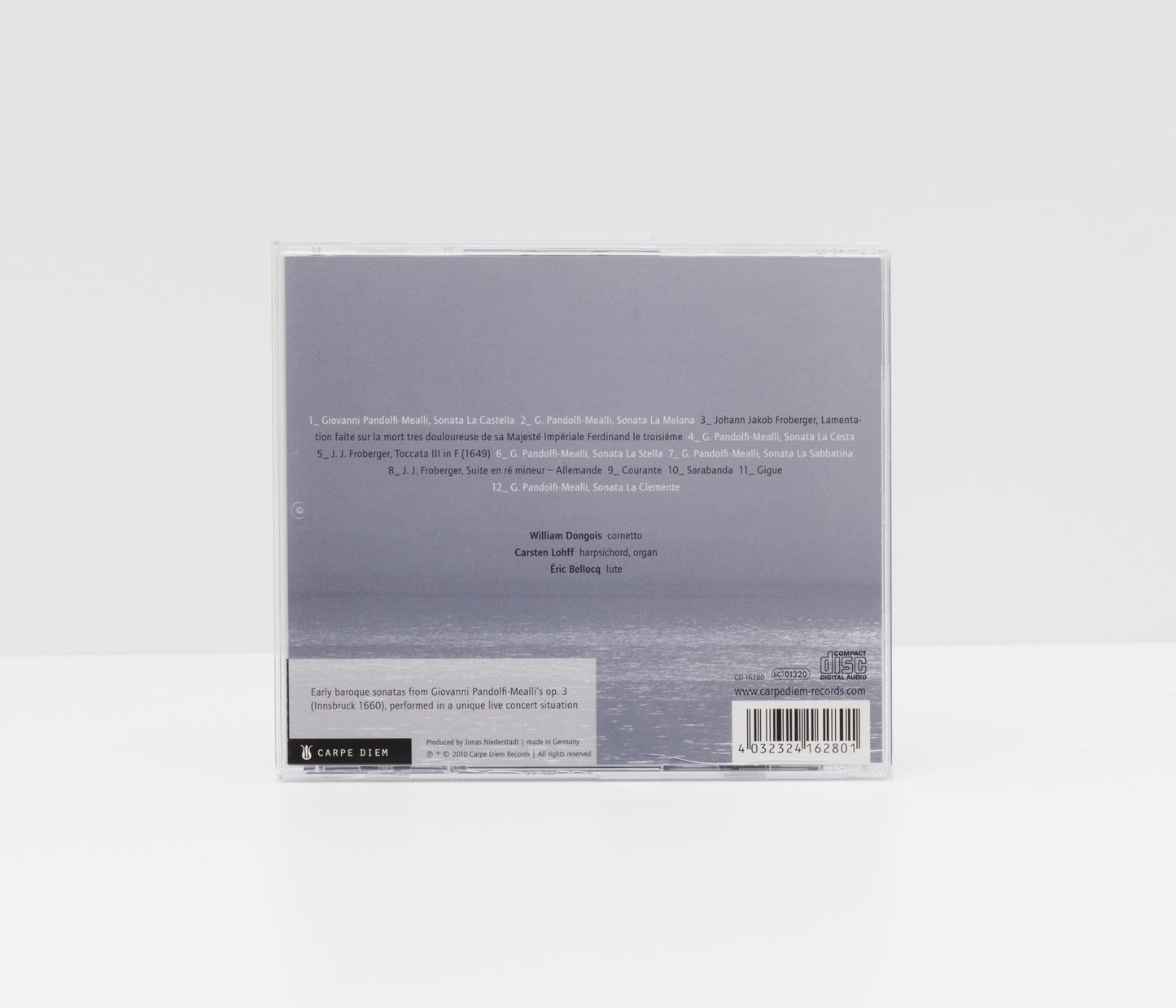
"Style fantastique" is the 2010 live album of the ensemble Le Concert Brisé lead by William Dongois (cornetto), and the ensemble's fourth recording with the label Carpe Diem.
The term Style fantastique refers to a 17th century style of composition and interpretation that is characterized by its very free form, its elements of improvisation and a highly dramatic arrangement.
The album holds the six sonatas op. 3 for solo instrument and continuo by Giovanni Pandolfi-Mealli (1620 - ca. 1669), printed in Innsbruck, Austria in 1660. The individual pieces are named after musicians who, together with Pandolfi-Mealli, were employed at the Habsburg Court in Innsbruck, for instance, Antonio Castello (sonata "La Castella").
Although the sonatas were originally composed for the violin, William Dongois makes the music resound with a lightness as if it had never been thought up for an instrument other than his own - here, once again, demonstrating the complete mastery of his instrument.
This recording is set with Le Concert Brisé's smallest lineup so far, almost intimate: aside from William Dongois, there are Carsten Lohff playing the harpsichord and organ, and Éric Bellocq on the lute and theorbo. They take on the continuo part in the six sonatas and as interludes feature solo pieces by Johann-Jakob Froberger (1616 - 1667). Thereby, the harpsichord played is a real treasure: an original Rückers instrument of 1632, taken from the inventory of the museum in Neuchatel, Switzerland.
Furthermore, and this distinguishes the CD at hand from all prior recordings with cornetto, it is truly a live recording, brought about by very particular circumstances: in October 2009, the ensemble played three consecutive concerts at the Museum of Art and History in Neuchatel. From the recordings of these three concerts, which differed in program, the best pieces were chosen and assembled on this album. This setting brought forth an exceptional dynamics and spontaneity in play, where the audience became the catalyst for capturing unpredictable musical moments and a very authentic interpretation which is hard to reach in a studio.
Style fantastique is an invitation to experience a contemporary and, for some, new understanding of the notion Stylus Fantasticus - an experience rarely found today: the spontaneous act of creation of both the composer and the interpreter. Music, interpretation and sound set the scene for a journey into the metaphysical immensity of music.
Release date:
Catalogue number: CD-16280
Share


More album information
tracklist
Tracklist of "Style Fantastique"
booklet text
recording information
press reviews
.... que ce cornetto !La musique jouée ici nous est plus familière jouée au violon, mais la lecture de W.Dongois, parfaitement justifié historiquement, nous la fait redécouvrir de manière des plus agréable.Belle prise de son.
Mr. Midgley has already reviewed the total CD, so let me merely discuss the cornetto as an instrument and William Dongois as a cornettist. The notes that accompany this CD are stylish enough but not fantastically informative, so some of what I write will be guesswork.At the beginning of the 17th C, the Italian cornetto ruled supreme throughout Europe as an instrument of virtuosity in ensemble music. Its only rival was the violin, and in both France and Germany the violin was regarded with suspicion, as an instrument suitable only for dance accompaniment. In Italy, cornetto and violin often squared off on stage and tossed impossibly acrobatic passages of virtuosity back and forth. By the end of the 17th C, the cornetto was in free fall toward oblivion. Why? Well, it's a fiendishly difficult instrument to play well, it ran into developing competition in orchestral music from the evolving oboe and later the chalumeau/clarinet. The latter is an instrument of even greater range and finger-fluidity than the cornetto. But there was, and is, an inescapable problem for the cornettist; chop fatigue! One simply can't keep playing fiery passagi on a cornetto, without an extended break, for hours and hours as one can on a violin. I seen very capable cornettists fade -- their lips benumbed and their tone imploding -- towards the end of concert half as long as the one recorded here. It's declared to be a "live performance" in the spotty notes, and what I hear makes me credit that assertion. It has the verve of live music. Besides, I know this repertoire; I'm the wise guy in the audience who can notice the two or three dropped notes, and grin to myself knowingly. I can also aver that this is a superhuman effort, not just virtuosity but a marathon of virtuosity.Curse those feeble notes! The first page thereof show Mr. Dongois playing a cornetto, but the cornetto isn't the curved black-leather-covered Venetian cornetto most people have seen in the hands of Doron Sherwin or Bruce Dickey. It's a "gerade Zink", a straight cornetto made of uncovered wood with a detachable ivory mouthpiece. That's the sort of cornetto which was favored in Germany and which outlasted the vogue of the Italian cornetto scaled in G. The straight Zink was usually scaled in C (with its lowest note a D). It sounds more trumpet-like than the Italian cornetto and much more trumpet-like than the "mute cornetto", which was also straight. I'm not 100% certain that this whole concert was played on such an instrument, but it sounds possible.The use of the lute and organ for continuo under the cornetto is positively gorgeous; the luet outlines the bass more 'vocally' than any harpsichord could do, and the organ pairs with the cornetto in timbre so well that at times one might confuse the two lines with each other. Performing Froberger as solo lute music is also a stroke of genius. Forgive me, harpsichordists, if I say that Eric Bellocq makes Froberger's 'keyboard' fantasy more fantastic on his archlute or theorbo than any harpsichordist ever has.
"Style Fantastique" désigne un style musical issu du "Stil Moderno", né en Italie dans la seconde moitié du 17e. siècle. Il est attaché à la musique instrumentale influencée par la musique vocale et l'art de l'improvisation. Les compositeurs de cette "musique fantastique" qui voulait exprimer les passions, les angoisses de manière parfois extrême, étaient d'abord de grands interprètes, virtuoses et improvisateurs. Les plus connus sont Frescobaldi et Froberger (ce dernier présent également sur ce disque) Ils ont excellé dans ce style. (Cf : Froberger :" Méditation sur ma mort future...")Mais, on retrouve ce courant artistique également chez Buxtehude (cf. "Klaglied" BWV 76/2), Reincken...On ne sait pratiquement rien de Pandolfi-Mealli, compositeur italien du 17e. siècle... Il est mentionné dans les annales de Charles-Ferdinand de Habsbourg, à Innsbrück, vers 1660. De ses oeuvres, seuls ont survécu deux beaux recueils de sonates, "opus 3" & "opus 4"William Dongois est avec Jean Tubéry un des plus grands spécialistes de cet instrument, le cornet à bouquin, à la sonorité si particulière, tellement envoûtante et émouvante, qui convient si bien à ce style musical. Le présent disque est un enregistrement "live", absolument superbe, où un public silencieux et recueilli ne donne aucun signe de sa présence... Et pourtant on la ressent, "cette présence" et elle influence le jeu des musiciens. Il y a une réelle communion entre ces artistes et ceux qui ont eu le bonheur d'assister à ce concert. Ecoutez ce disque magnifique, réécoutez-le avec un plaisir renouvelé et laissez vous gagner par cette émotion profonde et poétique. Très chaleureusement recommandé !