


Il viaggio d'Amore
Il viaggio d'Amore
Couldn't load pickup availability
About the album
Assembled on this album are traditional songs, songs from Renaissance sources as well as new compositions by Arianna Savall and, finally, the famous “Gracias a la vida” by Chilenian singer and political activist Violeta Parra.
The six musicians of Hirundo Maris combine all these diverse musical sources of their music into a time- and weightless dance through time and space. In the end, it is not clear anymore where the borders and differences between them are, and it is not even important anymore: Love as the universal uniting force is being applied here in a most practical way, and made comprehensible and very real to the attentive listener.
Ensemble Hirundo Maris
Petter Udland Johansen – tenor, hardingfele, cittern
Michal Nagy – guitar, voice
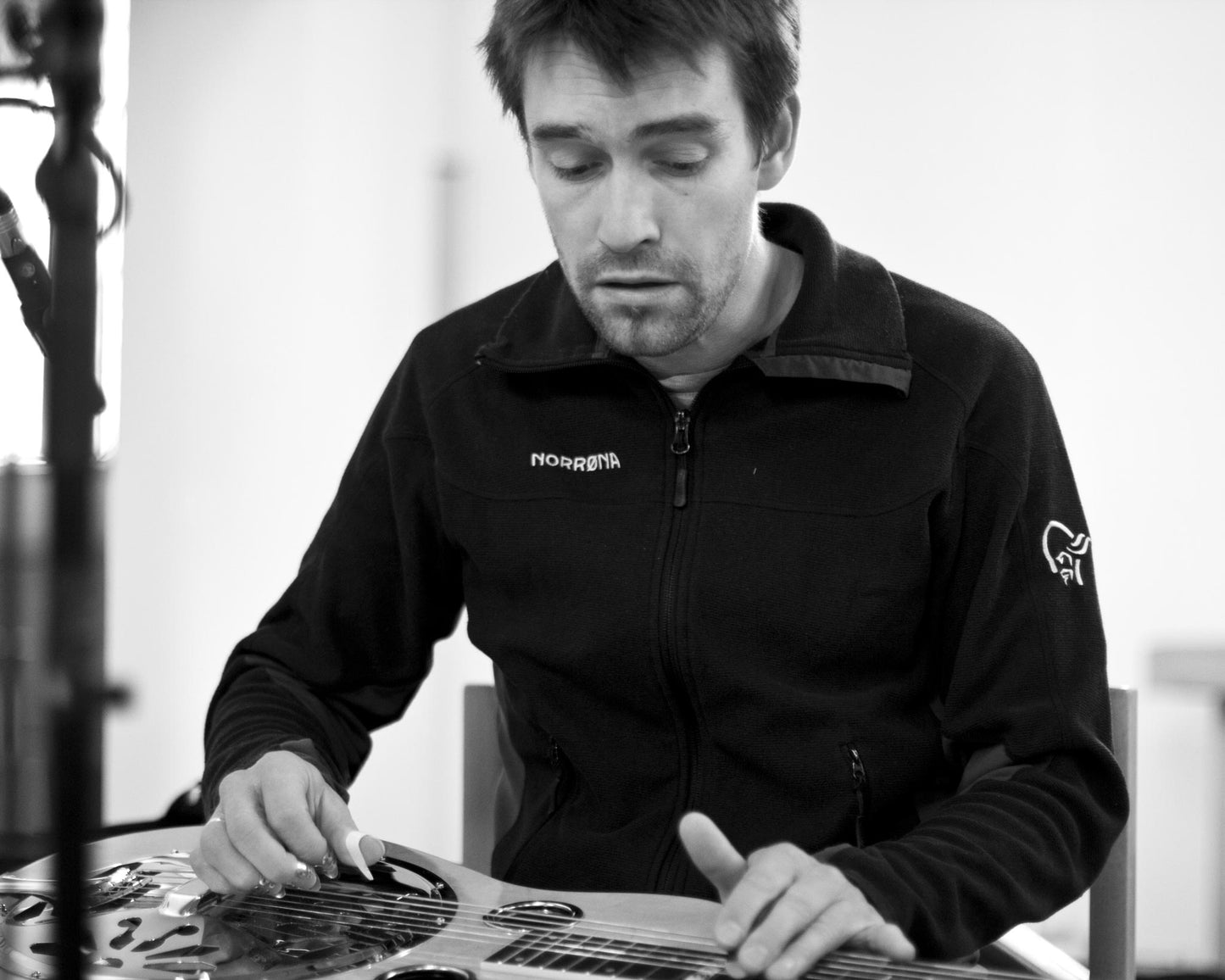
Sveinung Lilleheier – guitar, dobro, voice
Miquel Angel Cordero – colascione, double base, voice
David Mayoral – percussion, voice
Release date:
Catalogue number: CD-16307
Share


More album information
tracklist
Tracklist of "Il viaggio d'Amore"
Spain
01. Rosa fresca Anonym 16c. / Salinas / arr. Savall / Johansen 2:49
02. Canarios Anonym / Savall / Johansen 3:42
03. Yo me soy la morenica Cancionero de Palacio (14 c.) 2:40
04. La tarara Trad. / F. García Lorca (1898-1936) / Savall 3:17
05. Jotas Santiago de Murcia (1673 -1739) / Savall 2:54
Catalonia
06. La Dama d’Aragó Catalan folksong / A. Savall 7:22
Galicia
07. Cancro Cru Anxo Pintos / arr. J. Vogel / Savall / Johansen 3:58
Italy
08. Si dolce è il tormento Claudio Monteverdi / arr. Savall /Johansen 5:06
Switzerland
09. Girometta Trad. Ticino / arr. Savall /Johansen 3:21
France
10. L’amour de moi Anonym 16 c. / arr. A. Savall 3:25
11. Doulce mémoire Pierre Sandrin (1490-1561) / Savall / Johansen 6:08
12. L’adieu Guillaume Apollinaire (text) / Savall (music) 4:15
Germany and Austria
13. Heidenröslein Franz Schubert / J. W. von Goethe 2:23
England
14. I will give my love an apple Trad. / Johansen 3:28
Norway
15. Astri, mi Astri / Sekstturen Trad. / Johansen 7:22
Chile
16. Gracias a la Vida Violeta Parra (1917-1967) / Jan Hammarlund 7:15
(swedish text), arr. Savall / Johansen
booklet text
Il Viaggio D’Amore
There is a very beautiful image that can be used to explain what music from past times actually is. Imagine a message in a bottle, thrown into the sea somewhere hundreds of years ago, that we are only now opening. Ideally the hidden message it contains conveys to us all of the magic and energy that were once placed within it. The interpreter’s artistry is devoted to bringing this to life.
But is it possible? Simply to stride through countries and centuries, singing songs of love as though there were no borders in time and space? And to complement these old songs with new ones of our own, that take their place within a tradition while nevertheless representing the present? Of course it is possible; indeed it is a necessity if we wish to perceive ancient music as relevant to today. Arising at the instant when they are sung and played; understood at the moment when we hear them. This is just what Arianna Savall and Petter Udland Johansen do, and they invite us to join them on their journey.
These two performers and their ensemble pose a question that is as simple as it is transcendental, as topical as it is timeless: what is love like? In their quest for answers they travel through around a dozen countries, among them Spain, Austria, Norway and Switzerland, finally ending up in Chile. They take with them a selection of instruments that is as varied as the music itself: the triple harp, which was actually invented in Italy in Monteverdi’s time, and made its way via France to England, where it was highly regarded not only by King Charles I but also, before long, by Scottish and Irish folk musicians; the cittern, a plucked instrument that was even played by the Reformer Martin Luther; and the Hardanger fiddle, the most important instrument in Norwegian folk music, which features sympathetic strings in addition to its four bowed strings.
The journey begins with a dialogue from the Spanish Renaissance, the Romance of young Rose, who utters one of the uncomfortable truths about love: she trusts him, believes that he will marry her, but in fact he already has a wife and child. When the truth emerges, he lies and denies everything. By contrast Yo me soy la morenica from the famous ‘Cancionero de Palacio’, the song collection from the legendary court of King Ferdinand and Isabella, is a variant of the
‘Nigra sum’ from the Song of Solomon; to this day we are unsure as to whether the text originally described erotic, sensual love or metaphorically represented the ecstatic union of man and God. No such questions are raised by La tarara; it is very clear what the girl in the green dress is promising the young man picking olives… The Catalan ballad La Dama d’Aragó presents another problem: what if the lovers are brother and sister, and the brother must take his beloved to the man whom she is to marry?
We can give some thought to this matter while the Galician dance Cancro Cru takes us through the mists and across the sea to Italy. Si dolce è il tormento is one of the most famous solo madrigals by Claudio Monteverdi. It describes the absurdity of love that each of us must surely have felt: the contradiction that pain is caused by beauty – at least, if we feel rejected, like the singer of this song. Fortunately things are far jollier in Switzerland: Girometta, who in this folk song from Ticino comes down from the mountains, surely has more in mind than just playing the flute and dancing with her shepherd friend …
In France we start by sneaking into a mysterious Renaissance rose garden, in which the nightingale intones its seductive song. L’amour de moi tells of a pair of lovers who take their pleasure there by day and, especially, by night. How much more miserable, then, is the plight of the singer in Doulce mémoire: this, one of the most famous chansons of the French Renaissance, tells of the sorrow that comes when love fades. Everything that was once beautiful becomes horrible; happiness turns to despair. Next comes a setting by Arianna Savall herself of the poem L’adieu by Guillaume Apollinaire, a brief poem rich in symbolism in which the poet invokes eternal love that lasts beyond death.
Petter U. Johansen interprets Schubert’s famous Heidenröslein (a collaboration between the German poet Goethe and the Austrian composer Franz Schubert) as the shock of a young, inexperienced couple’s first sexual encounter – a very credible approach. And after brief detours to England (I will give my love an apple feasts on the generosity of new love, which can open up hearts and senses like no other) and Norway (in Astri, mi Astri a couple recognizes too late that they are really intended to be together), our love journey ends in Chile. And it is worth reflecting for a moment about Violeta Parra’s Gracias a la Vida. Thus far we have heard songs of love in all its lust and longing, in all its futility and fulfilment. This Chilean artist, however, who held strong political views, makes no such distinctions. She does not divide, but rather unites. In her song of gratitude to life she includes everything, strength and weakness, sorrow and joy. We want to believe her – especially because we know that shortly after composing this masterpiece, at the age of just 50, she took her own life. Nobody said that love would be easy – not even Arianna Savall, Petter U. Johansen and their ensemble. And therefore we listen all the more keenly.
Thomas Höft
Graz 31st August 2015
recording information
Location: Heilig-Kreuz-Kirche Basel-Binningen (Switzerland)
Recording Producer, Editing, Mix & Mastering: Jonas Niederstadt
Corporate Design: Tim+Tim, timandtim.com
Cover photography: Karoline Amaury
Booklet photography: Jonas Niederstadt
Translations: Andrew Barnett (Liner notes EN), Sophie Liwszyc (Liner notes FR), Gabriele Grunert (No. 8 DE), Kline, A.S. (No. 12 EN), E. A. Bowring (No. 13 EN), Frank Dobbins (No. 11 EN), Jacqueline Minett (No. 6 EN), Claudia Kalász (No. 6 DE), Jonas Niederstadt (No. 1, 4, 10, 12, 14, 15, 16 DE, No. 9 EN)
Produced by Jonas Niederstadt
press reviews
Rheinische Post
An enchanting journey of lovers
This is yet another one of those albums that defies categorization. It defies categorization; it has roots in Baroque music, folk music, the Renaissance, and jazz—one moment it leaps to Schubert’s “Heideröslein,” the next it nestles, so to speak, into a cashmere sweater woven by the great Claudio Monteverdi into the fabric of music history with his timelessly heartfelt “Si dolce è il tormento.”
It wanders here and there—and weaves a wonderful tapestry of love. The new CD by Arianna Savall and her ensemble Hirundo Maris is titled “Il viaggio d’amore,” and it depicts nothing less than a musical journey of love through Europe, through near and distant lands and eras. It also features
compositions by the singer Arianna Savall herself. The grand finale is the famous “Gracias a la vida” by the Chilean singer Violeta Parra.
The six musicians of the Hirundo Maris ensemble bring together all these diverse sources, as if they were dancing across borders. Such albums are commonly referred to as crossover productions, which seems rather banal given the sheer enchanting beauty of these interpretations. Hirundo Maris is a fabulous combo, and it would be a shame not to name the musicians individually.
Here they are: Arianna Savall (soprano, baroque triple harp), Petter Udland Johansen (tenor, Hardanger fiddle, mandolin), Michal Nagy (guitar, vocals), Sveinung Lilleheier (guitar, dobro, vocals), Miquel Angel Cordero (colascione, double bass, vocals), David Mayoral (percussion, vocals). The grandeur of this album (released by Carpe Diem Records) lies in how the vocal parts blend together. The timbres are light, without a greasy vibrato; they have mastered the art of developing a dynamic line on a single note without it ever sounding mannered.
In duets, they caress one another, drift together, pull back, and find each other anew. One might say: These duets are like life and love.
Wolfram Goertz, RP
- 5 stars: 7 (88%)
- 4 stars: 1 (13%)
- 3 stars: 0 (0%)
- 2 stars: 0 (0%)
- 1 star: 0 (0%)
I bought Chants du Sud et du Nord many years ago directly from ECM and enjoyed it immensely. It took me many, many years to look for more of their music and feel fortunate to have found several titles on Carpé Diem, purchasing all four as downloadable files. I prefer hard copies but understand the label's limitations on overseas shipping. I am listening to Vox Cosmica right now. I love the vocals, the arrangements, the instrumentation and the occasional use of silence. Thank you for supporting this unique ensemble.
Musica meravigliosa e coinvolgente, dopo aver visto il concerto dal vivo di questi artisti straordinari ho voluto acquistare il cd
eine echte Überraschung, wunderbare, berührende Interpretation - super Valentinsgeschenk für Leute, die Musik aus dieser Zeit mögen
Album spettacolare, qualità alta di registrazione, masterizzazione e compositiva.
Album généreux et varié. On sent la maîtrise et le plaisir qu'ils ont à jouer et chanter ce beau voyage d'amour..
Very interesting, virtuosic music. Seems somewhat experimental in style.
Nach Bella Terra ist dies meine zweite CD von der Tochter von Jordi Savall. Eine tolle Aufnahme, die Interpretation mittelalterlicher Liebeslieder aus ganz Europa ist schlichtweg bezaubernd. Wer sowohl Jordi Savall wie auch Rolf Lislevand schätzt sollte sich diese frische und lebendige Aufnahme Aufnahme anhören. Auch haben Stimme und Instrumente an Reife gewonnen. Die Aufnahmequalität ist hervorragend.
Excellent, and very interesting as well as varied