


Iki
Iki
Couldn't load pickup availability
Toyohiko Satoh – baroque lute
About the album
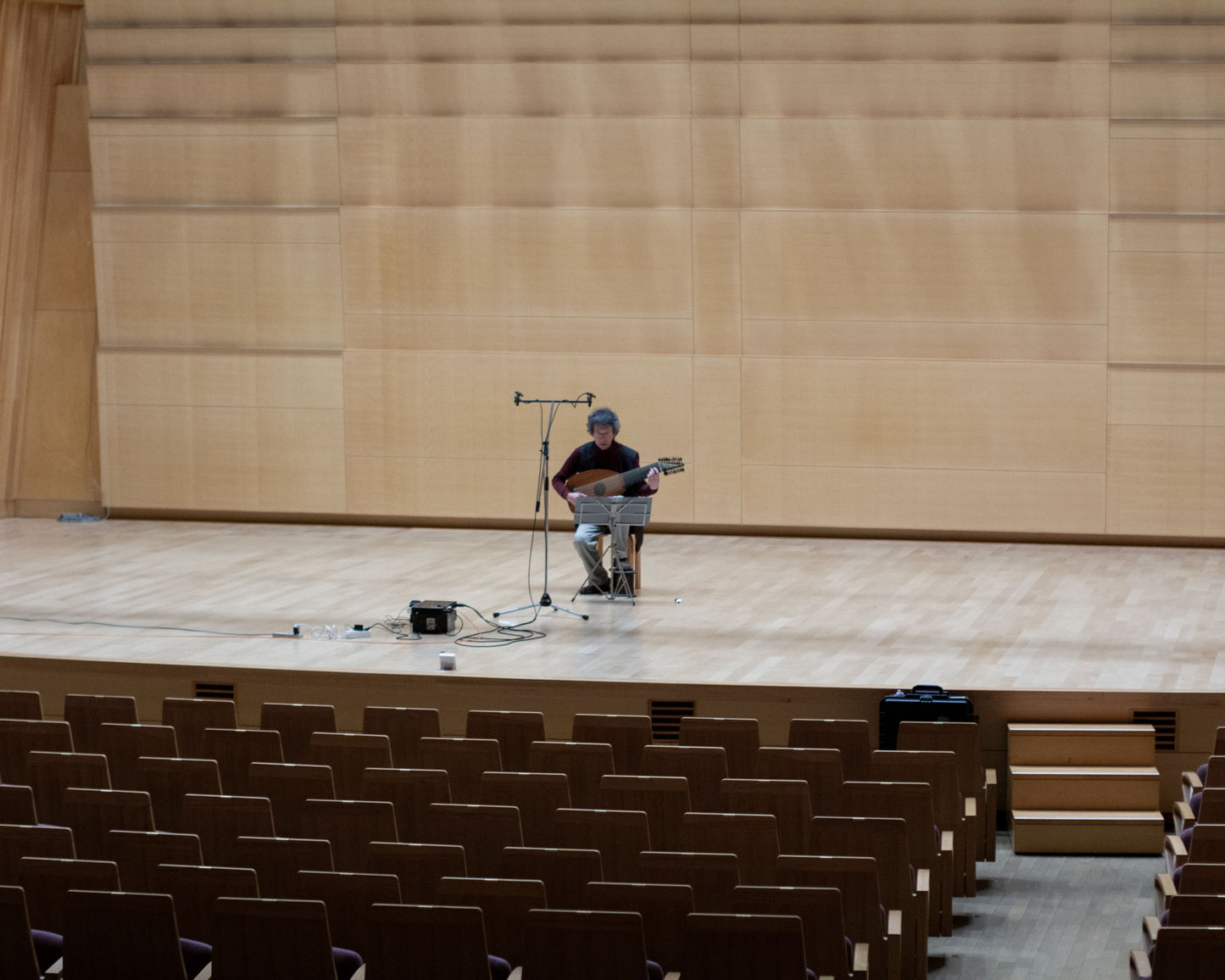
Japanese lutenist, composer, and tea master Toyohiko Satoh presents his final solo work on Carpe Diem Records, featuring his famous original baroque lute made in 1611 by Laurentius Greiff in southern Germany.
Now aged 75, the old master delivers his definite interpretation of the French baroque lute repertoire by linking it to the Japanese aesthetics of "Iki", which roughly translates into a style of elegant and highly sophisticated understatement. His approach to this music is unique, deeply personal, and spiritual in that he searches only for the core of the music, without getting distracted by outer form or musical convention. "Iki" is the silent, unagitated final masterpiece of a musical career that now lasts for more than half a century.
From the liner notes written by Toyohiko Satoh:
"There is a tale about Murata Jukō, a man known as the founder of the Japanese tea ceremony. He was making tea in his dingy little hut when a curious samurai passed by and tried to get a glimpse inside. The samurai then noticed that an extremely expensive horse was tied outside the hut. Inside was a frugal-looking man sitting by himself, just making tea."
Release date:
Catalogue number: CD-16320
Share


More album information
tracklist
Tracklist of "Iki"
Vieux Gaultier (Ennemond Gaultier) 老ゴーティエ (1575–1651)
Suite in F#-minor/A-major 組曲 F#マイナー・Aメジャー
01. Allemande la Pompe funèbre アルマンド「葬送」 4:51
02. La Pleureuse (Courante) クーラント「泣き女」4:32
03. Sarabande サラバンド3:03
04. La Chèvre (Canarie) カナリー「雌山羊」3:18
François Dufaut デュフォー (1604 以前–1682 以前)
Suite in A-minor 組曲 Aマイナー
05. Prélude プレリュード 2:21
06. Allemande アルマンド 3:24
07. Courante クーラント 2:00
08. Sarabande サラバンド 2:03
09. Gigue ジグ 2:16
Johannes Fresneau フレズノー (1615/16–1696 以前)
10. Les Larmes de Defresneau 「フレズノーの涙」 4:02
Suite in A-major 組曲 Aメジャー・F#マイナー
11. Prélude プレリュード 1:56
12. Tombeau トンボー 3:33
13. Courante クーラント 2:03
14. Sarabande サラバンド 2:37
15. Gigue ジグ 2:18
Charles Mouton ムートン (ca. 1626–ca. 1720)
Suite in C-minor 組曲 Cマイナー
16. Tombeau de Madame Pavanne パヴァーヌ「貴婦人に捧げるトンボー」 3:12
17. La Deliberée Courante クーラント「毅然とした女性」 1:52
18. La Bergere Sarabande サラバンド「羊飼いの娘」 2:59
19. La libertine Canarie カナリー「自由思想の女性」 2:41
20. La belle Espagnolle Chaconne シャコンヌ「美しきスペイン女性」 3:40
Total time 58:50
booklet text
Iki and Style Brisé
The characteristic style of 17th-century lute music in France is called Style Brisé, which translates to broken style, and refers to irregularly arpeggiated chords in a piece. This style is a result of trying to break free from the strict polyphonic style of the 16th century and allows for more flexible musical expression. Lately, I have discovered some connections between this Style Brisé and the Japanese idea of Iki.
Iki is often described as an expression of refinement, restrained stylishness and spontaneity. It is an aesthetic concept formed in the Edo period (1603–1867). The Japanese woodblock prints, Ukiyo-e, represent some important elements of this aesthetic. The slender female beauties depicted by artists such as Utamaro (ca. 1753–1806) are unpretentious and hold an implicit erotic charm. In contrast to this, European painters such as Pieter Paul Rubens (1577–1640) portrayed voluptuous and luxuriant women. The operas composed by Monteverdi around 1600 hold an extravagant aesthetic similar to those paintings. Monteverdi’s works mark the beginning of a new musical era, Baroque, in which the musical style became more dramatic, louder and faster. The lute did not take part in this movement due to its soft sound, and lute music progressed into a different direction. On one of my previous recordings, I wrote more about my view on the development of lute music and its relation to the traditional Japanese aesthetic Wabi-Sabi. Wabi-sabi is an idea derived from Buddhist teachings and is a world view centered around finding beauty within the imperfections of life and accepting the cycle of growth and decay. Unlike this intellectual concept, Iki has never been practiced by nobles or monks. It originated and was practiced solely among the ordinary townspeople. People praised Iki fashion, enjoyed Iki situations and wished to be Iki persons. One could call it the aesthetics of pure human everyday life.
Here is an example of Iki fashion: A person wearing a simple and unspectacular Kimono with luxurious, patterned lining material. The colorful lining playfully peeks out once in a while but is never completely visible. Similarly, there is a tale about Murata Jukō, a man known as the founder of the Japanese tea ceremony. He was making tea in his dingy little hut when a curious samurai passed by and tried to get a glimpse inside. The samurai then noticed that an extremely expensive horse was tied outside the hut. Inside was a frugal looking man sitting by himself, just making tea.
The 17th-century French music holds a similar aesthetic. Style Brisé may at first appear like ordinary music with some irregularly broken chords, but when listened to closely, you may hear that all pieces are in fact polyphonic. The distances between the notes are often so far that the melodies are not immediately noticeable. However, once you recognize the melody line, its sharp and clear beauty will emerge. To me, this resembles a delicate and alluring beauty on a woodblock print.
In this recording, I have attempted to apply some new musical expressions. Until now, I used to consider 17th and 18th-century French baroque music as the same and thus applied early 18th-century style ornamentations on all pieces. This is an elaborate ornamentation style represented by the music of Marin Marais (1656–1728) and Jacques-Martin Hotteterre (1674–1763). When I was playing the pieces of Gaultier and other composers of his time, I realized that this 17th-century music is not entirely different from 16th-century Renaissance music. Therefore I performed in a style which is closer to that of the 16th century and tried to avoid long appoggiaturas or trills that start with a long note. I expected the tempo of the pieces to become faster because of the quicker and shorter ornamentations, but surprisingly it was quite the opposite that happened. This style inspired me to play more slowly and more clearly. I think this also explains why the 17th-century French lute pieces are generally so short. If they are played too fast, the music will be finished too quickly, without any time to appreciate it. Of course, this does not mean all pieces should be played very slowly. The aim is to find an appropriate speed that is pleasant for the audience.
The first pieces on this CD are compositions by le Vieux Gaultier (Ennemond Gaultier 1575–1651). He supposedly established the D minor tuning of the Baroque lute, most likely in his later years after 1630. I have selected the following four pieces from his works: Allemande la Pompe funèbre, La Pleureuse (Courante), Sarabande and La Chèvre (Canarie). The original title of the first Allemande is le Languetock ou la Pompe funèbre ou Bien le Bucentaure. Languetock (Languedoc) is a region in southern France, Pompe funèbre is a funeral home and Bucentaure is thought to be a person’s name. This piece can be interpreted as a Tombeau. It starts with dissonant chords, which is quite unusual and nicely represents the aesthetics of Iki. The next piece is named La Pleureuse (mourning woman), which refers to a professional mourner who is compensated to cry at funerals. Paid mourning is still a common practice in Korea and some other Asian countries and is seen as a sign of wealth of the deceased; the more mourners you have at your funeral, the more respected you were in society. The piece La Chèvre is a Canary dance, inspired by the jumping goats of the Canary Islands. This very Iki piece starts with a dominant chord.
The next suite was composed by François Dufault (after 1604–ca.1682). He was a French lutenist who traveled all around Europe and left behind manuscripts of his works in many countries. All pieces of this suite, except for the prelude, can be found in a manuscript preserved in Prague. Dufault influenced many lutenists of his time, particularly in the German-speaking countries. Despite being one of the greatest lutenists of his generation, very little is known about his life. Many handwritten copies of his music survived, but none of it was ever printed. I believe he may have had an Iki way of living.
The next pieces are works by Johannes Fresneau (1615/16–ca. 1696). He was a lutenist of French origin who spent his entire life in the Netherlands and was the only Baroque lute player in the country during that time. He composed only a small amount of music, one of them being the unique Les Larmes de Defresneau (The tears of Fresneau). I wonder if he named the work after himself intending to leave a testament. The base notes are frequently left out at the beginning of each bar, which makes this composition sound odd and mysterious. I would call this an Iki aesthetic. The suite that follows consists of four pieces in A major and a Tombeau in F# minor. Fresneau’s style is considered Style Brisé, but his music has a different feel from that of other French lutenists of his time.
I conclude this CD with some compositions by Charles Mouton (ca. 1626–ca. 1720). He was one of the last French lutenists who composed in Style Brisé. I compiled the suite in C minor from a book which he self-published in Paris. The titles of lute music pieces of this time were mostly based on Greek mythology, famous literature or were indicating a dedication to a famous person. Mouton’s music was likely inspired by influential women of his time. I presume the two pieces La Deliberée Courante and La libertine Canarie were dedicated to the women who resisted the feudal society and chose to remain unmarried. Some of them lived their lifes as courtesans. In a way, we could see them as the pioneers of feminism. In 17th-century France, women played a very important role in upper-class society. Don’t you think that naming musical compositions after those women is also very Iki?
Toyohiko Satoh
Arao, March 2019
recording information
Recorded March 29–31, 2018
Location: Kirishima International Concert Hall “みやまコンセール” (Japan)
Balance engineer & recording producer: Jonas Niederstadt
Corporate Design: Tim+Tim, timandtim.com
Cover photography: Ronin de Goede
Booklet photography: Jonas Niederstadt
English Translation: Miki Satoh
Produced by Jonas Niederstadt
© 2019 Carpe Diem Records
press reviews
- 5 stars: 3 (100%)
- 4 stars: 0 (0%)
- 3 stars: 0 (0%)
- 2 stars: 0 (0%)
- 1 star: 0 (0%)
Hypnotic
Estoy feliz de tenerlo en mi colección. Es mi segundo disco de Satoh. Ojalá se pueda conseguir el disco de Bach que grabó en los 80s.
Hautement recommandé