


ファンタスティックスタイル
ファンタスティックスタイル
受取状況を読み込めませんでした
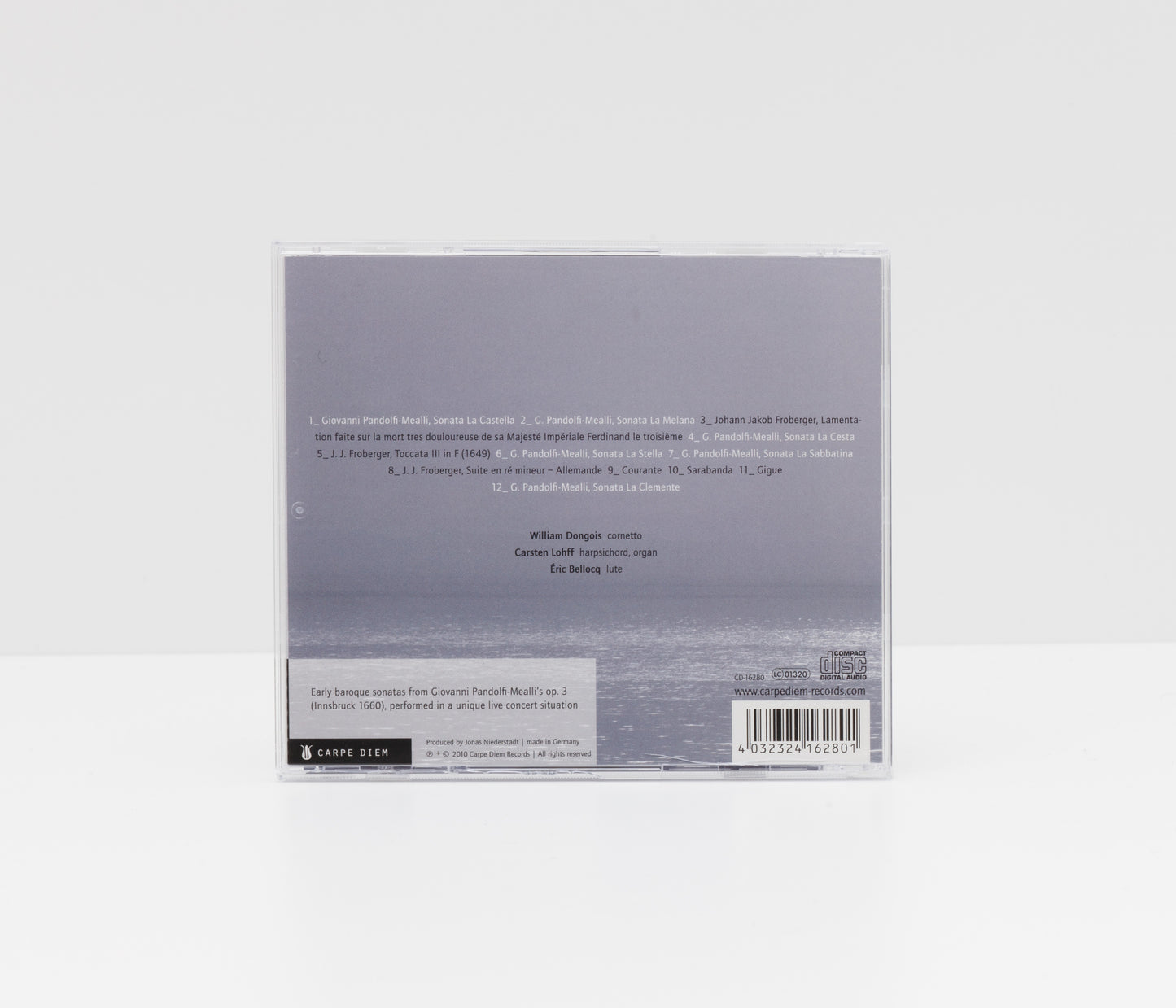
ウィリアム・ドンゴワ(コルネット)、カーステン・ローフ(チェンバロ、オルガン)、エリック・ベロック(リュート、テオルボ)
「Style fantastique」は、ウィリアム・ドンゴワ (コルネット) が率いるアンサンブル Le Concert Brisé の 2010 年のライブ アルバムであり、同アンサンブルの Carpe Diem レーベルによる 4 枚目のレコーディングです。
幻想的スタイルという用語は、非常に自由な形式、即興の要素、非常にドラマチックな編曲を特徴とする 17 世紀の作曲および解釈のスタイルを指します。
このアルバムには、ジョヴァンニ・パンドルフィ=メーリ(1620年 - 1669年頃)が作曲した、独奏楽器と通奏低音のためのソナタ6曲(作品3)が収められており、1660年にオーストリアのインスブルックで印刷された。各曲は、パンドルフィ=メーリとともにインスブルックのハプスブルク家の宮廷に雇われていた音楽家、例えばアントニオ・カステッロ(ソナタ「ラ・カステッラ」)にちなんで名付けられている。
このソナタは元々はヴァイオリン用に作曲されたものですが、ウィリアム・ドンゴワは、まるで自分の楽器以外の楽器のために考え出されたことがないかのように、軽やかに音楽を響かせます。ここでも、彼はヴァイオリンに対する完璧な熟達ぶりを披露しています。
この録音は、ル・コンセール・ブリゼのこれまでの録音の中で最も小規模で、ほとんど親密なメンバー構成となっています。ウィリアム・ドンゴワに加え、カーステン・ロフがチェンバロとオルガン、エリック・ベロックがリュートとテオルボを演奏しています。彼らは6つのソナタで通奏低音を担当し、間奏曲にはヨハン=ヤコブ・フローベルガー(1616 - 1667)の独奏曲が演奏されます。演奏されているチェンバロはまさに至宝です。スイス、ヌーシャテルの博物館所蔵品から取り寄せた、1632年製リュッカース製のオリジナルです。
さらに、このCDがコルネットを使ったこれまでの録音と一線を画すのは、まさに特別な状況下で実現した真のライブ録音であるということです。2009年10月、アンサンブルはヌーシャテル美術歴史博物館で3回連続のコンサートを行いました。プログラムが異なる3回のコンサートの録音から、最高の曲が選曲され、このアルバムに収録されています。この環境によって、演奏に並外れたダイナミクスと自発性が生まれ、聴衆が触媒となり、予測不可能な音楽的瞬間と、スタジオではなかなか表現できない真に迫る演奏が捉えられました。
スタイル・ファンタスティックは、現代的で、ある人にとっては新たな「スタイラス・ファンタスティックス」という概念の解釈への招待です。これは今日では稀有な体験であり、作曲家と解釈者双方による自発的な創造行為です。音楽、解釈、そして響きが、音楽の形而上学的な広大さへと旅する舞台を創り上げます。
リリース日:
カタログ番号: CD-16280
共有


アルバムの詳細情報
トラックリスト
「 ファンタスティックスタイル 」のトラックリスト
CDブックレット
記録情報
プレスレビュー
- 5 stars: 3 (100%)
- 4 stars: 0 (0%)
- 3 stars: 0 (0%)
- 2 stars: 0 (0%)
- 1 star: 0 (0%)
.... que ce cornetto !La musique jouée ici nous est plus familière jouée au violon, mais la lecture de W.Dongois, parfaitement justifié historiquement, nous la fait redécouvrir de manière des plus agréable.Belle prise de son.
Mr. Midgley has already reviewed the total CD, so let me merely discuss the cornetto as an instrument and William Dongois as a cornettist. The notes that accompany this CD are stylish enough but not fantastically informative, so some of what I write will be guesswork.At the beginning of the 17th C, the Italian cornetto ruled supreme throughout Europe as an instrument of virtuosity in ensemble music. Its only rival was the violin, and in both France and Germany the violin was regarded with suspicion, as an instrument suitable only for dance accompaniment. In Italy, cornetto and violin often squared off on stage and tossed impossibly acrobatic passages of virtuosity back and forth. By the end of the 17th C, the cornetto was in free fall toward oblivion. Why? Well, it's a fiendishly difficult instrument to play well, it ran into developing competition in orchestral music from the evolving oboe and later the chalumeau/clarinet. The latter is an instrument of even greater range and finger-fluidity than the cornetto. But there was, and is, an inescapable problem for the cornettist; chop fatigue! One simply can't keep playing fiery passagi on a cornetto, without an extended break, for hours and hours as one can on a violin. I seen very capable cornettists fade -- their lips benumbed and their tone imploding -- towards the end of concert half as long as the one recorded here. It's declared to be a "live performance" in the spotty notes, and what I hear makes me credit that assertion. It has the verve of live music. Besides, I know this repertoire; I'm the wise guy in the audience who can notice the two or three dropped notes, and grin to myself knowingly. I can also aver that this is a superhuman effort, not just virtuosity but a marathon of virtuosity.Curse those feeble notes! The first page thereof show Mr. Dongois playing a cornetto, but the cornetto isn't the curved black-leather-covered Venetian cornetto most people have seen in the hands of Doron Sherwin or Bruce Dickey. It's a "gerade Zink", a straight cornetto made of uncovered wood with a detachable ivory mouthpiece. That's the sort of cornetto which was favored in Germany and which outlasted the vogue of the Italian cornetto scaled in G. The straight Zink was usually scaled in C (with its lowest note a D). It sounds more trumpet-like than the Italian cornetto and much more trumpet-like than the "mute cornetto", which was also straight. I'm not 100% certain that this whole concert was played on such an instrument, but it sounds possible.The use of the lute and organ for continuo under the cornetto is positively gorgeous; the luet outlines the bass more 'vocally' than any harpsichord could do, and the organ pairs with the cornetto in timbre so well that at times one might confuse the two lines with each other. Performing Froberger as solo lute music is also a stroke of genius. Forgive me, harpsichordists, if I say that Eric Bellocq makes Froberger's 'keyboard' fantasy more fantastic on his archlute or theorbo than any harpsichordist ever has.
"Style Fantastique" désigne un style musical issu du "Stil Moderno", né en Italie dans la seconde moitié du 17e. siècle. Il est attaché à la musique instrumentale influencée par la musique vocale et l'art de l'improvisation. Les compositeurs de cette "musique fantastique" qui voulait exprimer les passions, les angoisses de manière parfois extrême, étaient d'abord de grands interprètes, virtuoses et improvisateurs. Les plus connus sont Frescobaldi et Froberger (ce dernier présent également sur ce disque) Ils ont excellé dans ce style. (Cf : Froberger :" Méditation sur ma mort future...")Mais, on retrouve ce courant artistique également chez Buxtehude (cf. "Klaglied" BWV 76/2), Reincken...On ne sait pratiquement rien de Pandolfi-Mealli, compositeur italien du 17e. siècle... Il est mentionné dans les annales de Charles-Ferdinand de Habsbourg, à Innsbrück, vers 1660. De ses oeuvres, seuls ont survécu deux beaux recueils de sonates, "opus 3" & "opus 4"William Dongois est avec Jean Tubéry un des plus grands spécialistes de cet instrument, le cornet à bouquin, à la sonorité si particulière, tellement envoûtante et émouvante, qui convient si bien à ce style musical. Le présent disque est un enregistrement "live", absolument superbe, où un public silencieux et recueilli ne donne aucun signe de sa présence... Et pourtant on la ressent, "cette présence" et elle influence le jeu des musiciens. Il y a une réelle communion entre ces artistes et ceux qui ont eu le bonheur d'assister à ce concert. Ecoutez ce disque magnifique, réécoutez-le avec un plaisir renouvelé et laissez vous gagner par cette émotion profonde et poétique. Très chaleureusement recommandé !