


Quando cala la notte
Quando cala la notte
受取状況を読み込めませんでした
コリーナ・マルティ&エネア・ソリーニ:イタリア・ルネサンスの愛の歌とチェンバロ独奏曲
チェンバロ奏者の Corina Marti とイタリアのテノール歌手 Enea Sorini が共演したこのアルバムには、16 世紀初頭のイタリアの歌曲と器楽作品が収められています。
柔らかく親密なプログラムには、フロットーレと、フロットーレ、リチェルカーリ、舞曲、その他のイタリアの鍵盤楽器音楽の組曲が含まれています。
二人の演奏家は、この音楽のどこか薄暗く内省的な肖像を描き出し、喜びに満ちたダンスと心温まる歌を織り交ぜています。チェンバロの柔らかく銀色の音色と、エニアル・ソリーニの軽やかでしなやかなテノールの組み合わせが、この音楽に特別な、そして心地よい色彩を与えています。
ミュージックビデオ
コリーナ・マルティがアルバムからの曲を演奏:
リリース日:
カタログ番号: CD-16308
共有




アルバムの詳細情報
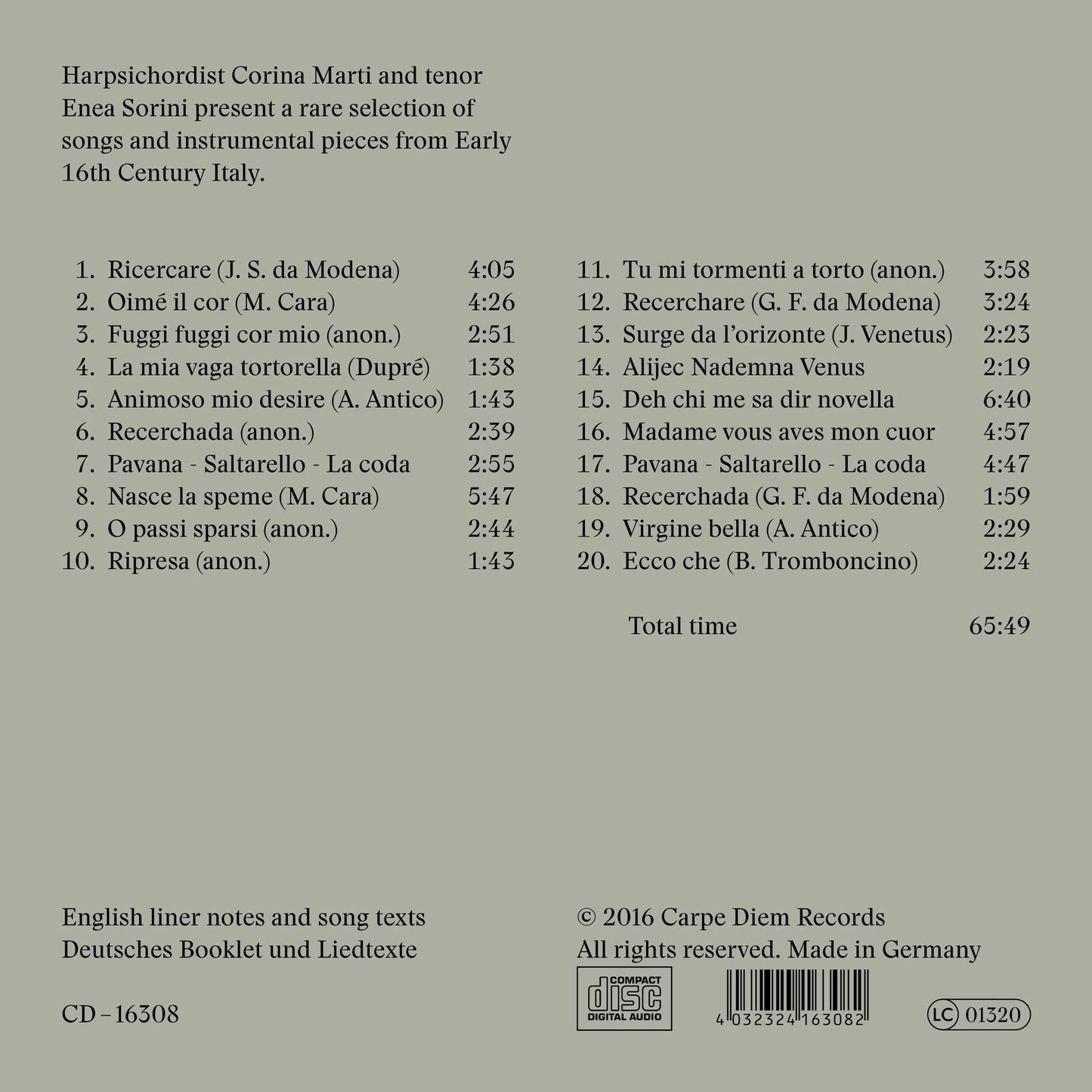
トラックリスト
「 Quando cala la notte 」のトラックリスト
01. リチェルカーレ・フリオ・セーニ・ダ・モデナ 4:05
02. オイメ・イル・コル、オイメ・ラ・テスタ・マルケット・カーラ 4:26
03. Fuggi fuggi cor mio anon.、フィリップ・ヴェルデロの後 2:51
04. ラ・ミア・ヴァガ・トルトレラ エリアス・デュプレ 1:38
05. アニモソ・ミオ・デザイア・アンドレア・アンティコ、バルトロメオ・トロンボンチーノにちなんで 1:43
06. 匿名で検索 2:39
07. パヴァーナ - パヴァーナのサルタレッロ - 匿名のコーダ 2:55
08. Nasce la speme mia da un dolce reso Marchetto Cara 5:47
09. O passi sparsi anon.、セバスティアーノ・フェスタ後 2:44
10. リプレサ 匿名 1:43
11.匿名の拷問 3:58
12. レチェルチャーレ ジャコモ・フォリアーノ・ダ・モデナ 3:24
13. 自然の波動 アポロ・ヨハネス・ルリヌス・ヴェネトゥス 2:23
14. アリイェク・ナデムナ・ビーナス [= デ・ラ・ダ・ラクア] ニコラウス・クラコヴィエンシス、フランチェスコ・サンタ・クローチェにちなんで 2:19
15. 中編小説ミケーレ・ペゼンティ 6:40
16. マルコ・アントニオ・カヴァッツォーニ、アノン後のマダム・ヴー・アヴェス・モン・クオール。 4:57
17. パヴァーナ - Il Saltarello de la pavana - La coda anonymous 4:47
18. レセルチャーダ・ジャコモ・フォリアーノ・ダ・モデナ 1:59
19. バルトロメオ・トロンボンチーノにちなんだヴァージニア・ベラ・チェ・デル・ソル・ヴェスティタ・アンドレア・アンティコ 2:29
20. Ecco che, per amarte, a quel ch'io arivo!バルトロメオ・トロンボンチーノ 2:24
CDブックレット
When the night descends
Now that the sky and the earth and the wind are silent,
and the wild creatures and the birds are reined in sleep,
Night leads its starry chariot in its round,
and the sea without a wave lies in its bed,
I look, think, burn, weep: and she who destroys me
is always before my eyes to my sweet distress:
war is my state, filled with grief and anger,
and only in thinking of her do I find peace.
So from one pure living fountain
flow the sweet and bitter which I drink:
one hand alone heals me and pierces me:
and so that my ordeal may not reach haven,
I am born and die a thousand times a day,
I am so far from my salvation.
(Petrarch, Canzoniere, No. 164. Translation: A. S. Kline 2002 / Poetry in Translation)
Night, which brings not only counsel, silence and peace but also melancholy and fears, has always proved inspirational for poets, musicians and painters. It is the ideal time for retrospection and gives us the chance to reflect on existence, life and death.
Within the framework of an imagined twilight, Corina Marti and Enea Sorini here present a meditation on themes of love, in the form of a collection of sixteenth-century frottole. In Ohimè il cor, ohimè la testa the lover, with innumerable sighs (‘ohimè’) bewails faithless, deceitful love and also his foolish heart for believing the blandishments and ambivalent words of a ‘great beauty’. By contrast La mia vaga tortorella praises the beauty of his beloved who, like a turtle dove, bewitches her man with her singing. Unrequited love as a source of suffering is the focus of Tu mi tormenti a torto, whilst in Ecco che per amarte, a quel ch’io arrivo! love transforms the lover into a scary shadow of itself. The mischievous side of love is present here too, for example in Deh chi mi sa dir novella, where the lover desperately seeks his pretty little nun. Finally, the lover in Surge da l’orizonte il biondo Apollo feels, at sunrise, like someone who is resuming his daily tasks after a peaceful night, recovered from the previous day’s toil, but still consumed by love’s ardour. Unlike the creatures of the forest, he is incapable of finding joy, delight and amusement.
The frottola, a strophic form that flourished in northern Italy, frequently dealt with themes of love and arose from the practice of using musical improvisation to accompany the declamation of poetry. The texts that were set to music belong to a wide range of genres: canzoni, ballate, ode, sonnetti, barzelette, capitoli and strambotti. Composed polyphonically but often performed by a single singer with instrumental accompaniment (usually a lute, but sometimes also viols or harpsichord), the frottola became widespread as a result of the printed editions by Ottaviano Petrucci, from which the vocal pieces on this recording derive (Nos 2, 4, 8, 11, 13, 15 and 20). Between the years 1504 and 1514, Petrucci published eleven volumes of frottole; these were reprinted on numerous occasions and enjoyed great success owing to their lightweight character. Well-known names among the authors of frottole include Marchetto Cara and Bartolomeo Tromboncino, who were at the same time active as lutenists, singers and teachers at the Gonzaga Court in Mantua – Cara in the service of Francesco Gonzaga II and Tromboncino in the service of his wife Isabella d’Este. Although as a musician Cara travelled from court to court, his activities centred on Mantua. Tromboncino led a more erratic life: after an honour crime, the murder of his wife, he did not stay long in the service of the Gonzaga family but moved to Lucrezia Borgia’s residences in Ferrara and Venice.
Meanwhile, in Rome, Andrea Antico was producing frottole for keyboard instruments: his Frottole intabulate da sonare organi – the first edition of organ tablatures in Italy – appeared in 1517. The frontispiece shows a nobleman at the harpsichord; next to him stands a lady scaring away a monkey that is holding a lute – probably an allusion to Petrucci, who published various collections of lute music, or perhaps just a reference to the older form of accompaniment, suggesting that it was fit only for circus animals and was less ‘noble’ than organ tablature. This might also explain why Antico did not hesitate to borrow material from his competitors’ collections.
Most of the ricercares, pavanes and other harpsichord tablatures played on this recording between the vocal frottole come from the manuscript of Castell’Arquato (Nos 1, 6, 7, 10, 12, 17 and 18). Others come from a manuscript of Johannes de Lublin (Ms. 1716 in the Polish Academy of Sciences Library in Kraków: Nos 3, 4 and 19) and from the two volumes Recerchari, motetti, canzoni by Marco Antonio Cavazzoni (Venice, Bernardino Vercellese 1523, No. 16) and Frottole intabulate by Andrea Antico (Nos 5 and 19). In Virgine bella by Petrarch the omnipresent love theme is transformed into sacred love. In the pieces that were originally vocal music, however, secular love is to the fore, for instance in O passi sparsi, Animoso mio desire and Madame vous aves mon cuor, one of the jewels by Marco Antonio Cavazzoni, a composer by whom, unfortunately, only a small number of works have survived. The frottola died out around 1530, and its place was taken by a new genre: the madrigal.
What dew, what weeping,
What tears were they
That I saw falling from the nocturnal mantle
And from the bright countenance of the stars?
And why did the white moon
Sow a pure cloud of crystal stars
In the fresh grass’s lap?
Why, in the darkness,
Was there heard, almost lamenting all around,
The soughing of the winds until daybreak?
Were they perhaps signs of your departure,
Life of my life?
(Torquato Tasso, Rhymes, No. 324)
Text: Alexandra Nigito
記録情報
Recorded January 2015
Location: Schloss Beuggen (Germany)
Balance engineer & musical producer: Jonas Niederstadt
Corporate Design: Tim+Tim, timandtim.com
Cover photography: Matthias Risse
Booklet photography: Jonas Niederstadt
Translations: Andrew Barnett (English), Nicoletta Gossen (German)
Produced by Jonas Niederstadt