


Wenn ich nur Dich hab
Wenn ich nur Dich hab
Couldn't load pickup availability
Richard Resch – tenor
About the album
On his debut solo album, German tenor Richard Resch presents a selection of early Baroque cantatas and other vocal music works from northern Germany. Together with Ensemble La Silla, he explores this beautiful but not so well-known repertoire, including two world premiere recordings of rediscovered works by Johann Friedrich Meister and Gottfried Philipp Flor.
The musicians of Ensemble La Silla
Franciska Anna Hajdu –violin I
Uwe Ulbrich – violin II, viola
Irene Klein – viola da gamba
Liam Byrne – viola da gamba
Kit Scotney – violone
Gianluca Geremia – theorbo
Sabine Erdmann – organ
Music video
Richard Resch in a beautiful music video for the song "Inter Brachia Salvatoris Mei":
Release date:
Catalogue number: CD-16330
Share


More album information
tracklist
Tracklist of "Wenn ich nur Dich hab"
01. Christian Flor | Inter Brachia Salvatoris mei 6:25
02. Johann Friedrich Meister | Ach Herr, strafe mich nicht* 15:24
Gottfried Philipp Flor | Redet untereinander*
03. I. Aria 2:41
04. II. Recitativo 1:50
05. III. Aria 3:31
06. IV. Recitativo 2:09
07. V. Choral 4:30
08. Dieterich Buxtehude | Herr, wenn ich nur Dich hab 4:10
09. Franz Tunder | An Wasserflüssen Babylon 4:06
10. Friedrich Nicolaus Bruhns | Wein, ach wein jetzt um die Wette 4:59
11. Christian Flor | Es ist gnug 7:25
12. Johann Mattheson | Ach Absalom 7:11
13. Franz Tunder | Ach Herr, lass Deine lieben Engelein 8:37
Total time 73:04
*world premiere recording
booklet text
Lord, if I have you alone
The north of Germany and Denmark are linked by a rich and eventful history that is marked by mutual exchange, but they live in the shadow of other regions like Central Germany, for example. Our small selection of gems from this „North German“ cultural landscape of the Baroque is intended to remedy this.
Of course, there are a few composers from this area that renowned, such as Dietrich Buxtehude, who was one of the most famous and appreciated musicians of his time. However, there are also some lesser known, but no less exciting artists who are worth our attention. In fact, many impressive testimonies of the cultural wealth of this area can be found in places like Copenhagen, Flensburg, Husum, Lübeck, Lüneburg, Hamburg, and Hanover.
For our brief journey through this region between the North Sea and the Baltic Sea, we have compiled a small selection of works following the motto: „Lord, if I have only You, I ask nothing of heaven and earth“. The focus is on Protestant sacred music of the Baroque period and invites the listeners to take a short individual walk through a landscape between heaven, earth, and sea.
The very first piece, „Inter Brachia Salvatoris mei“ (In the arms of my redeemer), expresses an intimate devotion to God and the hereafter that is so characteristic of the early Baroque, and its special instrumentation particularly emphasises its contemplative atmosphere. Officially attributed to Christian Flor, a composer born into a musical dynasty in Husum, there is growing suspicion that it might have been the work of Kaspar Förster the Younger (1616-1673), a musician born in the Hanseatic city of Gdansk, whose activities took him to Copenhagen several times and also into Venetian service. Significantly, the manuscripts of the famous Düben Collection and the archives in Grimma bear Förster‘s initials and thus identify him as a composer.
By contrast, the large solo cantata „Ach Herr, strafe mich nicht in Deinem Zorn“ (Lord, do not punish me in your wrath) can be attributed with certainty to Johann Friedrich Meister (ca. 1655-1697). Born in the Hanover region, Meister was first employed in the Duchy of Brunswick-Lüneburg before moving north, where he worked first in Eutin and then in Flensburg and Glücksburg. His trio sonatas achieved international fame, and this recording is a world premiere recording of his equally remarkable vocal compositional art.
With the New Year‘s cantata „Redet untereinander“ (Talk among yourselves), another exponent of the fourth generation of the Flor family of musicians comes into focus, namely Christian Flor‘s son Gottfried Philipp Flor (1682-1723). In addition to Lüneburg, he also worked in the Duchy of Mecklenburg. This cantata prays for a salutary year and a prosperous future for the land and its inhabitants, but especially for its regent Duke Karl Leopold, who had moved his seat of government to Dömitz, which is mentioned in the song.
From there our journey leads to Lübeck and thus to the pivotal point in the musical world of the time: Dieterich Buxtehude (1637-1707). Born in Helsingborg and known and admired far beyond the country‘s borders, many musicians made a pilgrimage to this famous organist of Lübeck‘s Marienkirche, including Johann Sebastian Bach. „Herr, wenn ich nur Dich habe“ is one of his best-known compositions, which, like „Inter Brachia“, underpins the positive basic trust in God, no matter how hard times may be. By contrast, the chorale „An Wasserflüssen Babylon“ (By the rivers of Babylon) expresses the quarrels with earthly existence, allegorically condensed in the topos of the Babylonian captivity. Originally composed in Strasbourg in 1532 by Martin Dachstein, this chorale quickly spread throughout the German-speaking world and was included in Martin Luther‘s hymnal. It was set to music by Franz Tunder (1614-1667), who thus created another „classic“ of Baroque sacred literature. Tunder, himself probably born in Lübeck and not only Buxtehude’s predecessor in office but also his father-in-law, introduced the tradition of evening music in Lübeck, which continues to this day and has found many wonderful imitators throughout the world.
Another lament follows with „Wein, ach wein... meiner beiden Augen Bach“. This aria, which was performed several times by Johann Sebastian Bach, is part of the St Mark Passion, which is often attributed to the composer Reinhard Keiser (1674-1739), who worked in Copenhagen and Hamburg, among other places. However, this has been disputed and another name has been brought into play: Friedrich Nicolaus Bruhns (1637-1718). Throughout his life, he wrote his name in German as „Brauns“ and, as director of the Hamburg Ratsmusik and Canonicus Minor at Hamburg Cathedral, he conducted a performance of the St Mark Passion in 1707. He came from a dynasty of musicians in what is now Schleswig Holstein, which also produced his nephew, Nicolaus Bruhns, who is much better known today.
Christian Flor set in music „Es ist gnug, Herr“ (It is enough, Lord), an Old Testament text from the Book of Kings, where the prophet Elijah settles down in the desert under a broom and speaks resignedly to God.
King David‘s lament „Ach Absalom“, in which he laments the death of his son Absalom, goes a little further back in the Old Testament, sensitively set to music by Johann Mattheson (1681-1764), a great singer, composer, and chronicler of his time, who also worked in Hamburg. Mattheson writes of Franz Tunder that he studied with Girolamo Frescobaldi although more recent research tends to assume that it was actually Tunder‘s predecessor as court organist to Frederick III at Gottorf Castle, Johann Heckelauer, who was a pupil of the Italian master.
With „Ach Herr, lass deine lieben Engelein am letzten Tag die Seele mein in Abrahams Schoß tragen“ (Oh Lord, let your dear angels carry my soul into Abraham‘s bosom on the last day), our walk through the North German musical landscape concludes with one of the most intimate works of Baroque literature and a great moment for every musician and music lover. In fact, the Belgian astronomer and music lover Eric Walter Elst named the asteroid he discovered „(7871) Tunder“ after Franz Tunder.
Unfortunately, another jewel of Baroque music is the virtuoso solo cantata „Jauchzet dem Herren alle Welt“ by Nicolaus Bruhns (1665-1697) did not make it onto this CD because of the limited space, but it is available online as a bonus track. It is one of the few surviving works by Bruhns, who is regarded as Buxtehude‘s most talented pupil. Buxtehude recommended him to Copenhagen at an early age. Bruhns died at the age of 31 as a church musician in his birthplace Husum. Along with Buxtehude and Bach, Bruhns is probably one of the most prominent German representatives of the „Stylus Phantasticus“, of which Johann Mattheson said that it „is the freest and most unconstrained kind of singing and playing that one can conceive, since one soon comes up with these or those ideas, since all kinds of otherwise unusual passages, hidden ornaments, sensuous turns and embellishments are produced without any real observation of the act and tone; sometimes quickly, sometimes hesitantly; sometimes in one or many voices; sometimes also for a short time after the act: without sound measures; but not without the intention to please, to hurry and to astonish.“
Similarly, the scoring of these works is fantastical and creative. Some of the works are world premiere recordings, others are already well known and have been interpreted by wonderful colleagues. For instance, the works by Buxtehude and Tunder are available in impressive recordings with soprano, and „Inter Brachia“ has also been performed by an alto. Which voices these works were composed for is a matter of argument, but this tenor recording adds another colour to the bouquet of interpretations. In particular, considerable liberties were taken with the aria „Ach Absalom“, which is actually written for a high bass. This pearl of Baroque literature had to be included, however, because producing this recording was very close to my heart. It took place in the Corona winter of 2021/2022 despite all the adversities with spontaneous cast changes due to covid infections, colds, slipped discs, freezing temperatures, and other challenges.
It was a great ensemble performance, for which I would like to thank my tireless, patient, flexible and always good-humoured colleagues and friends Liam Byrne, Sabine Erdmann, Gianluca Geremia, Franciska Anna Hajdu, Irene Klein, Christopher Scotney, and Uwe Ulbrich from the bottom of my heart. Without you, it would not have been possible to realise this project.
Neither would we be able to hold this little musical treasure box in our hands without Jonas Niederstadt and Dirk Fischer and their know-how, commitment, and empathy.
I would also like to thank Mark Jost, Elina Albach, Jutta Berr-Resch, Frank Jaeger, Ralf Lützelschwab, Martin Märkl, Milan Markovic, Jakob Rattinger, Michael Sauter and so many other good spirits who have supported me mentally, morally and professionally and to whom I am deeply indebted.
Richard Resch, July 2022
recording information
Recorded January 25-29, 2022
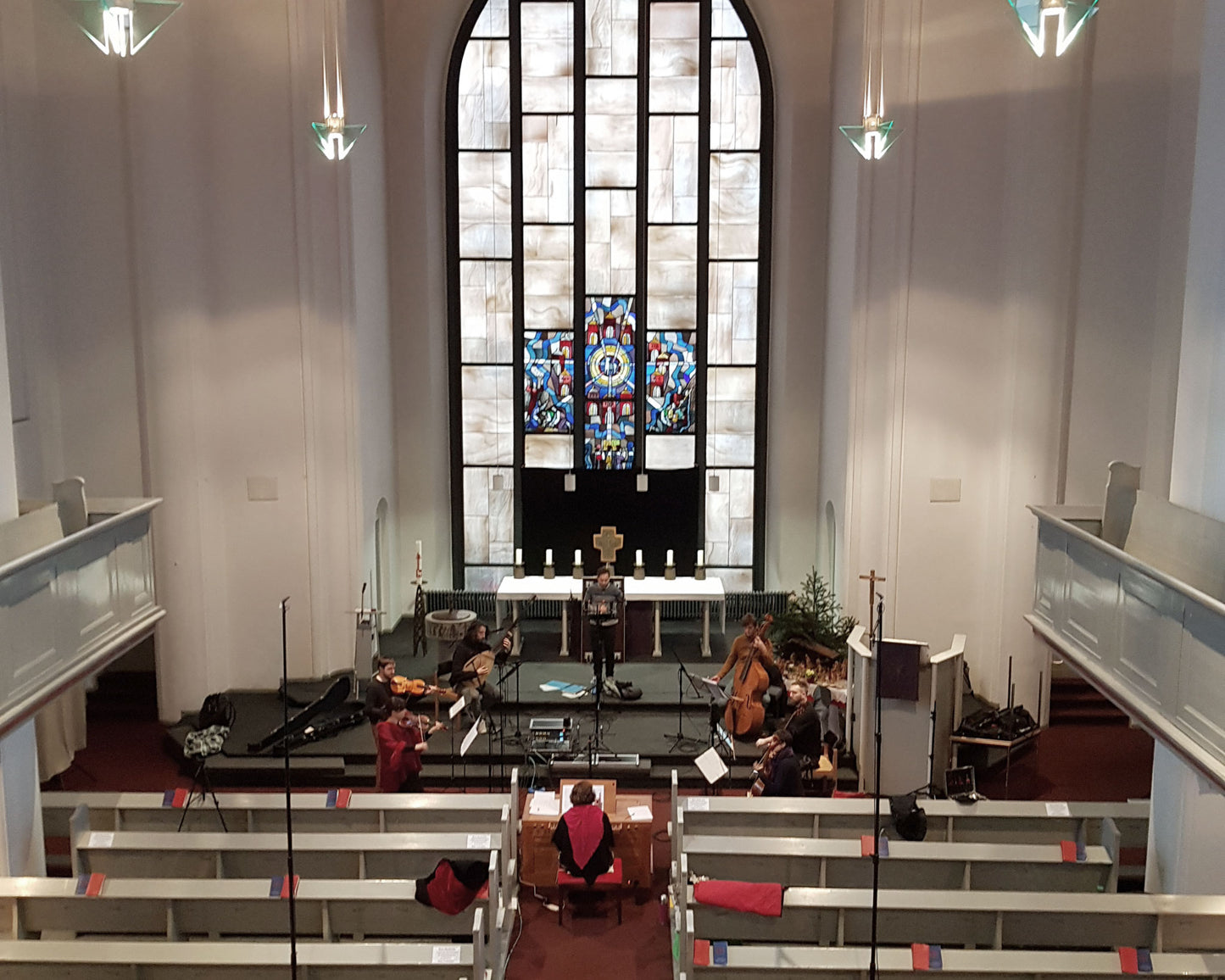
Location: Evangelisch-Lutherische Gemeinde „Zum Heiligen Kreuz“ (Berlin, Germany)
Balance engineer & recording producer: Jonas Niederstadt
Assistant engineer: Dirk Fischer
Corporate Design: Tim+Tim, timandtim.com
Cover photography: Nikolas Hagele
Booklet photography: Jonas Niederstadt
Produced by Jonas Niederstadt
©+℗ 2022 Carpe Diem Records
press reviews
An extraordinary recording and a great moment for this difficult, still somewhat unknown repertoire: tenor Richard Resch and the ensemble "La Silla" interpret a selection of North German baroque songs and cantatas that revolve around the themes of transience and grief, hope of salvation and peace of mind. Resch's characteristic, baritonal darkened voice has a luminous core, which he is very disciplined in and uses with a minimum of vibrato. The resulting sound is nonetheless of a compelling intensity. Apparently, the singer does not simply want to "please" or beguile in a tasteful way with his design - which Resch is nevertheless able to do with his beautiful tone - but to touch and shake existentially. And he does this in a special way. Apart from Dieterich Buxtehude, the composers gathered on this CD are not necessarily popular, but rather niche repertoire. Nevertheless, Franz Tunder, Christian Flor and Johann Mattheson, like the other "little masters", made a substantial contribution to German Baroque, as you can hear here. Some pieces are already known in other interpretations, also in different voice registers. But one should rarely have heard Mattheson's overwhelming Absalom lament, Christian Flor's reaching out to heaven confession "Inter Brachia Salvatoris mei" or the restrained jubilation of Buxtehude's "Lord, if I only have you" so urgently and soulfully. Resch weighs every word and the musical rhetoric carefully and does not shy away from strong, moving emphasis and tones of pain, without ever drifting into the artificial. It's always a tightrope walk, which nonetheless suits this emotionally charged music very well. The exciting slowness of his performance and the many disturbing moments of deep silence - as a listener you hold your breath - increase the effect even more. Presented with such intense intensity, this seemingly distant repertoire moves disturbingly close to today's listeners. This corresponds to the no less sensitive instrumental accompaniment by the ensemble "La Silla", in which the often very sparsely arranged music sometimes only hangs on a few notes. The inner richness of this music is hidden behind superficial, often forced limitations of means, a consequence of the Thirty Years' War. Making this richness audible in the strict simplicity of music is a great art.
This was an accidental find and it is truly wonderful. He has beautiful voice, timbre and pitch. Stunning