


Viennese Lute Music
Viennese Lute Music
Couldn't load pickup availability
Lutenist Toyohiko Satoh plays music from the court of Vienna around 1700. A special discovery is the suite by Adam Franz Ginter, who was a famous castrato singer in that time, but also composed some pieces for the lute. This recording is a tribute to this largely forgotten musician who most probably had a short and rather sad life. The following suite by Saint-Luc contains a “Tombeau for Francois Ginter” and was composed to lament the early death of this extraordinary singer, lutenist and composer.
Music video
See Toyohiko Satoh performing a piece by Adam Franz Ginter from his album in the recording hall:
Release date:
Catalogue number: CD-16317
Share


More album information
tracklist
Tracklist of "Viennese Lute Music"
François (Adam Franz) Ginter (1671–1706) F. ギンター
Suite in E minor 組曲: Eマイナー
01. Allemande アルマンド 4:00
02. Courante クーラント 2:49
03. Sarabande サラバンド 3:01
04. Menuet メヌエット 1:28
05. Bourée ブーレ1:44
06. Gigue ジグ3:21
Jacques-Alexandre de Saint-Luc (1663–ca. 1710) J. de サン・リュク
Suite in F-sharp minor 組曲: F#マイナー
07. Tombeau de Mr. François Ginter フランソワ・ギンタ―氏に捧げるトンボー4:24
08. Courante クーラント2:25
09. Sarabande サラバンド3:55
10. Gigue ジグ3:07
11. Gavotte ガヴォット1:36
12. Menuet メヌエット1:54
Johann Georg Weichenberger (1676–1740) J. G. ヴァイヒェンベルガー
Suite in G major 組曲: Gメジャー
13. Prelude プレリュード3:00
14. Allemande アルマンド4:34
15. Courante クーラント2:57
16. Bourée ブーレ1:59
17. Menuet en Rondeau ロンド風メヌエット2:27
18. Sarabande サラバンド3:02
19. Gigue ジグ2:41
20. Paysanne ペイザンヌ2:11
Anonymous (18th C.) 作者不詳
21. Siciliana / Adagio シチリアーナ (アダージョ)5:37
Total time 62:24
booklet text
Viennese lute music
When one thinks of Vienna, the capital of classical music, brilliant images appear of the Viennese boys’ choir, of Mozart, Johann Strauss and others. The Viennese boys’ choir nowadays consists not only of Austrian boys, but of young boys with beautiful voices from a number of different countries. These boys can preserve their beautiful high voices until the time of their puberty vocal change around the age of 15. Some centuries ago, in order to preserve this voice for their entire lifetime, castrations were carried out on boys before the time of their change of voice. This culture of creating male sopranos, also called castrates, was mainly found in Italy.
Of course, nowadays this practice has been abandoned. Castrates showed an impressive appearance, having a male body with smooth skin and no beard. With their angelic high voices they were regarded holy creatures, unifying god, man and music. Nevertheless, only a few castrates made it to this splendid life of fame and fortune. The majority of them had been castrated by will of their parents in the hope of escaping bitter poverty. Some sources say that during the baroque era, around 4000 boys annually underwent the operation. But, by now I got sidetracked a little. While there was this glorious boys’ choir at the royal court, what was actually going on in the lute world during that time?
This recording begins with music by Francois Ginter (1671-1706), whose real name was Adam Franz Ginter, a soprano singer at the royal boys’ choir of Vienna. Ginter, who was born in Vienna and had a beautiful voice since he was a young boy, became a castrato when he was around fifteen years old. As he was not a very pretty boy, people around him disapproved of this idea, but his father decided to have the castration be carried out anyway. Almost no records are left of Ginter’s activities as a castrato, but it seems that he also was a lute player. From the fact that the back-then very famous Viennese lutenist Saint-Luc dedicated a Tombeau to Ginter, we can conclude that he must have been a noticeable lutenist in his own right. Only a few of Ginter’s compositions have remained to the present day, and among them only one complete suite survived; the Suite in E minor. The bodies of castrates generally grew abnormally large due to the hormonal imbalances, and they were said to often have short lives. Ginter died at the age of 35. He probably wrote this suite in his final years, even though he was actually still quite young. As a human who had to bear the heavy fate of being a castrate, this suite is a deeply touching composition with profound and complex ideas. To me it does not sound at all like the composition of a 35-year old musician, but rather like the work of a 70-year old lutenist. If Ginter would not have become a castrate but a lutenist instead, maybe he would have lived much longer and might have composed many more of these wonderful suites. This suite is composed of six dances: Allemande, Courante, Sarabande, Menuet, Bourée and Gigue. The last piece is a so-called “Allemande giguée” – a Gigue in Allemande style, which is basically a Gigue in a slower tempo. Similarly to the well-known Gigue “Testament de Mesangeau” by Vieux Gaultier (Ennemond Gaultier), this Gigue might have represented Ginter’s own testament.
Around 1700, Vienna attracted many lute players, including the famous Jacques-Alexandre Saint-Luc. In Vienna he was seen as equal to Sylvius Leopold Weiss (1687-1750), one of the most famous lutenists in Europe at that time. Saint-Luc, who was born in Brussels in Belgium, served shortly at the court of Louis XIV in Paris before he travelled through Berlin to Vienna in 1700 to serve Prince Eugen von Savoyen. Prince Eugen came from a noble family in France and served the court of Vienna. He won many wars against the Ottoman Turkish and French armies. Saint-Luc composed the “Tombeau de Mr. François Ginter”, a Tombeau dedicated to Ginter. This is the first piece of his Suite in F sharp. The reason why he didn‘t use Ginter‘s German name “Adam Franz”, but instead wrote the French version “François”, is because the Tombeau was one of the most important musical forms in 17th Century’s France. Saint-Luc was famous for composing light melodic pieces, but in this suite, he didn‘t make use of the high note range of the instrument at all. It is as if the music is looking back on Ginter‘s rather sad fate as a soprano singer. According to some researchers, Saint-Luc was born in 1616 and died in 1717. In a different manuscript this Tombeau is named “Tombeau sur la mort de Mr. François Ginter” and states more clearly that it was composed to mourn the death of Ginter (1706). In this case, Saint-Luc would have been 90 years old at the time of writing the piece. This would have been quite sensational if it was true, but I don’t find it very likely. There is unfortunately no record of such a remarkable thing. Under the family name of Saint-Luc, we find such diverse first names as Jaques, Jaque-Alexandre, Laurent and others, so we cannot know for certain how many different persons these were. Here I used the name Jacque-Alexandre from the cover title of the Prague manuscript. The Suite in F sharp consists of six pieces: Tombeau (Allemande), Courant, Sarabande, Gigue, Gavotte, and Menuet. The Courant and Menuet in the suite are “sans chanterelle”, which means they are composed without using the first string of the lute. Especially the Menuet is a dark, fantastical piece.
The next suite, which is bright and colorful in contrast to the previous one, is composed by Johann Georg Weichenberger (1676-1740). Weichenberger was a lutenist born in Graz, Austria and later worked as a bookkeeper at the Viennese court. At that time is was not rare to have a second profession besides being a musician. Apart from church organ players and court musicians, there were not many who worked exclusively as musicians. Some of Weichenberger‘s early works are influenced strongly by the French style just like Ginter and Saint-Luc, but this suite is written in Gallant Style similar to the works of S. L. Weiss. It is thought that Weichenberger composed the suite in his later years. When Weiss started using a 13-course lute around 1720, this instrument became extremely popular in the German speaking areas of Europe. Weichenberger, who was only 10 years older than Weiss, remained using his 11-course French lute until the end of his career. His works are characterized by the beautiful melodies. The suite consists of six pieces: Allemande, Courant, Menuet en Rondeau, Sarabande, Gigue and Paysanne. In this recording I added a prelude from a different manuscript to the beginning of the suite. The style of the Menuet already foreshadows the emergence of Mozart in the near future.
The last piece of this recording is a Siciliana in E minor by an unknown composer. Siciliana is a dance piece that originates from the island Sicily. It is a calm piece that might remind us of a boat floating on the Mediterranean Sea on a sunny day. The tempo indication for this piece is “Adagio”. We don‘t know who composed the piece, but from the harmonic style and the tempo indication, one could estimate that it was composed around the beginning of the 18th century. This beautiful piece gives us a glimpse of how Vienna would flourish as the capital of classical music in Europe from the end of the 18th century all the way into the 20th century. The piece is taken from a manuscript preserved in Vienna.
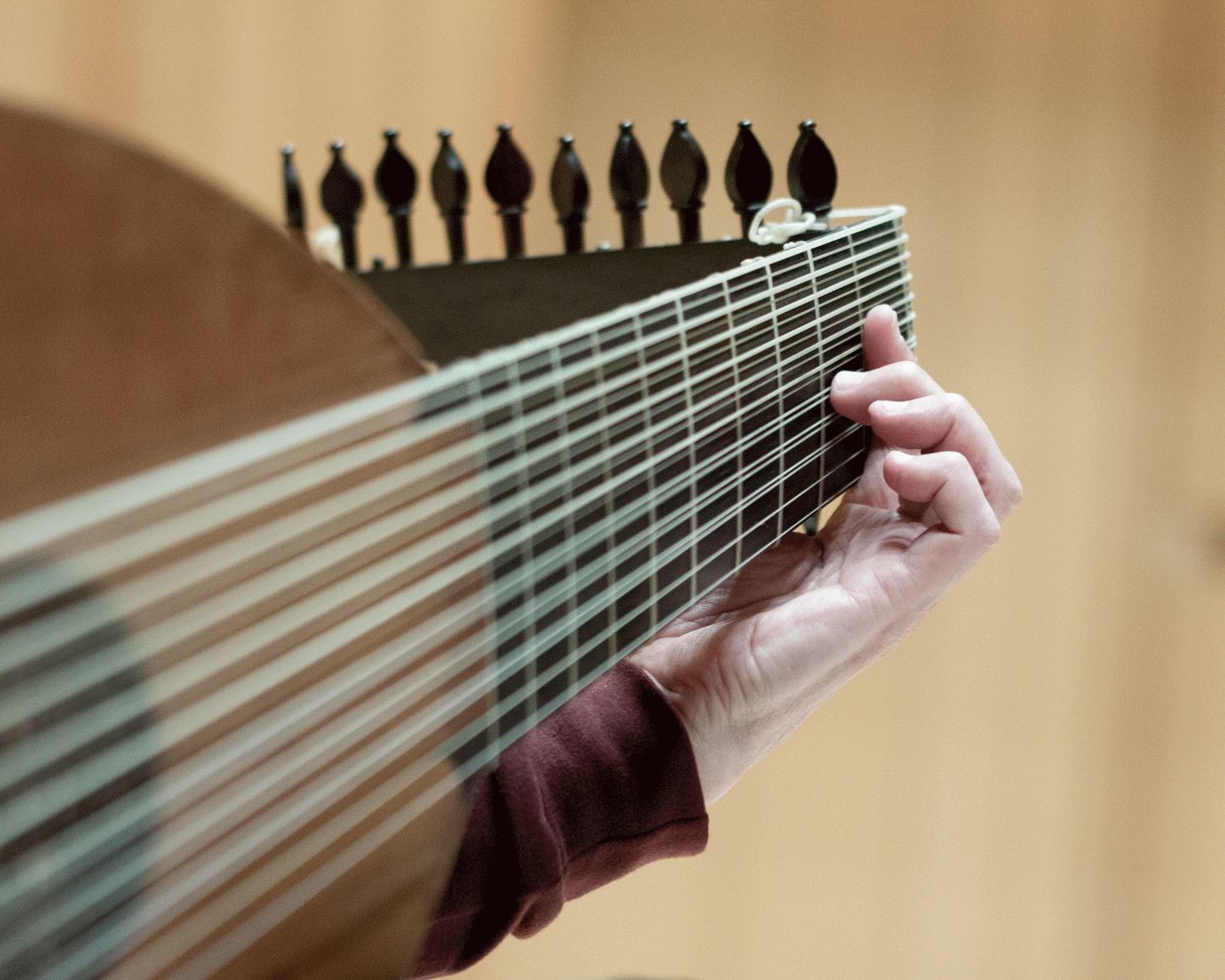
The original lute used for this recording is not from Vienna. It was built in Ingolstadt, Germany by Laurentius Greiff in 1611. It was originally a renaissance lute, and was rebuilt into an 11-course French baroque lute in 1673. It was then kept in a castle near the Austrian border until the end of the 20th century. There might be a chance that one of the many lutenists who gathered in Vienna in the 17th century played on this lute. I think this somewhat nostalgic idea goes along with the atmosphere of the works gathered on this CD.
Toyohiko Satoh, Arao 2018
recording information
Recorded November 14-16, 2017
Location: Kirishima International Concert Hall “みやまコンセール” (Japan)
Balance engineer & recording producer: Jonas Niederstadt
Corporate Design: Tim+Tim, timandtim.com
Cover photography: Marion Denis
Booklet photography: Jonas Niederstadt
Translations: Miki Satoh / Jonas Niederstadt
Produced by Jonas Niederstadt
© 2018 Carpe Diem Records
press reviews
American Record Guide
"This is a lovely program devoted to the Viennese lute school of the High Baroque—music composed between the final decades of the 17th and early decades of the 18th centuries. Jacques-Alexandre de Saint-Luc (1663-c. 1710), whose Suite in F-sharp minor Satoh plays here, is the only one of the four lutenists represented on the program who ever worked for King Louis XIV, among the great lutenists who played at Versailles. Yet most of the music on the program appears to have been touched by the French lute school. The brooding nature of François (Adam Franz) Ginter’s (1671-1706) Suite in E minor bears the style of contemporary French music, with its expressive appoggiaturas and other refined figuration. The program also includes the Suite in G by Johann Georg Weichenberger (1676-1740) and an anonymous 18th-Century’Siciliana’.
Toyohiko Satoh’s playing is subtle, full of feeling. The emotion of his touching tribute to François Ginter seems to extend to his playing. The pacing of the music, the way he hangs on to certain harmonic progressions, turns of phrase, and the way he carries a melody along seems to reach into the soul of its creator." © 2019 American Record Guide
Scherzo magazine
"At this point, Toyohiko Satoh needs no introduction. He is known to everyone as one of those Japanese musicians who, almost from the very beginning, formed part of the battalion of young entrepreneurs who forever transformed the way Baroque music is understood. Whether as a soloist or as part of the basso continuo of a number of specialized groups, he has a long and solid recording career which, now that he has passed his biological maturity, he occasionally adds to with some unique releases. In this case, he has selected some very unusual music by musicians based in imperial Vienna at the end of the 17th century and in the first half of the 18th century.
The first of these is Adam Franz Ginter (1671-1706), a Viennese singer who was castrated at the age of 15 and who also left behind some compositions for lute, such as the suite selected here, the only one of his compositions that has survived in its entirety and which reveals complexity and depth. The Belgian Jacques-Alexandre de Saint-Luc (1663-c.1710) arrived in Vienna already a famous performer and enjoyed well-deserved popularity there. His rather light music was highly appreciated, but the work selected here, which begins with a Tombeau dedicated precisely to the memory of Ginter, is rather reflective and intimate. Johann Georg Weichenberger was a lutenist—and also an accountant in the imperial administration—born in Graz and possessed of a remarkable melodic sense that is perfectly reflected in the suite selected here. The album concludes with a beautiful anonymous dance movement (Siciliano) which, like the rest of the album, is approached by Satoh with restrained emotion, serenity, depth, and musicality, all the result of his rich experience as a performer. A very beautiful album that lovers of plucked string music will appreciate." © 2019 Scherzo