


Udopia
Udopia
Couldn't load pickup availability
About the album
The ensemble consist of seven musicians from various backgrounds of world, classical and jazz music, who have played together in this formation for many years, creating mutual musical understandings that transcend conventional stylistic boundaries.
German Record Critics' Award 03 / 2016
The musicians
Αvgerini Gatsi – voice
James Wylie – saxophone, lyra
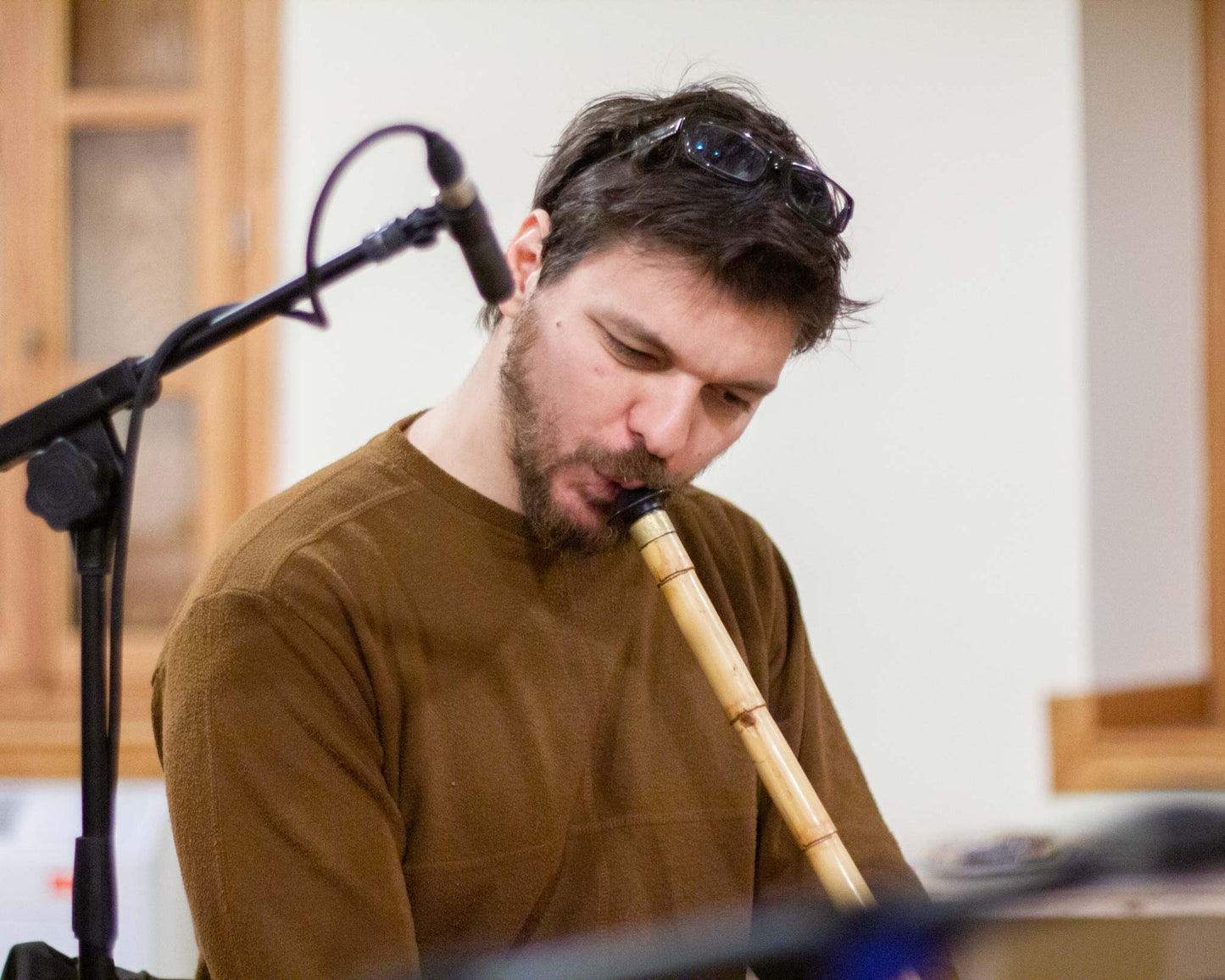
Nikos Paraoulakis – ney, mantoura
Elektra Miliadou – cello, viola da gamba
Kostas Anastasiadis – drums, percussion
Dimitris Zacharakis – marimba, percussion
Release date:
Catalogue number: CD-16309
Share


More album information
tracklist
Tracklist of "Udopia"
1. Nada (2010) 13:51
Music by Thimios Atzakas (lyrics by a Greek Epirus lament song )
2. Melos (1999) 06:52
Music by Thimios Atzakas (arranged from the original piece:
Topografia for solo guitar)
3. Βού – doo (2015) 16:02
Music by Thimios Atzakas
4. Erik Satie - Gnossienne No.1 07:21
Arranged for ud and marimba by Thimios Atzakas
5. Diaplous (2010) 10:00
Music by Thimios Atzakas
Kemenceci Nikolaki – Buselik Pesrev (arranged by Thimios Atzakas)
6. Lost Dervish (2007) 09:17
Music by Thimios Atzakas
7. Έρμα {Ballast} (2014) 04:58
Music by Thimios Atzakas
8. Tertsina (2004) 03:21
Music by Thimios Atzakas (lyrics by Nikos Kazantzakis)
Total time 71:48
booklet text
Udopia
‘We reach ecstasy by a contestation of knowledge.’
G. Bataille
Udopia is a land that is moved by vibration. It is a land where once a piece of ancient wood broke asunder and harmony oozed from within it.
In this land the oud is like a chimera, rough and crude. Upright and curved in equal measure, it comes and goes, and can never be persuaded to stay.
The vibrations that bring Udopia to life are made of dreams, spontaneous ideas and forgotten melodies that came to me without my being aware of them.
In the macrocosm of sounds, I dream of music in a way that I have never known it before, in which I experience things that I have not experienced before, and in this way I can listen to my own here and now. These sounds mirror a part of myself that is wholly unfamiliar to me.
My encounters with the familiar and unfamiliar melodies from my beloved Orient remind me of distant relatives that we occasionally meet at celebrations and family gatherings. We might not even remember their names, or their relationship, but we can still chat to them. We can approach them without shame, although not without a certain formality and reserve. Their mere presence gives us an indeterminate though pleasant feeling of security. Deep down,
however, we know that we are alone.
My use of the modal scales – with a greater or lesser degree of proficiency – originates in my multi-faceted, sometimes contradictory approach to music. It sheds light on aspects of my
inner life, even if I can often find those aspects only outside myself.
The music of Udopia is original, with the exception of two adaptations of the music of Erik Satie and Nikolakis, a composer and kemenche player from Istanbul. They lived at almost the same time, and composed elegant music that was often at odds with the prevailing musical mainstream.
In Udopia I experience the essential connection between the musical argument and the oral tradition of musical sounds. In a sense, therefore, I see myself as a narrator. The narrative sometimes appears clear and structured, saturated with unfulfilled memories. At other times it is more fluid, breathless, as if on the border of the present, leaving the musical activity in a state of muteness and uncertainty – as if the sound, note by note, had been forged already, before it is finally heard.
Like the cedars in the desert, the musical landscape of Udopia appears harsh and dry, although juices and perfumes flow beneath its rough wooden surface. Its musical stories appear and fade away again, constantly assuming new shapes.
For years I wandered alone on the hills of Udopia with my oud. On the way to this recording I met great masters of sound, musicians who inspired me with their gentle guidance. In their company I set my gaze upon the shining radiance that music produces.
Today, with the enthusiasm of a seasoned traveller, we enjoy the scents that emanate from the shared experience of music. I am grateful to them all – mainly because they didn’t let me invite them on this journey, but rather came on their own initiative to find me. In Udopia they felt at home, like visitors who spontaneously stay longer than anticipated.
Finally, I should like to thank Jonas, our sound engineer and producer, who has saved us more than once with his astute interventions from the dangers of extreme enthusiasm but, also, from the emptiness of excessive contemplation that can lull us unwittingly to sleep at any time.
Thimios Atzakas
recording information
Recorded April 2015
Location: Aghios Lavrendios (Greece)
Balance engineer: Jonas Niederstadt
Musical producing, mix & editing: Jonas Niederstadt, Thimios Atzakas
Corporate Design: Tim+Tim, timandtim.com
Cover photography: Alexander Gehring
Booklet photography: Jonas Niederstadt
Translations: Andrew Barnett (English), Jonas Niederstadt (German)
Produced by Jonas Niederstadt
© 2016 Carpe Diem Records
press reviews
Lira magazine
“Udopia” sometimes resembles a story from Arabian nights, a fairytale that melds ancient and new elements, the West and the East, and explores the very roots of our musical heritage. "In the exciting group of instruments belong the saxophone, neyflöjt, cello, viola da gamba, percussion and marimba. The singer Avgerini Gatsi builts with elaborately modulated voice parts of his work. But most of the album consists of his tight performance. His solo performance is an intensely profound state of musical concentration. Thimios Atzakas develops empathy with the musical experiences and impulses that give shape to his work. In Udopia he summarizes both the composer and the masterful oud player." - Lira magazine
De la musique du monde de haut niveau. Très recommandable !