


None but the Brave
None but the Brave
Couldn't load pickup availability
Maximilian Ehrhardt – harp
About the album
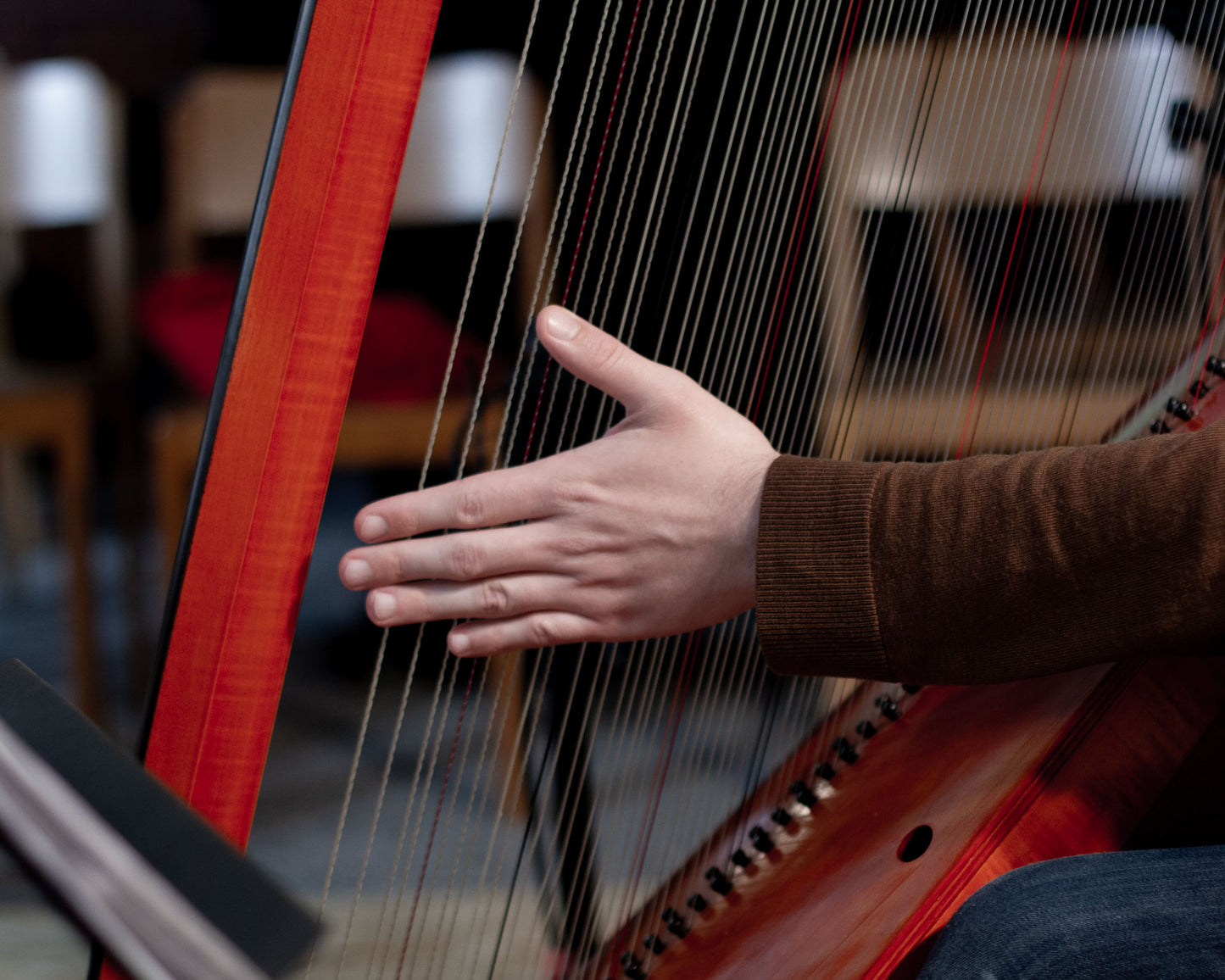
Maximilian Ehrhardt plays 18th century harp music from Wales on a Welsh triple harp, combining traditional Welsh melodies with famous works of 18th century composers like Handel, Vivaldi and Corelli. All works on this CD are taken from three unique manuscript collections from the National Library of Wales, Aberystwyth, and John Parry’s ‘A collection of Welsh, English & Scotch Airs with new Variations’. These collections show that the harpists played all kinds of music ranging from variations on traditional songs and melodies, harpsichord music, violin concertos and sonatas, opera arias and even orchestral pieces. The complexity of the writing shows the outstanding musicianship and virtuosity of the Welsh harpists. Most of the pieces have never been recorded so far and thus present an exciting new perspective on the rich repertoire of Welsh harp music.
Release date:
Catalogue number: CD-16321
Share


More album information
tracklist
Tracklist of "None but the Brave"
01. Dafudd Gareg Wen with Variations by John Parry 3:19
Welsh traditional / variations by John Parry (1710–1782)
02. Gig in the Third Solo of Corelli 2:47
Arcangelo Corelli (1653–1713)
03. Happy Pair, none but the Brave deserves the Fair 3:30
George Frideric Handel (1685–1759)
04. Of noble Race was Shenkin 4:44
Thomas d’Urfey (1653–1723) / variations by John Parry
05. The Fifth of Vivaldi 3:41
Antonio Vivaldi (1678–1741)
06. Allegro 33:07
Anonymous
07. Overture in Rodelinda 3:54
George Frideric Handel
08. Minuet in Rodelinda 4:14
George Frideric Handel / variations by John Parry
09. Rhydlan Marsh 6:59
Welsh traditional / variations by John Parry
10. The Eleventh Solo of Corelli - Allegro 3:23
Arcangelo Corelli
11. The Eleventh Solo of Corelli - Gavot0:52
Arcangelo Corelli
12. Largo 32:29
Anonymous
13. Allegro 32:26
Anonymous
14. Thro’ the Wood Laddie 2/44:06
English traditional / variations by John Parry
15. The Third of Vivaldi 32:33
Antonio Vivaldi
16. Rosline Castle 43:53
Scottish traditional / Anonymous variations
17. See See 34:36
Anonymous
18. Handel’s Water Musick2:06
George Frideric Handel
19. Burton’s Chace 3:56
John Burton (1730–1782)
Total time 66:48
booklet text
The Welsh harp tradition
The harp is the national instrument of Wales and has captured audiences for centuries with its beauty. It is documented as early as the first century BC that the Welsh played harps or harp-like instruments by the writer Diodorus Siculus (90–30 BC). In the tenth century, the Welsh law of Hywel Dda - which survives in written sources from c.1250 - describes the positions of poet harpers (bards) in Welsh courtly hierarchy and divides them into three groups: the house or court poet (bardd teulu), the chief bard (pencerdd) and the common musician or minstrel (cerddor). Giraldus Cambrensis (1141–1220) writes in his Topographica Hibernica ca.1185 that the harp was the instrument favoured by the Welsh – together with the crwth (a bowed lyre) and the pipes – and was played in large numbers throughout all parts of Welsh society. The bardic tradition was a highly professionalized, complex and regulated, yet purely oral tradition, where chief bards taught their knowledge in a long apprenticeship to their students. From the twelfth century onwards competitions (Eisteddfodau) were organized, where musicians and poets competed and took qualifying examinations for further musical degrees.
Early Welsh harps existed in many different sizes, ranging from 23 to 32 strings, and were strung with horsehair for the beginning harpist. By the fifteenth century the Welsh had adopted gut strings, though horsehair and metal strung harps, an Irish tradition, were also in use. Contrary to the rest of Europe, Welsh harps are played on the left shoulder, with the left hand playing the treble and the right hand playing the bass.
The sixteenth century saw both the peak and decline of bardism. After Henry VIII, King of England, passed laws making Wales part of England in 1536 and 1542, Welsh language lost its official status as a language of administration. From this time onwards the leaders of Welsh society - the gentry - started to become more English in language and influence. During the course of the sixteenth and seventeenth centuries the earlier Welsh music was replaced with popular music from England, principally from theatres and ballad-mongers. In Elizabethan times the professional minstrels started to disappear with their highly organised art and old complex metrical poetry and were replaced by popular entertainers. The songs of the English theatres were so powerful in their influence that their styles were copied by the Welsh harpists. An existing book of early Welsh harp music is the manuscript of Robert ap Huw (c.1580–1665) of Llandeusant on the island of Anglesey, a chief bard who compiled music in an earlier style around the year 1613. The music is written in a harp tablature which by the eighteenth century - only a hundred years later - no harpist was able to decipher anymore.
French theoretician Marin Mersenne (1588–1648) describes in his treatise Harmonie Universelle (Paris, 1636) a harp with three parallel rows of strings which was introduced to England by the famous French harpist John le Flelle around the year 1629. Both outer rows of this harp are tuned diatonically and the inner row chromatically - a chromatic harp or triple harp. In 1660 Charles Evans was appointed harpist to the prince of Wales and is the first Welshman known to have played an Italian (chromatic) harp bought for him in 1663. According to Welsh antiquarian Iolo Morganwg (1747–1826) the earliest Welsh triple harps were made by Elis Siôn Siamas of Llanfachreth, harpist to Queen Anne, only a couple of years later. Soon the Triple Harp became the instrument favoured by Welsh harpists. When Welshman William Powell became royal harpist in 1736, performing in the orchestra of George Frideric Handel (i.e. the harp concerto in Alexander’s Feast), he played on a triple harp.
Later in the eighteenth century an unparalleled flourishing of Welsh culture in London could be witnessed. The affluent Welsh in London saw themselves as the custodians of their heritage with an obligation to pass on their culture to the next generation. Welsh societies were established with harp music as an integral part of their meetings.
John Parry
The most famous Welsh harpist of the eighteenth century was John Parry (1710–1782). Blind from birth, Parry learned to play the harp at an early age at Bryn Cynan near Nefyn on the Llŷn Peninsula. Known as Parri Ddall, Rhiwabon (Blind Parry of Ruabon), he became harpist to the Welsh nobleman Sir Watkin Williams Wynn of Wynnstay and later to his son. As a member of parliament Sir Watkin spent much time in London, where he introduced Parry to London society. He soon was celebrated for his virtuosity and beauty of sound, playing in aristocratic houses in the capital and all over the British Isles. An article in the Leeds Mercury in 1742 lists music by Corelli, Vivaldi, Geminiani, Handel together with Scottish and English airs in his concert programme.
Parry published several collections of music: Ancient British Music (London, 1742), A collection of Welsh, English and Scotch Airs with new Variations (London, 1761) and British Harmony (London, 1781). As a teacher he can be called the father of the Welsh harpists in recent times and most famous nineteenth century harpists can be directly linked to him. His printed collections together with the publications of Edward Jones (‘Bardd y Brenin’ 1752–1824) are the foundations of the music for the harp in Wales.
The Aberystwyth manuscripts
All works on this CD are taken from three unique manuscript collections from the National Library of Wales, Aberystwyth, and John Parry’s ‘A collection of Welsh, English & Scotch Airs with new Variations’. These collections show that the harpists played all kinds of music ranging from variations on traditional songs and melodies, harpsichord music, violin concertos and sonatas, opera arias and even orchestral pieces. The complexity of the writing shows the outstanding musicianship and virtuosity of the Welsh harpists.
The three manuscripts MS 12393 D, MS 14427 B and MS 11970 D date from the third quarter of the eighteenth century and are the oldest manuscripts with harp music from the National Library of Wales. These books have been written and owned by different harpists and are a rare example of the eighteenth century Welsh harp tradition.
The contents of the manuscripts are an example of the harpists’ repertoire and virtuosity during the eighteenth century and a reflection of John Parry’s own repertoire. There is a prominent amount of Italian and Italianesque music as well as compositions by Handel in all three volumes, representing the musical taste of the aristocracy and the educated class of the time. The amount of compositions and variations written by John Parry is astonishing. The manuscripts contain many published and unpublished works of Parry, which suggests that the writers might have had a personal connection to him. One of the manuscripts belonged to Robert Edwards, a student of John Parry, and another belonged to John Richards of Llanrwst (1711–1789), a famous triple harp maker who is known to have built Parry’s last harp.
Maximilian Ehrhardt, Berlin 2019
recording information
Maximilian Ehrhardt plays on a Welsh Triple Harp after John Richards (1764) made by Dario Pontiggia (Milano, 2009).
Recorded May 27-29, 2019
Location: Andreaskirche Wannsee, Berlin, Germany
Balance engineer & recording producer: Jonas Niederstadt
Producer: Bettina Schmidt
Corporate Design: Tim+Tim, timandtim.com
Cover photography: Alexander Gehring
Booklet photography: Jonas Niederstadt
Produced by Jonas Niederstadt
©+℗ 2020 Deutschlandradio/Carpe Diem Records
press reviews
- 5 stars: 1 (100%)
- 4 stars: 0 (0%)
- 3 stars: 0 (0%)
- 2 stars: 0 (0%)
- 1 star: 0 (0%)
Da mich der Harfinist persönlich informiert hatte, dass er diese CD bespielt hat, war ich neugierig und habe sie gekauft. Beruhigende schöne Musik, die man auch bei eine Beschäftigung nebenbei hören kann.