


Harmonice Mundi
Harmonice Mundi
Couldn't load pickup availability
Viktor Töpelmann - viola da gamba
Daniela Niedhammer - organ
About the album
At the Benedictine abbey of Kremsmünster, a magnificent bass viol built by Hanns Khögl in Vienna in 1674 has survived nearly unaltered to this day. This instrument inspired the viol player, music historian and historical performance specialist Viktor Töpelmann to look for a matching solo repertoire and its sound world of the late 17th century. Several fine viols from this period – built by Khögl in Vienna, Johannes Schorn in Salzburg or Johann Seelos in Linz – have come down to us, yet virtually no original solo music for viol exists from the southern part of the German speaking lands. Viol virtuosos, such as Matthias Puecher (c1660–1743) in Kremsmünster or Gottfried Finger (c1660–1730), apparently played violin compositions on their instruments.
Thus, several transcriptions of violin music are heard on this recording alongside original compositions for viola da gamba by August Kühnel (1645 – after 1699) and Johannes Schenck (1660 – after 1717). Ignazio Albertini’s (c1644–1685) violin sonata was adapted for the viol by Gottfried Finger in the late 17th century and Viktor Töpelmann transcribed sonatas by Johann Heinrich Schmelzer (c1620–1680) and Heinrich Ignaz Franz von Biber (1644–1704) for this recording. In addition, the CD features organ music by Johann Caspar Kerll (1627–1693) and Georg Muffat (1653–1704), performed by the organist and harpsichordist Daniela Niedhammer on a historical organ from 1662.
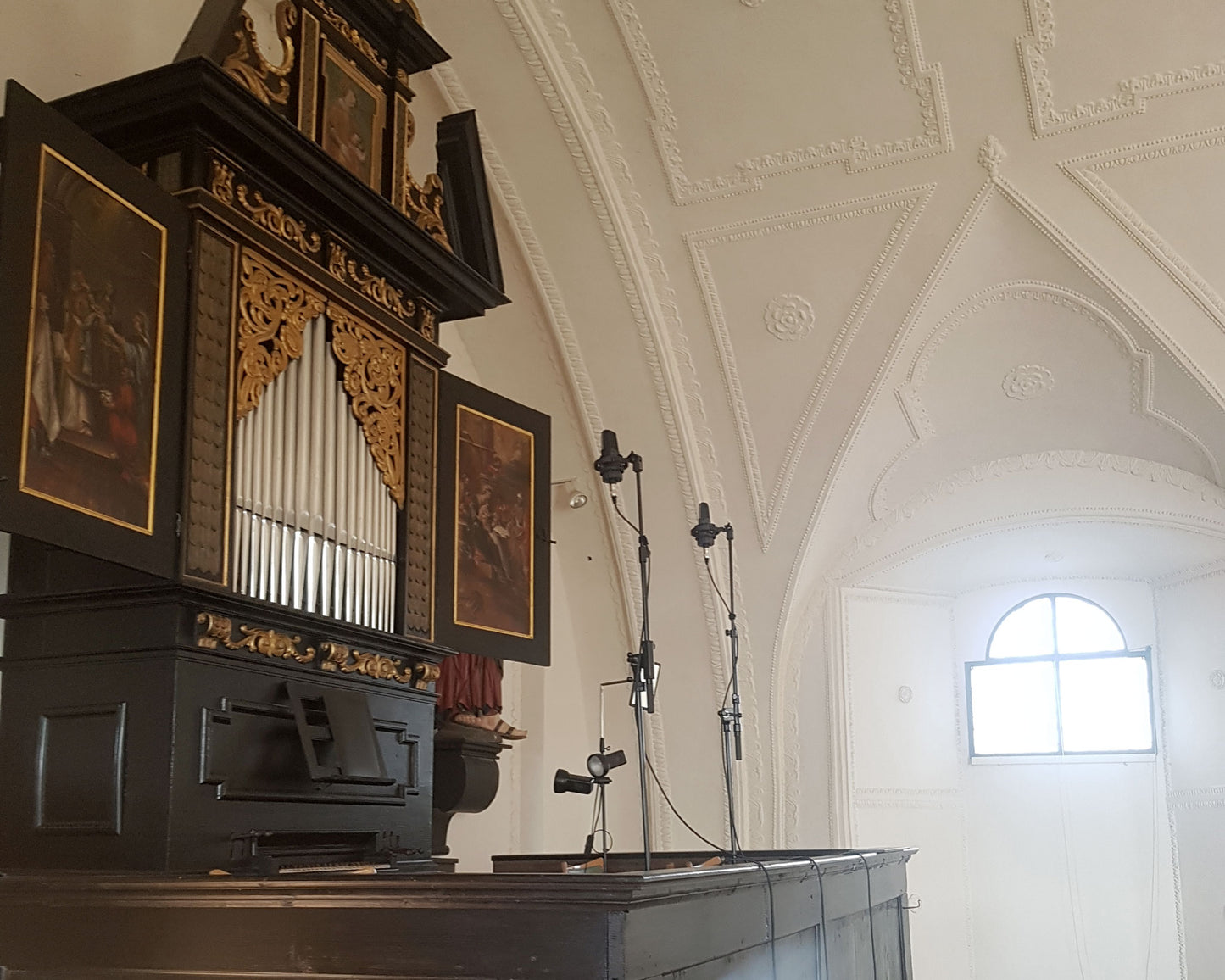
In conjunction with the artists, these two stunning historical instruments shape the characteristic sound of the recording. Khögl’s viol is highly resonant and powerful; it has a radiant singing quality in the treble and a ligneous core to its bass. The stringing used for this recording with six pure gut strings enhances the upper harmonics of its sound and simultaneously gives the sound an earthy quality. The organ with five stops on one manual was built by Hans Vogl for the St Stephanus church in Vormoos, where it still stands today. The wooden 8-foot pipes provide an ideal accompaniment to the viol and its high registers ablaze with colour in the solo works. The title of the recording »Harmonice Mundi« refers to Johannes Kepler (1571–1630) and his idea of a musical harmony of the spheres, which can be experienced by the listener »through an artful symphony in a fraction of an hour«.
Release date:
Catalogue number: CD-16326
Share


More album information
tracklist
Tracklist of "Harmonice Mundi"
Heinrich Ignaz Franz von Biber (1644–1704)
01. Sonata XIV in D-major (»The Rosary Sonatas«, Salzburg c1674) 13:00
August Kühnel (1645–after 1699)
02. Sonata VII in G-major (Sonate o partite ad una o due viole da gamba, Kassel 1698) 11:28
Johann Caspar Kerll (1627–1693)
03. Toccata in a-minor 5:40
Ignazio Albertini (c1644–1685)
04. Sonata I in d-minor (Sonatinae XII. violino solo, Vienna 1692) 8:30
Georg Muffat (1653–1704) 05. Ciacona in G-major (Apparatus musico-organisticus, Salzburg 1690) 5:28
Johann Heinrich Schmelzer (c1620–1680)
06. Sonata IV in D-major (Sonatae unarum fidium, seu a violino solo, Nuremberg 1664) 12:16
Johannes Schenck (1660–after 1717)
Sonata V in e-minor (L’Echo du Danube, Amsterdam 1704)
07. Adagio 2:56
08. Aria – Largo 2:40
09. Gavotte – Presto 1:08
10. Adagio 2:16
11. Giga – Vivace 1:56
12. Aria 4:35
booklet text
Harmonice Mundi
According to the astronomer Johannes Kepler (1571–1630), »the movement of the celestial spheres is nothing else but constant polyphonic music«. Kepler expounds in his Harmonices Mundi Libri V (»five books on the harmony of the world«), how the mathematical proportions of the planetary orbits accord with the proportions of musical harmonies. Thus it is possible to depict »the perpetual movement of the world through an artful symphony in a fraction of an hour«. This provides humankind a possibility to acquire a taste of »the holy Creator’s pleasure upon his works […] in the sweet delight that music as an emulation of God offers«. The polymaths Robert Fludd (1574–1637) and Athanasius Kircher (1602–1680) propagated similar views, which put music and harmonic proportions at the beginning of the creation of the universe. Musical harmony mirrors transcendental principles and thus music offers a path and a vocabulary towards discovering the fundamental secrets of this world.
During the 1670s the Benedictine Abbey of Kremsmünster acquired a number of new string instruments, in order to experience »the sweet delight that music as an emulation of God offers«. The account books of the time document countless musical purchases. Pater Sigismund Gast (1645–1711), who lived in Vienna to further his musical studies, bought sheet music, strings, bows, rosin and instruments for the abbey: a viol for the sum of 15 fl. and two violins for 18 fl. in 1674, a year later two »violettas« for 15 fl. and another viol for 30 fl. This last instrument is in all likelihood the viol built by Hans Khögl (1614–1680), which remains in possession of the abbey to this day and which can be heard on this recording. The archival records also identify Matthias Catharina Puecher (? – 1743) as the first virtuoso performer on this instrument. Puecher came into the service of the abbey in 1674 and the music heard on this CD is a hypothetical vision of his solo repertory. At the same time, the music presents diverse euphonious approximations to the harmony of the world from the late 17th century.
Today, several magnificent viols from this period – built by Khögl in Vienna, Johannes Schorn in Salzburg or Johann Seelos in Linz – have come down to us, yet virtually no original music for viol and continuo or viol solo exists from the southern part of the German speaking lands. Viol virtuosos, such as Matthias Puecher or Gottfried Finger (c1660–1730), apparently played violin compositions on their instruments, and the playing techniques of the violin and the viol were closely related at that time. One example of this practice is Finger’s transcription of a violin sonata by Ignazio Albertini (c1644–1685), which is included on this recording. Another informative source regarding a common repertory for violin and viol is a Sonatina à Viola da Gamba aut Violino Solo, which survives in Kroměříž and which is occasionally attributed to Heinrich Ignaz Franz von Biber (1644–1704).
Biber was not only a stupendous violin virtuoso in his youth but also an excellent viol player. Today, his name is associated with the scordatura technique on the violin in particular: the re-tuning of the strings of a stringed instrument in unusual tunings is in itself a technique which was first cultivated by lute and viol players and which only belatedly found its way into the violin repertory. The Sonata XIV from the so-called »Rosary Sonatas« is originally written for a violin in scordatura. It calls for a tuning in which three strings of the violin correspond to the normal tuning of the top three viol strings (d’ – a – e) up an octave. Thus the chords and passagework of the composition fit particularly well on the viol. Incidentally, the abovementioned sonata for viol or violin from Kroměříž asks for an identical re-tuning of the violin. Each sonata in the cycle of »Rosary Sonatas«, which is preserved in a magnificent presentation copy for the Salzburg archbishop Maximilian Gandolf von Kuenburg, incorporates a small printed image at the beginning of the music. Sonata XIV features a depiction of the assumption of Virgin Mary. The remaining eleven apostles are sitting around a baroque tomb and look with pious devotion into the empty grave or up towards heaven. In the centre of the image, Mary is ascending on a fluffy cloud with open arms and hands. Biber’s sonata is a musical contemplation of this scene: the sonata starts with a long pedal note in the organ and improvisatory runs and figures in the viol that gradually turn into musical motifs and melodies – as if we are listening to the formation of the composition in heaven. With the end of the introduction the music has arrived in our world, firmly grounded on earth, and the bass part initiates a Ciacona that is going to last for 240 bars. This perpetual rotation in the bass is a musical analogy of the everlasting movement of the harmony of the world. The bass pattern has been in existence ever before and is going to last forever thereafter: it is simply made audible by the organ for the duration of this sonata. The solo viol performs a musical ascent into heaven, which gradually gathers momentum until it finally abandons the rotating earth.
August Kühnel (1645 – after 1699) was born into a north German family of musicians. He was employed as viol player at the court of count Moritz von Sachsen-Zeitz until 1682. The same year, an appointment at the court chapel in Munich failed to materialize, because Kühnel refused to convert to Catholicism before his commencement of duties. In a letter from 15 October 1682 he laments »that I cannot come to a place, where I’d be welcome and where I’d like to settle, because of my religion (which actually is not of such a significant difference, as both sides pretend it to be)«. He could imagine to convert to Catholicism only »if persuaded in his heart by the passing of time« but not out of opportunism. Instead Kühnel travelled to England in 1682. He gave concerts in London performing on the viol and the baryton and appearing together with Gottfried Finger. Kühnel’s Sonata VII for viol and basso continuo is taken from his only printed collection Sonate o partite ad una o due viole da gamba (Kassel 1698). In its tripartite form ([Adagio] – Allegro – Adagio) the introductory sonata is indebted to north German preludes as, for example, in compositions by Dieterich Buxtehude (c1636–1707), and it has a markedly different character in comparison with the searching introductions of many south German or Austrian sonatas. Yet, similarly to Biber’s sonata, the music starts in heaven with floating, tranquil harmonies, gradually changing colours. The following allegro is a lively display of virtuosity which ends with a run down the entire range of the bass viol ending on the bottom note of a six-string viol. The subsequent adagio is an affect-laden example of Athanasius Kircher’s maxim that a musical introduction should »just like a preamble prepare and stimulate the heart of the listener for the resplendence of the following symphony«. In Kühnel’s sonata, »the following symphony« consists of three arias with their elaborate variations: the first aria is of a melodious, vocal character, the second creates a transfigured atmosphere and the third aria presents a jubilant dancing feast as conclusion to the sonata.
Johann Caspar Kerll (1627–1693) was the foremost German-speaking composer of the late 17th century and his chamber music and operas were received throughout Europe. He was born in Adorf in the Vogtland region and settled in Vienna in the mid-1640s where he studied with Giovanni Valentini (c1582–1649). Contrary to August Kühnel he converted to Catholicism during his time in Vienna – if this step was motivated by pragmatism or if »his heart was persuaded by the passing of time« remains an open question. Kerll met Athanasius Kircher during a study visit to Rome and one of Kerll’s toccatas is included in Kircher’s Musurgia Universalis as paradigm of a worthy composition. The toccata in a-minor on this recording is the third of a set of eight toccatas in the most common church modes.
Around 1670 the Italian-born violinist Iganzio Albertini (c1644–1685) joined the court chapel of Kroměříž. The prince-bishop Carl von Liechtenstein-Kastelcorn (1623–1695) was urgently looking for a violin virtuoso as replacement for Biber, who had failed to return from a trip to Tyrol, staying in Salzburg instead. On the recommendation of Johann Heinrich Schmelzer (c1620–1680) the bishop hired Albertini. Yet, Albertini was dismissed again after a couple of months due to »objectionable behaviour«. Gottfried Finger was born in Moravia and also served at the court of Carl von Liechtenstein-Kastelcorn for some time. Thus Finger might have known Albertini’s sonata in d-minor from his time in Kroměříž even before the piece was published as first sonata in Albertini’s posthumous collection Sonatinae XII. violino solo (Vienna 1692). Finger’s transcription of this piece is mainly a matter of transposing the melody down an octave, fitting it to the compass of the bass viol. Finger also replaced the introduction of Albertini’s sonata with a simpler, improvisatory opening above a long bass pedal on D.
Georg Muffat’s (1653–1704) Apparatus musico-organisticus was published in Salzburg in 1690. Born in the Duchy of Savoy Muffat was organist at the Salzburg court and a colleague of Biber’s from 1678 until 1690, when he was appointed as Kapellmeister in Passau. The Apparatus musico-organisticus consists of twelve free toccatas in all church modes in the style of Girolamo Frescobaldi and three cyclical works: the Ciacona in G-major heard on this CD, a large-scale Passacaglia in the French style and an aria with variations. The eclectic content of Muffat’s collection mirrors his musical socialisation in France, Germany and Italy.
Johann Heinrich Schmelzer joined the Viennese court chapel as a violinist in 1649 and rose through the ranks until he was appointed Hofkapellmeister thirty years later. He was the first non-Italian musician to hold this position in the 17th century and he was regarded as »the famous and most distinguished violin player in the whole of Europe«. The publication of his collection with violin sonatas Sonatae unarum fidium, seu a violino solo in Nuremberg in 1664 heightened his international reputation as composer and violinist. The fourth sonata, which is included on this recording, draws a circle back to Biber’s musical meditation on the Feast of Assumption. While we listened to the formation of music in heaven in Biber’s composition, Schmelzer’s Sonata Quarta starts with the musical analogy of Kepler’s »the perpetual movement of the world«: the bass repeats a constant descending movement of four notes over four bars. Above this rotary motion a melody gradually emerges in the viol part and from a tentative start it develops into affectionate melodies, virtuoso passagework and jubilant dances. Two compositional forms come into being without any change to the bass movement: first a melancholic, retrospective Sarabande and, thereafter, an exhilarating Gigue to conclude the first part of the sonata. At this point, the perpetual movement in the bass ends and the following music is a personal, affecting expression and not any longer a sounding image of transcendental harmony. A contemplative and singing phrase starts this section, which successively gathers momentum and becomes livelier, increasing its fiery energy and ending in resounding musical fireworks.
Johannes Schenck’s (1660 – after 1717) sonata in e-minor for viol solo concludes this recording as an epilogue to the varied musical depictions of the harmony of the spheres. From 1696 Schenck was in the employment of Johann Wilhelm II, Elector Palatine and Duke of Neuburg, who split his time between his two residences in Düsseldorf and in Neuburg. Both cities, or rather the names of their defining rivers, found their way into the titles of two of Schenck’s sonata collections from that time: Le Nymphe di Rheno (Amsterdam 1702), which contains twelve sonatas for two viols, and L’Echo du Danube (Amsterdam 1704), which was dedicated to the Neuburg chamberlain Adam von Diemantstein. The latter collection comprises six sonatas for viol and bass or for viol alone. The sonatas excel in their successful fusion of elements of the Italian sonata and of the French suite. The cyclical, rotatory experience, which defined the sense of time during the 17th century and which shaped many musical works, is supplanted by a linear story telling in separate movements. Schenck’s Sonata V in e-minor opens with two slow-moving arias which present two sides of the sorrow and anguish associated with this key. According to Athanasius Kircher, e-minor »is fond of sadness and anguish« and the music theorist Johann Mattheson (1681–1764) characterizes the key as »very pensive, profound, afflicted and doleful, yet in such a way that one still hopes to be comforted«. The following Gavotta comes across as a high-voltage attempt to escape the melancholy of the key, yet to no avail. The central Adagio starts abruptly on a low a-sharp, which is the note furthest away from the tonic, and the movement guides the listener through a profound metamorphosis. This transformation leads into a sprightly Giga without the ponderous melancholy of the previous movement. The closing Aria returns to the basic melancholy associated with the key of the sonata, but the wistfulness is placated and Mattheson’s »hope to be comforted« prevails finally.
Schenck’s compositions for viol found their way to Vienna during his lifetime. The sonata in e-minor is preserved in an autograph manuscript in the Austrian National Library in Vienna. Maybe, Schenck entertained hopes for a prestigious appointment at the Habsburg court and presented the manuscript to the emperor. Alternatively, the music reached Vienna by way of the family links between the dynasties of Palatine and Habsburg: in 1676 Johann Wilhelm’s sister Eleonore Magdalene of Palatine-Neuburg had married Emperor Leopold I.
In 1699 the account books of the abbey of Kremsmünster chronicle a »Lutheran viol player« passing through and presenting the abbot with six viol pieces; the itinerant musician received one florin and thirty kreutzer in return. Regrettably, these viol pieces are not preserved in the music archive of the abbey and so it remains pure speculation, if this Lutheran viol virtuoso might have been August Kühnel. Matthias Catharina Puecher, whose speculative solo repertory inspired this recording, served over sixty years as a musician, teacher and copyist at the abbey. He witnessed the arrival of the magnificent viols by Khögl in the 1670s, he commissioned the temporary conversion of the instrument heard on this CD into a seven stringed viol in the early 18th century in order to play the modern French viol repertory and he was still in service when the viols went out of use and the abbey acquired several violoncellos and bass violins. On 20 December 1743 the death records of the parish note that »the noble and artful Herr Mathias Puecher, most venerable senior of the musicians« had died after more than 65 years in the service of the abbey.
Viktor Töpelmann, 2021
recording information
Recorded October 1-4, 2020
Location: St. Stephanus Vormoos (Feldkirchen bei Mattighofen, Austria)
Balance engineer & recording producer: Jonas Niederstadt
Corporate Design: Tim+Tim, timandtim.com
Cover photography: Alexander Gehring
Booklet photography: Viktor Töpelmann (p.3), Martin Chiang (p.6),
Valentin Behringer (p.18)
Produced by Jonas Niederstadt
©+℗ 2021 Carpe Diem Records