


Esaias Reusner: Lute Music
Esaias Reusner: Lute Music
Couldn't load pickup availability
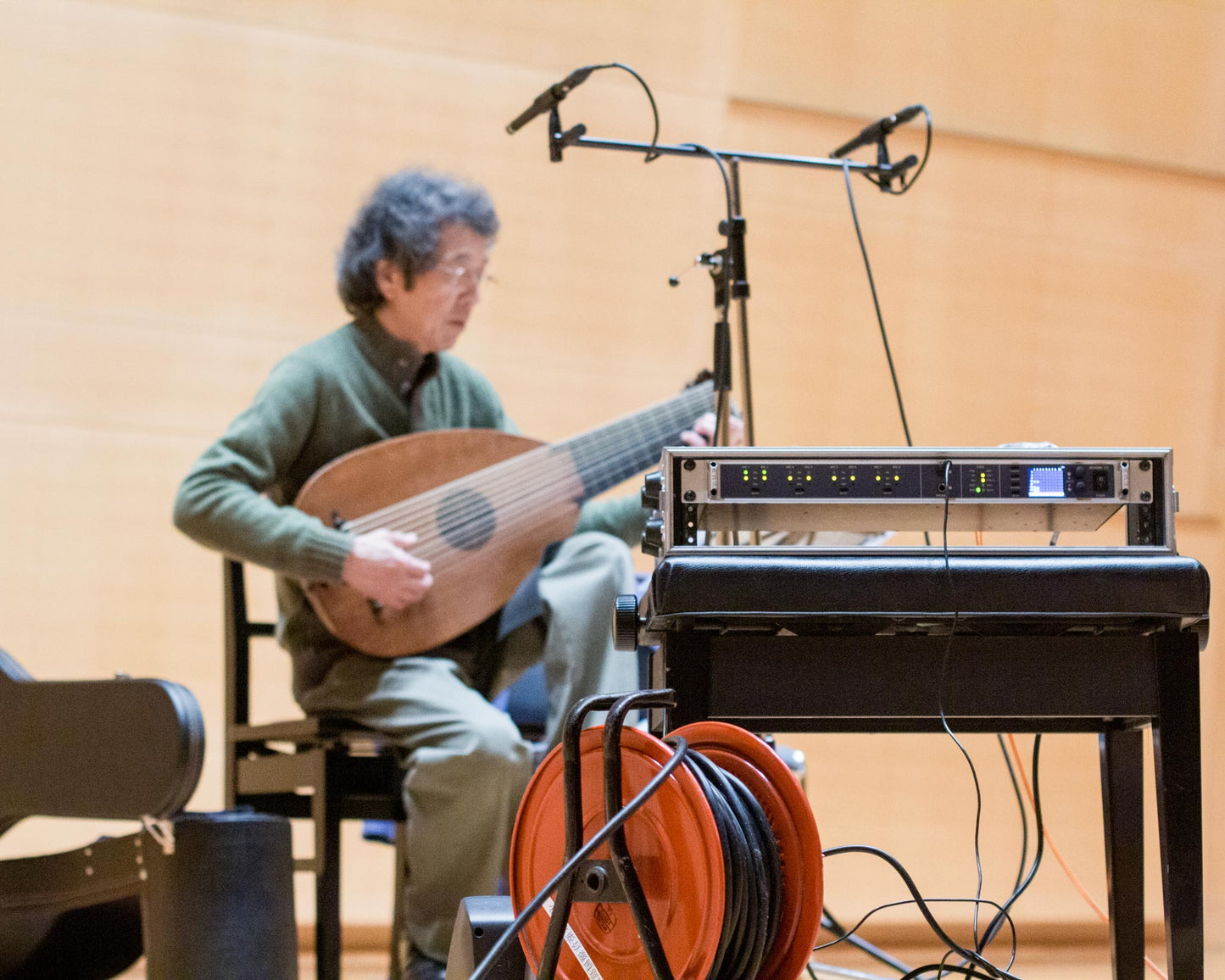
Toyohiko Satoh, Lute: The lute music of German Esaias Reusner (1639-1679): Zen & Baroque Music
This new solo album of world-renowned Japanese lute master Toyohiko Satoh (佐藤豊彦) features music by the German baroque composer and lutenist Esaias Reusner (1639-1679), who published two volumes of compositions for solo lute. The pieces of this CD are taken from “Neue Lautenfrüchte”.
Reusner’s style is as interesting as it is special and unusual, compared to works of his contemporaries. His pieces are mostly short, sober and pragmatic, showing a very clear and unostentatious attitude.
Toyohiko Satoh links this approach to the eastern idea of meditation and appreciation of imperfection (Wabi-Sabi). He delivers an outstanding interpretation far from trying to be virtuosic or impressive, but instead staying totally true to himself, letting the music unfold by itself. Reusner’s music becomes a quiet musical meditation that transcends time and space.
Music video
Toyohiko Satoh performs a piece by Esaias Reusner from the album:
Release date:
Catalogue number: CD-16310
Share


More album information
tracklist
Tracklist of "Esaias Reusner: Lute Music"
Suite B-Dur
11. Praeludium 02:12
12. Sonatina 02:25
13. Allemanda 03:48
14. Courant 02:05
15. Sarabanda 02:01
16. Aria 01:48
17. Gigue 01:31
18. Ciacona 04:22
Suite A-moll
19. Allemanda 04:04
10. Courante 02:20
11. Sarabanda 02:00
12. Aria 01:38
13. Gigue 02:26
14. Allemanda 02:59
Suite G-moll
15. Courante 01:41
16. Sarabanda 01:51
17. Aria 01:17
18. Gigue 01:09
19. Aria II 01:16
Suite D-Dur
20. Sonatina 03:43
21. Allemande 03:04
22. Courant 01:39
23. Sarabanda 01:59
24. Gavotte 01:28
25. Gigue 02:06
26. Passagalia 05:13
Total time 62:21
booklet text
Lute music by Esaias Reusner
Haiku is a traditional form of Japanese poetry, and one of the shortest poetic forms in the world. Likewise, the lute music of Esaias Reusner mostly consists of very short compositions. A haiku is composed of only 17 syllables, yet it is able to capture our most essential thoughts and feelings and inspire the reader’s imagination. In this sense, the idea of haiku is close to the Zen concept of mu (無 nothingness), or mugen (無限 infinity). Esaias Reusner (1639–79) was a contemporary of one of the most important haiku poets, Matsuo Bashō (1644–94). The four suites on this CD were selected from Reusner’s Neue Lauten-Früchte*, which he published in Berlin in 1676; he was then 37 years of age, and Bashō was five years younger.
I shall not go into detail concerning all the works recorded on this CD, but shall focus instead on the Sarabandes. The four Sarabandes consist of 16 bars (8 + 8) each, or rather 32 bars including repeats – the shortest possible dance form of the time. Another feature of Sarabandes was that they are composed for two voices only: melody and bass. A gradual change from contrapuntal to chordal composition started from the middle of the 17th century, and most composers at this time began using chordal textures for Sarabandes as well. Yet there was still a two-part compositional form called the bicinium, which was primarily used for counterpoint exercises. Its last representatives are the well-known Two-Part Inventions by J.S. Bach. Bach’s “Piéces pour la Luth à Monsieur Schouster” (Suite in G minor, BWV 995), which are largely identical to the Cello Suite No. 5 (C minor, BWV 1011), feature a Sarabande that much resembles those of Reusner. Bach’s Sarabande is a little longer, consisting of 20 bars (8 + 12). It is written as a highly abstract monophonic piece, using single notes to adumbrate the underlying harmonies.
Bach was an extremely gifted composer, with boundless inventive abilities. Reusner, on the other hand, was just a lutenist. In expressing the full range of his ideas with a minimum of notes (or sounds, for that matter), his intentions seem to have been similar to those of Bashō. A more ostentatious composer would not have taken this approach. Not only the Sarabandes but most of Reusner’s other pieces, too, are short and sober. This attitude could be seen as a contrast to the prevalent musical environment in Europe, where making music was regarded as a business, and it shows a certain similarity to the wabi-sabi (aesthetics of transience and imperfection) of the haikai poet Bashō, who sought the tranquil and solitary life of a hermit.
Western music became more extravagant and ambitious, progressing from Monteverdi at the beginning of the 17th century to Handel and Vivaldi at the beginning of the 18th century.
Meanwhile, music for the 11-course French lute, which Reusner played, developed a quality of almost reclusive exclusivity, similar to the concept of the Japanese tea house. In fact, in Japan in the course of the 17th century, kabuki theatre, which was aimed at the general public, rose in popularity and replaced the upper-class, Zen-inspired Nō theatre of the Samurai society. Kabuki theatre continued to grow, and developed a reputation similar to that of baroque opera in Europe. This might indicate that even though Japan and Europe are geographically distant, the aesthetic sensibilities of human beings all over the world do not differ greatly, even if their languages and ways of expression vary.
Today, Haiku is still a common form of poetry in Japan, and its value is recognized worldwide. It is a timeless style. The same goes for Bach’s music, which is still widely appreciated today. Reusner’s music also shows timeless elements, resembling both baroque and contemporary music; it transcends the concept of being old or new. Before publishing Neue Lauten-Früchte, Reusner released Delitiae Testudinis in Leipzig in 1667. Although some Sarabandes of the suites in this earlier volume consist of 8 + 8 bars, most of the pieces, including the other dances, are longer and somewhat more elaborate than those in the later Neue Lauten-Früchte (1676).
I sometimes find this early work, which Reusner published at the age of 28, difficult to understand. This might be because the composer was still young enough to need to promote himself. To that end he might have wanted to show his skills in lute playing as well as his ability to compose highly sophisticated music. My impression is that he was seeking something, but I cannot grasp entirely what he was attempting to express. And so his development towards the concise aesthetics of Haiku, within only nine years, could be seen as nothing short of phenomenal. Today only a few people know of Reusner, but as a lutenist who has lived thirty years longer than him, I hugely admire what he achieved artistically in his short life of only forty years. Regardless of time, age and style, I again ventured on a recording adventure with my ancient Greiff lute, expressing what I see in Reusner’s music honestly and without reserve.
Toyohiko Satoh
* The Second Suite in G minor is taken from the handwritten supplement to Neue Lauten-Früchte that is kept in Berlin (Staatsbibliothek Preussischer Kulturbesitz Mus. Ms. 18380).
Postscript: All the dances on this CD originated in France and were already used by Gaultier, Dufaut, Gallot and others before Reusner. But as far as I know, Reusner was the first to write a suite in the sequence of Allemande – Courante – Sarabande – Gigue in the same tonality. In other words he was the first lutenist to establish the form of the suite. It became a standard outside the lute world, too, in the late baroque period. In this sense Delitiae Testudinis (1667) is regarded as an important publication. The (inconsistent) spellings of the dances in the programme were taken from Neue Lauten-Früchte.
recording information
Recorded April 2015
Location: Kirishima International Concert Hall “みやまコンセール” (Japan)
Balance engineer & recording producer: Jonas Niederstadt
Corporate Design: Tim+Tim, timandtim.com
Cover painting: Carsten Dietz
Booklet photography: Jonas Niederstadt
Translations: Junko Nagiyama / Andrew Barnett (English),
Jonas Niederstadt (German)
Produced by Jonas Niederstadt
© 2016 Carpe Diem Records
press reviews
Diapason magazine
"An influential composer of his time, Esaias Reusner was the first lutenist to adopt the French-style dance suite form, paving the way for Weiss.
Toyohiko Satoh, a renowned Japanese lutenist, presents a selection of suites from his “new collection,” Neue Lauten-Früchte. The performer also piques our curiosity by drawing an analogy, as he explains in the liner notes, between the pieces, which are relatively short and tend toward concise expression, and the poetic form of haiku. Reusner was a contemporary of Basho, the great haiku poet.
Interesting both for what they say and what they foreshadow, these Suites give us a measure of how far we have come to reach Bach, the master of the genre. Satoh, with his velvety sound and defined attacks, revives this music with a very clear rhythmic relief which, beneath its austere appearance, proves to be very captivating. He owes this to his understanding and acceptance of the rigor intrinsically present in these pieces: rather than a confinement, for him it is a path to follow in order to free himself and increase the expressive possibilities tenfold.
With the sincerity and humility of a performer who effaces himself before the composer in order to interpret him as well as possible. The tempos chosen are in keeping with both the conventions of dance and the deep breathing of Satoh, a master of simple, concise, and limpid beauty." Emile Huvé, Diapason
Lute News
"There can be little doubt that Satoh and Reusner are a winning team, the soothing and understated voice of what Satoh playfully terms ‘my ancient Greiff lute’ proving a subtly compelling vehicle for what emerges as a gently persuasive musical offering. [...]
In drawing a distinction between Bach as ‘an extremely gifted composer’ and Reusner as ‘just a lutenist’, Satoh is perhaps stating the obvious, but his generosity towards the more humble figure of Reusner is what brings this music to life. Despite a plentiful but never excessive dose of ornamentation, the transparency of Reusner’s language is respected and retained throughout. Perhaps the prevailing quality of Satoh’s interpretations is their ever-present sense of space. Every note is allowed to breathe, to an extent that the listener is not only conscious of where it starts, but also where it stops."
P. Fowles, Lute news 120, Dec. 2016
- 5 stars: 2 (100%)
- 4 stars: 0 (0%)
- 3 stars: 0 (0%)
- 2 stars: 0 (0%)
- 1 star: 0 (0%)
Die beste akustische Reproduktion eines Saiteninstruments, die ich je gehört habe. Natürlicher Klang, verzerrungsfrei aufgenommen, adäquate räumliche Abbildung. Wenn Sie neue Boxen brauchen... testen Sie sie damit. Musikalisch habe ich beim Kauf Neuland betreten. Die vier Suiten sind einfach und weisen noch nicht auf die barocke Polyphonie JSBs hin. Nur hören wenn Sie allein in der Wohnung sind, nicht über Kopfhörer. Das Instrument sollte Sie von vorne anklingen.
Gorgeous music and sublimely played. Add to that an outstanding recording. A treasured disc.