


Cantà in cumpagnia
Cantà in cumpagnia
Couldn't load pickup availability
A musical encounter between Corsican polyphony and the art of the Italian Renaissance
What if the boundaries between traditional and classical music were far less distinct than we have come to believe? With Cantà in cumpagnia, the Camerata Figarella explores precisely this idea, bringing together the living vocal traditions of Corsica and the rich polyphonic repertoire of medieval and Renaissance Italy in a musical encounter that transcends centuries, languages and cultural boundaries.
The programme is as fascinating as it is unusual. Medieval Franciscan laude from the Laudario di Cortona, early Italian madrigals by Jacopo da Bologna and Gherardello da Firenze, and sophisticated Renaissance compositions by Philippe Verdelot, Jacques Arcadelt and Orlando di Lasso meet traditional Corsican paghjelle and sacred songs. The selection also includes rarely heard and previously unrecorded music, among them the early madrigal Entrava Phebo con lucenti raçi and Nato era maggio, a song preserved through oral transmission in the Corsican village of Sorbu. Particularly striking is the juxtaposition of centuries-old repertoire with more recent expressions of Corsican musical life, such as U lamentu à Ghjesù, a Passion song that has become part of the island's living Holy Week traditions.
Corsica is far more than the geographical setting of this recording. Its deeply rooted culture of oral transmission, communal singing and distinctive male polyphony provides the musical inspiration and artistic perspective for the entire project. The traditional paghjella, with its characteristic interplay of seconda, bassu and terza voices, is a particularly remarkable expression of this heritage. Shaped by the island's landscape, language and spiritual life, these vocal traditions carry a musical knowledge passed down through generations. It is this very knowledge that the Camerata Figarella brings into dialogue with the written musical heritage of the Renaissance.
At the heart of the ensemble is an extraordinary combination of four singers and four wind players. Three traditional Corsican singers – Michele Paoli, Daniel Gonet and Jean-Étienne Langianni – are joined by Italian baritone Enea Sorini, a specialist in medieval and Renaissance vocal music. Their different backgrounds and approaches create a fascinating interplay between the immediacy and natural ornamentation of traditional singing and the refined polyphonic language of early Italian music.
The instrumental ensemble is equally distinctive: William Dongois on cornetto, Stefan Legée on sackbut, Fausto Sierakowski on alto saxophone and Ange Sierakowski on clarinet. The combination of historical wind instruments with modern saxophone and clarinet opens up unexpected sonic perspectives. Together, the eight musicians form a kind of double choir, in which voices and instruments constantly exchange roles, complement one another and create new musical textures.
A central element of this encounter is the Renaissance art of diminution: the improvisational ornamentation of existing melodies through increasingly elaborate note patterns. Originally a vocal practice, it was later adopted by instrumentalists, who sought to imitate the flexibility and expressiveness of the human voice. Here, this historical technique meets the melodic variations and modal improvisation of Corsican singing, creating a natural connection between two seemingly distant musical traditions.
Recorded in the church of Santa Maria Assunta in Mandriale, in the mountains above Bastia, Cantà in cumpagnia captures something of the spiritual and acoustic landscape from which this music emerges. Rather than reconstructing a historical sound world or simply juxtaposing different traditions, the Camerata Figarella creates a genuine musical conversation – one in which the Renaissance becomes what its name originally suggested: a continual renewal, deeply rooted in the past yet alive in the present.
Release date:
Catalogue number: CD-16341
Share


More album information
tracklist
Tracklist of "Cantà in cumpagnia"
01. Avà vene lu veranu & Ecco la primavera 4:00
M.: Traditional & Francesco Landini (1335–1397)
T.: Dumenicu Ceccaldi dettu Menicu d’Osani & Francesco Landini
02. Italia mia6:27
M.: Philippe Verdelot (1480/1485–1530/1552), T.: Petrarca
Diminutions: William Dongois
03. Sò le muntagne d’Orezza4:09
M.+T.: Traditional, Harmonisation: Jean Étienne Langianni
04. Improvisation to Entrava Phebo2:09
M.: Fausto Sierakowski (*1988)
05. Entrava Phebo con lucenti raçi3:35
M.: Jacopo da Bologna (1290/1300–1360), T.: Anonyme, codex Squarcialupi
06. Laudar vollio per amore3:49
M.: Laudario di Cortona (XIII siècle), T.: Anonyme
07. Da pacem Domine2:43
M.: Orlando di Lasso (1532–1594), Diminutions: William Dongois
08. L’Alcenagina3:56
M.: Adriano Banchieri (1568–1634), Diminutions: William Dongois
09. U lamentu à Ghjesù7:24
M.: Nando Acquaviva (1939–2025) & Toni Casalonga (*1938)
T.: Roccu Mambrini, J.D. Marcotorchino
10. Nell’apparir del sempiterno sole2:20
M.: Francisco Soto de Langa (1534–1619), T.: Padre Giovenale Ancina
11. Per non far lieto4:30
M.: Gherardello da Firenze (1320/1325–1362), T.: Anonyme, codex Squarcialupi
12. Il bianco e dolce cigno3:31
M.: Jacques Arcadelt (1507–1568)
T.: Giovanni Guidiccioni, Diminutions: William Dongois
13. Nato era maggio5:00
M.: Traditional, T.: Fulvio Testi
14. O dolce nocte3:02
M.: Philippe Verdelot (1480/1485–1530/1552), T.: Niccolò Machiavelli
15. Spirito Sancto glorioso3:50
M.: Jean Etienne Langianni (*1959), T.: Jacopone da Todi, laudario di Cortona
16. Oimè lasso e freddo lo mio core3:32
M.: Michele Paoli (*1966), T.: Garzo dell’Incisa, laudario di Cortona
Total time 64:08
booklet text
Cantà in cumpagnia
It is in the 1584 manuscript of the Italian cornettist Girolamo Dalla Casa: “Il vero modo di diminuir con tutte le sorti di stromenti di fiato, corda, e di voce humana”, that the expression “Cantar in compagnia” appears, describing a musical practice in which singers and instrumentalists gathered as an ensemble to perform sacred and secular compositions.
Made of four singers and four winds, this ensemble takes the form of a double choir, reminiscent of the large ensembles of pifferari and singers depicted in the paintings of the Basilica San Marco in Venice but on the scale one might imagine in a small village church.
In the mountains of Corsica, recording in the church of Santa Maria Assunta in Mandriale, these eight voices gathered and brought to life the musical and spiritual landscape of vernacular polyphony. From Corsican to Umbrian, by way of Old Tuscan, the programme bears witness to the extraordinary dialectal richness and the communal particularism that lay at the heart of the Renaissance. The polyphony and its ornamentation are woven into the rich contrapuntal fabric of the sixteenth-century madrigal and motet, while at times loosening its threads to recover the modal simplicity of the thirteenth-century Franciscan lauda and the earliest two-voice experiments of the “madrigale del Trecento”, reflecting a world in which the boundaries between traditional and classical culture were far more permeable than nineteenth and twentieth-century narratives have often suggested.
«...the tales of Ariosto, Tasso or Fulvio Testi find their way into the rugged language of shepherds from the highlands. Thus cultures are born, emerging from shadowed scriptoria to irrigate the ever-awake consciousness of ordinary people: labourers, anonymous men and women, those dismissed as uncultured, yet within whom slumbers that higher spark, that elusive virtuosity we call popular genius. The reverse journey is equally possible: a simple tune sung along the furrows of the fields, or during the threshing, may become a work of poetry, transformed into a treasure of all humanity through the magic of the one who recognised its splendour and immortalised it within the refined scales of learned music...»
Roman national, by Marc Biancarelli, Actes Sud, 2026.
Inspired by the fertile diversity of that era, this recording is built around multiple encounters. Among them is that of Renaissance practices of vocal diminution which intertwines with the art of melodic variations in traditional Corsican singing. It was through this research that the Camerata Figarella invited traditional singers to perform a sophisticated repertoire from the Italian Renaissance, drawing on their oral tradition and striving to preserve in their interpretations their own conception of a “natural voice”, the natural temperament, and improvised vocal diminution.
Jean-Charles Adami defines traditional singing as «the sonic expression of a way of inhabiting the world, which carries within it a memory, a language, a landscape; polyphony constitutes its sung projection. In rural societies, song first arises from an intimate relationship with the land. It accompanies agricultural work, festivals, mourning, pilgrimages, and moments of sharing. This dimension is particularly strong in regions where oral transmission has long been the primary vehicle of culture. Voices are forged in a specific environment: they bear the imprint of the topography, the climate, the acoustics of the valleys, churches, and village squares. Thus, polyphony becomes a reflection of a landscape that is as much human as it is natural.»
It is this landscape that Camerata Figarella wishes to bring to life here. Following, as a guiding thread, the Renaissance in its original sense, the fruit of perpetual renewal, with its ancestral roots, like a fragile Anthemis flower slipping between the old flagstones, witnesses to too many wounds that spring will have to heal. – Ange Sierakowski
recording information
Recorded August 1–3, 2025
Location: L’église de Mandriale, Corsica
Balance engineer & recording producer: Jonas Niederstadt
Artistic direction: Ange Sierakowski, Lauriane Maudry
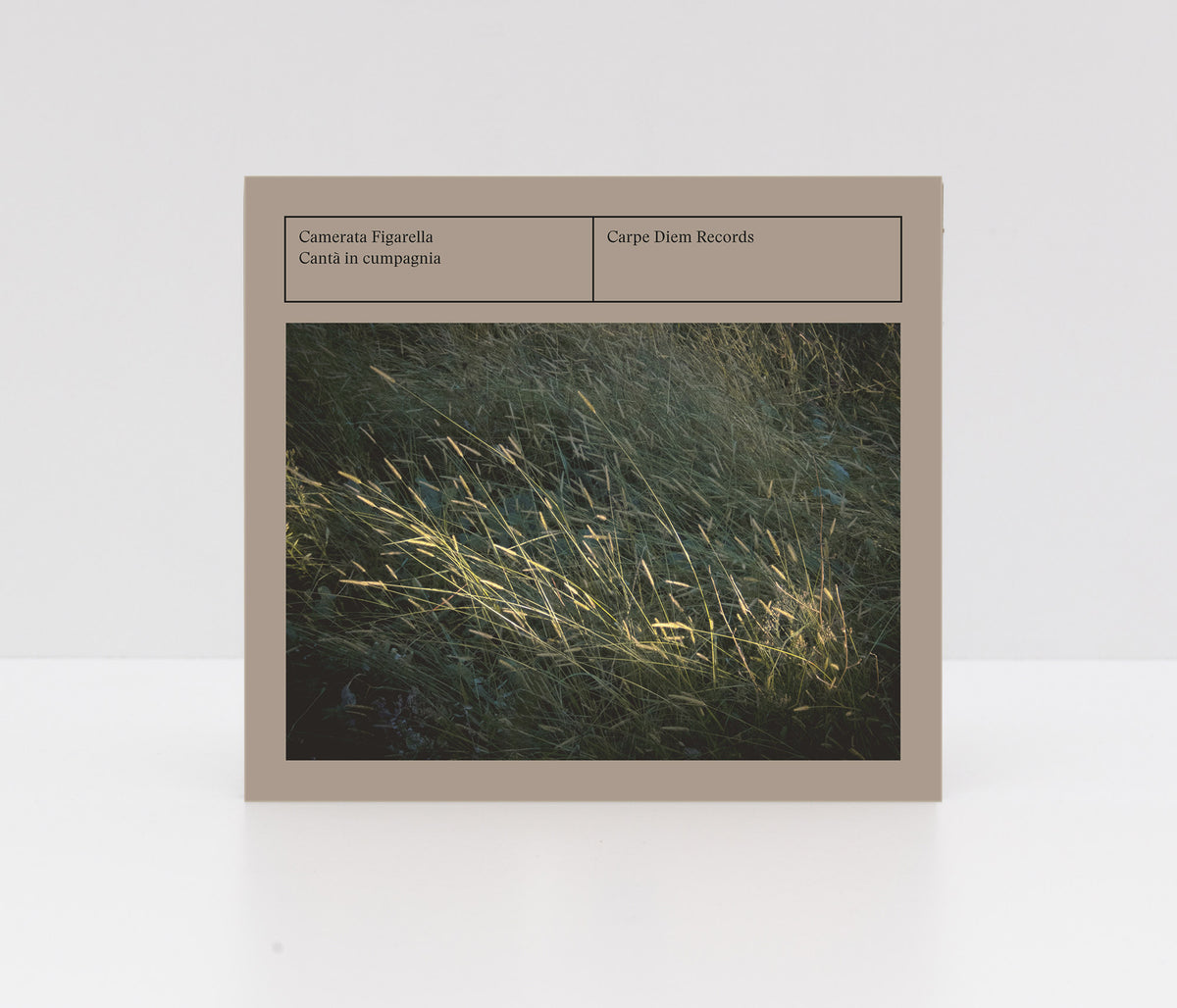
Cover image: Raphaël Poletti
Booklet photography: Lauriane Maudry (p. 3), Jonas Niederstadt (all others)
Corsican translation: Stella Retali Medori
Corporate Design: Tim+Tim, timandtim.com
Produced by Jonas Niederstadt
© 2026 Carpe Diem Records