


Bach & Castelnuovo-Tedesco: Guitar Music
Bach & Castelnuovo-Tedesco: Guitar Music
Couldn't load pickup availability
Luise Neumann – guitar
About the album
This is the second solo album of the young German guitarist Elise Neumann. She chose to combine two seemingly very different composers on this album: J. S. Bach and Mario Castelnuovo-Tedesco. The latter also wrote music in form of the suite, just as Bach, but his musical ideas are completely different.
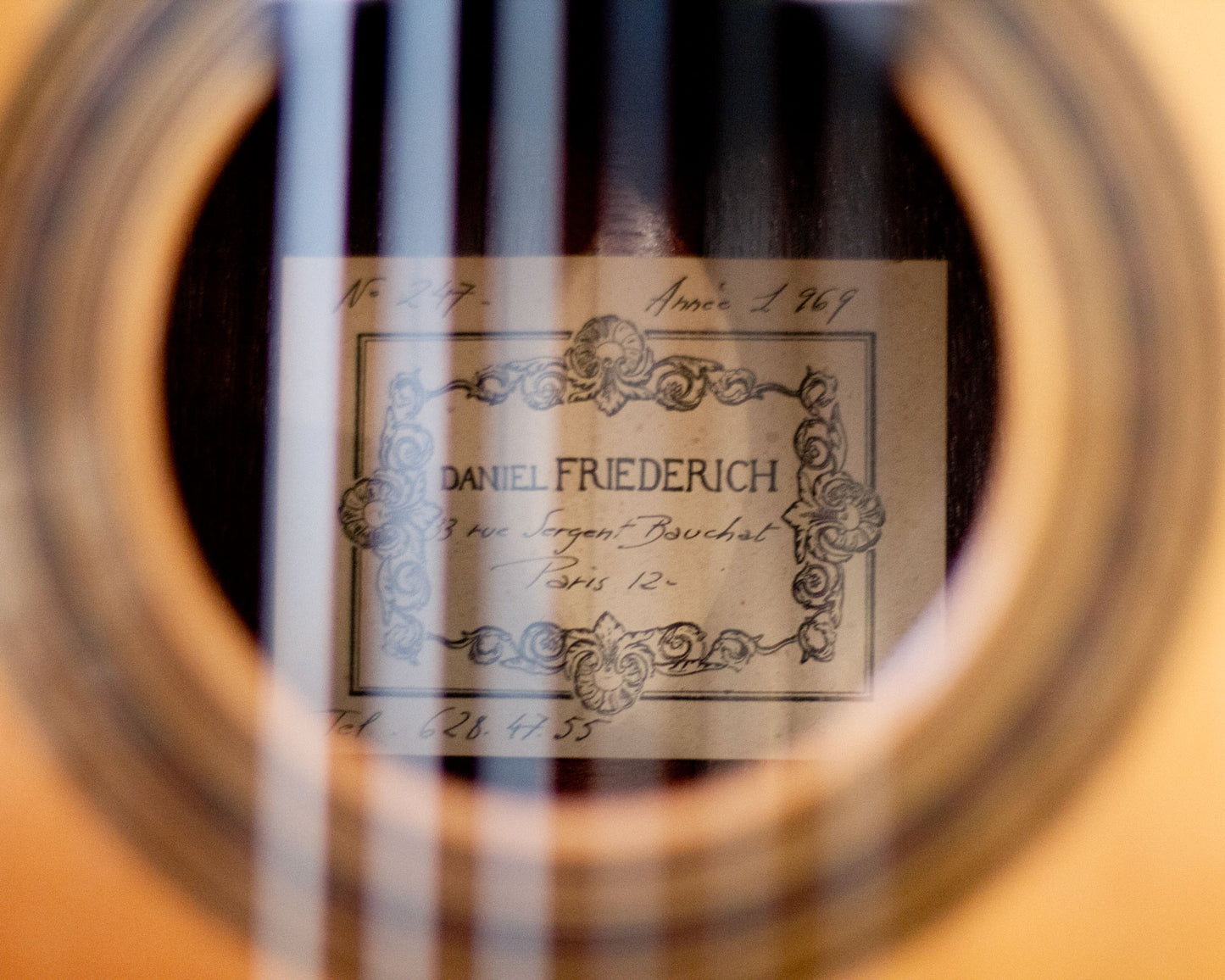
Elise Neumann plays with her acclaimed warm and soulful tone on a rare instrument built by the luthier Daniel Friederich in 1969. On this recording, instrument and player form a perfect team, establishing a most natural, effortless and deeply musical interpretation of these well-known works.
Release date:
Catalogue number: CD-16315
Share


More album information
tracklist
Tracklist of "Bach & Castelnuovo-Tedesco: Guitar Music"
Johann Sebastian Bach (1685–1750)
Suite c-Moll BWV 997
01. Prelude 3:49
02. Fuga 8:15
03. Sarabande 4:26
04. Gigue & Double 6:57
Mario Castelnuovo-Tedesco (1895–1968)
Escarramán – A Suite of Spanish Dances from the XVIth Century (after Cervantes) op. 177
05. Gallarda 3:45
06. El canario 3:52
07. El villano 3:20
08. Pesame dello … 4:48
09. El Rey Don Alonso el Bueno 4:45
10. La guarda cuydadosa 4:23
11. Capriccio Diabolico op. 85 10:17
total time 58:43
booklet text
“To give a guitar a beautiful voice, a beautiful sound, that is the work of a lifetime.” Daniel Friederich
Born on January 16th 1932 in Paris, Daniel Friederich initially followed in the footsteps of his father, Léon, and grandfather, Mathias, by learning the cabinet-making trade. The Friederich family had a long tradition as wheelwrights in the Parisian neighbourhood of Faubourg Saint-Antoine, an area famous for its wood and furniture craftsmen. Despite being one of the 11 best of 400 woodworking apprentices in his year, Daniel Friederich soon developed the wish to change direction and become a luthier, specialising in guitars. Although his father was initially sceptical, the quality of Daniel Friederich‘s first guitar convinced him and he supported Daniel by helping him to set up his own workshop. The legendary French luthier, Robert Bouchet, also had a key influence on the young instrument maker.
Daniel Friederich spent over 60 years crafting superior instruments which have been played by discerning guitarists around the world. In 2012 he was awarded the Industry Leadership Award by the Guitar Foundation of America. Martha Masters, President of the Guitar Foundation of America, marked the occasion of his acceptance into the GFA Hall of Fame with the following words: “Your extensive work in the world of guitar and your devotion to your craft have influenced the entire world of luthierie, and inspired countless guitarists.”
Friederich guitars are known for their exquisitely deep and harmoniously balanced character, producing a rich tone which continues to unfold to greater fullness long after the strings have been played.
Bach & Castelnuovo-Tedesco
Johann Sebastian Bach (1685–1750) and Mario Castelnuovo-Tedesco (1895–1968) – two widely differing musical poles. The marriage of these two worlds in one recording is an unconventional and ambitious project. This is without doubt a challenging but rich and rewarding combination, which shows the full potential of the instrument and allows the guitar to fully accentuate its depth, balance and sustained quality of sound.
The Suite in C Minor BWV 997, also known as the Partita for lute, lute-harpsichord or harpsichord, has been the cause of many musicology disagreements. Although there is no longer an original manuscript available, there are a wide variety of copies. It is not certain on which instrument Bach intended the Suite to be played and the untypical setting poses many questions. Although Baroque suites were usually composed around a standard core of four movements (Allemande – Courante – Sarabande – Gigue), only the latter two of these exist in this case. One special detail is the relatively extensive Da Capo Fugue, reminiscent in its length of Bach‘s violin sonatas, which is then balanced out by the subsequent slow movement in a relative key. The Prelude, one of the most well-known by Bach, the Fugue and also the Sarabande all begin with the same tonal material. The initial theme of the Sarabande evokes memories of the final chorus of the St. Matthew Passion (“Wir setzen uns mit Tränen nieder”). Gigue and Double –two movements with the same harmonic structure– form a contrast to the depth and weight of the preceding movement. Johann Mattheson, a contemporary of Bach, describes the key in which this Suite is played as “a delightfully sweet but melancholy tone”.
Originally a pianist, Mario Castelnuovo-Tedesco later also wrote music for the guitar and left a technically demanding repertoire for this instrument of exquisite artistic quality. His works frequently reflect his own struggle to process the trauma of escaping persecution to live in exile. As in the case of his ancestors, traceable back to the 15th century, who emigrated from Spain to Italy during the persecution of the Jewish people, he was destined for a similar flight in 1939, leaving Italy for America. This reliving of his family’s history gave Castelnuovo-Tedesco an affinity for Spanish culture and literature. When setting the Escarramán to music, Castelnuovo-Tedesco based it on the form of a Suite, while also picking up on traditional Spanish dance styles, such as Galliard or Canarie, and freely combining these elements.
Escarramán was a figure of the underworld in Siglo de Oro (Spanish literature), mentioned also by Miguel de Cervantes (1547-1616) in his Entremeses. During the time of Cervantes, the Entremeses served as an interlude in Spanish plays, inserted between two acts and often culminating in a musical and dance performance. Although interludes of a more primitive type were more common, those by Cervantes were minute works of art with fine satirical undertones. Their artistically more demanding tone may have been the reason why they were never performed, although Cervantes did have the Entremeses printed. Mario Castelnuovo-Tedesco was primarily inspired by the Interlude of the Widowed Ruffian Trampagos when composing a work for guitar. The final passages of this tale break into a dance for two guitars and Escarramán – actually a rogue, who stole from the rich to give to the poor, but who was also known as an excellent dancer, demonstrates his skills during Galliard, Romance, Canario etc.. In his Suite, Castelnuovo-Tedesco does not set these dances in the style of that era but instead as short, musical tales with his own special type of composition.
He once was chained to heavy oars
And doomed to die there on a ship.
To their surprise and his good luck,
Escarramán gave them the slip.
He’s back again to show the world
His strength and quickness on the floor.
His fancy moves, his royal airs,
He’s here to stay forever more.
(…)
Whatever you want we will play;
The “Leg-Swing”, the “Canary Jig”,
The “Country Rigadoon”;
The “Saraband”, the “Sambapale”,
The “I’m so sorry” and more,
The dance of “Good King Don Alphonse”.
Escarramán:
Now play something a little slower, and I will dance a solo.
Musician:
I’ll play like silver so you can dance like gold.
(Miguel de Cervantes)
In 1932, Mario Castelnuovo-Tedesco met the Spanish guitarist Andrés Segovia in Venice. They developed a friendship, which inspired numerous compositions for the guitar. The Capriccio Diabolico was written three years later – it is dedicated to Segovia, who requested an Homage to Paganini from Castelnuovo-Tedesco. Niccolò Paganini (1782–1840) was also a virtuoso on the guitar and composed musical works for the instrument. His knowledge of guitar technique influenced his violin playing – through the transfer of his skill in guitar technique to the violin, he was able to create what is frequently noted as the diabolic effect of his violin performances in conjunction with the theatrical presentation of his shows. Castelnuovo-Tedesco’s Capriccio Diabolico focuses less on highlighting virtuosity and impresses more with its lyrical, melancholic passages. This is not an imitation of Paganini but only a reference to him at the end of the work, with a brief theme from the violin concerto No.2 op. 7 “La Campanella”.
An anecdote about the instrument
My father found an old, Italian guitar in a friend‘s attic. He was able to buy it from him and began to teach himself to play the instrument. His passion and enthusiasm for the guitar allowed him to practice for hours, forgetting the time. One Christmas Eve, my grandfather called him to table three times, only to hear him still plucking his guitar. In a fit of anger, Grandfather climbed the stairs to my father‘s room, grabbed the guitar from him and hit him over the head with it. The instrument broke into many tiny pieces. The same evening, they sat together at the table, trying to sort the tiny pieces and glue the guitar back together. Despite this, the guitar continued to play a role in our family.
Later on, when my father met my mother and asked her about her work, the subject came up again and memories were rekindled. Many years afterwards, as my grandfather asked me what I intended to study, we returned to the matter once more, although he did his best to convince me to choose the piano. My parents and I were looking for a new instrument for me at that time, one that could fulfil the requirements for competitions, studies, concerts, chamber music etc. We travelled a great deal to try out instruments and by chance we received a message from a dealer who had just added two beautiful instruments to his collection: an R. Jacob Weißgerber and the Daniel Friederich guitar.
We drove there together and played both guitars. The Friederich guitar was like a queen of instruments, surpassing all other guitars in the quality of its sound. On the other hand, it required intense work to really reveal these qualities. We would have been prepared to face this challenge and my father would have been happy to fulfil this wish for me and my mother. However, I found that it would not be appropriate to simply receive a gift of such value and so I decided not to take it.
On the way back, none of us spoke. We were still enraptured by the sound of these two special guitars, relishing the feeling of playing them and questioning the wisdom of our decision. Secretly, each of us dreamed about these guitars.
A few days later, my father returned from a business trip and to our great surprise, took both of those guitars out of the car: the Weißgerber and the Friederich, for my mother and I..
Lübeck, February 2018
Elise Neumann
recording information
Guitar by Daniel Friederich, built 1969, No. 247, spruce-rosewood
Recorded September 17-19, 2017
Recording location: Schloss Borbeck, Essen, Germany
Balance engineer & recording producer: Jonas Niederstadt
Corporate design: Tim+Tim, timandtim.com
Cover photography: Leif Marcus
Booklet photography: Leif Marcus (p.3, 13), Jonas Niederstadt (p.21)
English translation: Bridget Gerstner
© 2018 Carpe Diem Records
press reviews
American Record Guide
"BACH, J.S.: Lute Suite, BWV 997 (arr. for guitar) / CASTELNUOVO-TEDESCO, M.: Escarramán / Capriccio diabolico (E. Neumann) CD-16315
Guitar Recital: Arlotti, Renata - CASTELNUOVO-TEDESCO, M. / ASENCIO, V. (Suites and Homages) STR37079
I love this man’s music and have played lots of it and read through lots more. But the Suite Escarraman is new to me. I don’t recall ever having heard it performed, nor do I have the score. Now we have two performances—and very fine ones.
The work has the subtitle ‘A Suite of Spanish Dances from the XVIth Century (after Cervantes)’. Only 3 of the 6 movements are named for dances, and none has any real dance character. It is “after Cervantes” only broadly, evoking antique sounds without any specificity. It is delightful music—perhaps not among his very finest works, but certainly worth knowing and performing. The music is sunny, charming, inventive—there is often a sense of programmatic content, though nothing specific can be understood from the titles alone.
And both artists give us superb performances. Arlotti has a somewhat better and more varied sound, Neumann has a somewhat more perceptive interpretation, but it’s impossible for me to pick one over the other. You won’t go wrong with either.
Neumann adds in a fine, if not especially transcendent, Bach C-minor Suite—clear counterpoint, smooth, effortless playing, expressive without any exaggeration. I still prefer a more distinct personality, as in Jason Vieaux’s Azica disc (J/A 2009) or Scott Tennant on GSP, though that seems to be deleted. Neumann also adds one of Castelnuovo-Tedesco’s greatest works, the Capriccio Diabolico. It’s a fiery performance, very free in the slower passages—too much for my taste (though it is an homage to Paganini, after all). It stands at the top of performances I know. […]
Both artists are young—Arlotti is making her debut recording. And both are students of Oscar Ghiglia, though Arlotti seems to be a real protege, and Ghiglia offers a glowing (and well-deserved) introduction. Neumann’s primary teacher is Franz Halasz, and she is already well established, winning prizes for the last decade and teaching for Lubeck University.
So, how to choose? Both are full price, so that’s no help. As for the couplings, I’d have to give Arlotti a slight edge for including several works by Asencio, but then there’s Neumann’s Capriccio Diabolico. So cough up the bucks and spring for them both. You’ll thank me." © 2018 American Record Guide