


Viennese Lute Music
Viennese Lute Music
Verfügbarkeit für Abholungen konnte nicht geladen werden
Der Lautenist Toyohiko Satoh spielt Musik vom Wiener Hof um 1700. Eine besondere Entdeckung ist die Suite von Adam Franz Ginter, der zu dieser Zeit ein berühmter Kastratensänger war, aber auch einige Stücke für die Laute komponierte. Diese Aufnahme ist eine Hommage an diesen weitgehend vergessenen Musiker, der wahrscheinlich ein kurzes und eher trauriges Leben hatte. Die folgende Suite von Saint-Luc enthält ein "Tombeau für Francois Ginter" und wurde komponiert, um den frühen Tod dieses außergewöhnlichen Sängers, Lautenisten und Komponisten zu beklagen.
Musikvideo
Hier spielt Toyohiko Satoh die Allemande E-Moll von Adam F. Ginter:
Erschienen am:
Katalognummer: CD-16317
Share


Mehr Infos zum Album
tracklist
Tracklist von "Viennese Lute Music"
François (Adam Franz) Ginter (1671–1706) F. ギンター
Suite in E minor 組曲: Eマイナー
01. Allemande アルマンド 4:00
02. Courante クーラント 2:49
03. Sarabande サラバンド 3:01
04. Menuet メヌエット 1:28
05. Bourée ブーレ1:44
06. Gigue ジグ3:21
Jacques-Alexandre de Saint-Luc (1663–ca. 1710) J. de サン・リュク
Suite in F-sharp minor 組曲: F#マイナー
07. Tombeau de Mr. François Ginter フランソワ・ギンタ―氏に捧げるトンボー4:24
08. Courante クーラント2:25
09. Sarabande サラバンド3:55
10. Gigue ジグ3:07
11. Gavotte ガヴォット1:36
12. Menuet メヌエット1:54
Johann Georg Weichenberger (1676–1740) J. G. ヴァイヒェンベルガー
Suite in G major 組曲: Gメジャー
13. Prelude プレリュード3:00
14. Allemande アルマンド4:34
15. Courante クーラント2:57
16. Bourée ブーレ1:59
17. Menuet en Rondeau ロンド風メヌエット2:27
18. Sarabande サラバンド3:02
19. Gigue ジグ2:41
20. Paysanne ペイザンヌ2:11
Anonymous (18th C.) 作者不詳
21. Siciliana / Adagio シチリアーナ (アダージョ)5:37
Total time 62:24
Booklet-Text
Viennese lute music
When one thinks of Vienna, the capital of classical music, brilliant images appear of the Viennese boys’ choir, of Mozart, Johann Strauss and others. The Viennese boys’ choir nowadays consists not only of Austrian boys, but of young boys with beautiful voices from a number of different countries. These boys can preserve their beautiful high voices until the time of their puberty vocal change around the age of 15. Some centuries ago, in order to preserve this voice for their entire lifetime, castrations were carried out on boys before the time of their change of voice. This culture of creating male sopranos, also called castrates, was mainly found in Italy.
Of course, nowadays this practice has been abandoned. Castrates showed an impressive appearance, having a male body with smooth skin and no beard. With their angelic high voices they were regarded holy creatures, unifying god, man and music. Nevertheless, only a few castrates made it to this splendid life of fame and fortune. The majority of them had been castrated by will of their parents in the hope of escaping bitter poverty. Some sources say that during the baroque era, around 4000 boys annually underwent the operation. But, by now I got sidetracked a little. While there was this glorious boys’ choir at the royal court, what was actually going on in the lute world during that time?
This recording begins with music by Francois Ginter (1671-1706), whose real name was Adam Franz Ginter, a soprano singer at the royal boys’ choir of Vienna. Ginter, who was born in Vienna and had a beautiful voice since he was a young boy, became a castrato when he was around fifteen years old. As he was not a very pretty boy, people around him disapproved of this idea, but his father decided to have the castration be carried out anyway. Almost no records are left of Ginter’s activities as a castrato, but it seems that he also was a lute player. From the fact that the back-then very famous Viennese lutenist Saint-Luc dedicated a Tombeau to Ginter, we can conclude that he must have been a noticeable lutenist in his own right. Only a few of Ginter’s compositions have remained to the present day, and among them only one complete suite survived; the Suite in E minor. The bodies of castrates generally grew abnormally large due to the hormonal imbalances, and they were said to often have short lives. Ginter died at the age of 35. He probably wrote this suite in his final years, even though he was actually still quite young. As a human who had to bear the heavy fate of being a castrate, this suite is a deeply touching composition with profound and complex ideas. To me it does not sound at all like the composition of a 35-year old musician, but rather like the work of a 70-year old lutenist. If Ginter would not have become a castrate but a lutenist instead, maybe he would have lived much longer and might have composed many more of these wonderful suites. This suite is composed of six dances: Allemande, Courante, Sarabande, Menuet, Bourée and Gigue. The last piece is a so-called “Allemande giguée” – a Gigue in Allemande style, which is basically a Gigue in a slower tempo. Similarly to the well-known Gigue “Testament de Mesangeau” by Vieux Gaultier (Ennemond Gaultier), this Gigue might have represented Ginter’s own testament.
Around 1700, Vienna attracted many lute players, including the famous Jacques-Alexandre Saint-Luc. In Vienna he was seen as equal to Sylvius Leopold Weiss (1687-1750), one of the most famous lutenists in Europe at that time. Saint-Luc, who was born in Brussels in Belgium, served shortly at the court of Louis XIV in Paris before he travelled through Berlin to Vienna in 1700 to serve Prince Eugen von Savoyen. Prince Eugen came from a noble family in France and served the court of Vienna. He won many wars against the Ottoman Turkish and French armies. Saint-Luc composed the “Tombeau de Mr. François Ginter”, a Tombeau dedicated to Ginter. This is the first piece of his Suite in F sharp. The reason why he didn‘t use Ginter‘s German name “Adam Franz”, but instead wrote the French version “François”, is because the Tombeau was one of the most important musical forms in 17th Century’s France. Saint-Luc was famous for composing light melodic pieces, but in this suite, he didn‘t make use of the high note range of the instrument at all. It is as if the music is looking back on Ginter‘s rather sad fate as a soprano singer. According to some researchers, Saint-Luc was born in 1616 and died in 1717. In a different manuscript this Tombeau is named “Tombeau sur la mort de Mr. François Ginter” and states more clearly that it was composed to mourn the death of Ginter (1706). In this case, Saint-Luc would have been 90 years old at the time of writing the piece. This would have been quite sensational if it was true, but I don’t find it very likely. There is unfortunately no record of such a remarkable thing. Under the family name of Saint-Luc, we find such diverse first names as Jaques, Jaque-Alexandre, Laurent and others, so we cannot know for certain how many different persons these were. Here I used the name Jacque-Alexandre from the cover title of the Prague manuscript. The Suite in F sharp consists of six pieces: Tombeau (Allemande), Courant, Sarabande, Gigue, Gavotte, and Menuet. The Courant and Menuet in the suite are “sans chanterelle”, which means they are composed without using the first string of the lute. Especially the Menuet is a dark, fantastical piece.
The next suite, which is bright and colorful in contrast to the previous one, is composed by Johann Georg Weichenberger (1676-1740). Weichenberger was a lutenist born in Graz, Austria and later worked as a bookkeeper at the Viennese court. At that time is was not rare to have a second profession besides being a musician. Apart from church organ players and court musicians, there were not many who worked exclusively as musicians. Some of Weichenberger‘s early works are influenced strongly by the French style just like Ginter and Saint-Luc, but this suite is written in Gallant Style similar to the works of S. L. Weiss. It is thought that Weichenberger composed the suite in his later years. When Weiss started using a 13-course lute around 1720, this instrument became extremely popular in the German speaking areas of Europe. Weichenberger, who was only 10 years older than Weiss, remained using his 11-course French lute until the end of his career. His works are characterized by the beautiful melodies. The suite consists of six pieces: Allemande, Courant, Menuet en Rondeau, Sarabande, Gigue and Paysanne. In this recording I added a prelude from a different manuscript to the beginning of the suite. The style of the Menuet already foreshadows the emergence of Mozart in the near future.
The last piece of this recording is a Siciliana in E minor by an unknown composer. Siciliana is a dance piece that originates from the island Sicily. It is a calm piece that might remind us of a boat floating on the Mediterranean Sea on a sunny day. The tempo indication for this piece is “Adagio”. We don‘t know who composed the piece, but from the harmonic style and the tempo indication, one could estimate that it was composed around the beginning of the 18th century. This beautiful piece gives us a glimpse of how Vienna would flourish as the capital of classical music in Europe from the end of the 18th century all the way into the 20th century. The piece is taken from a manuscript preserved in Vienna.
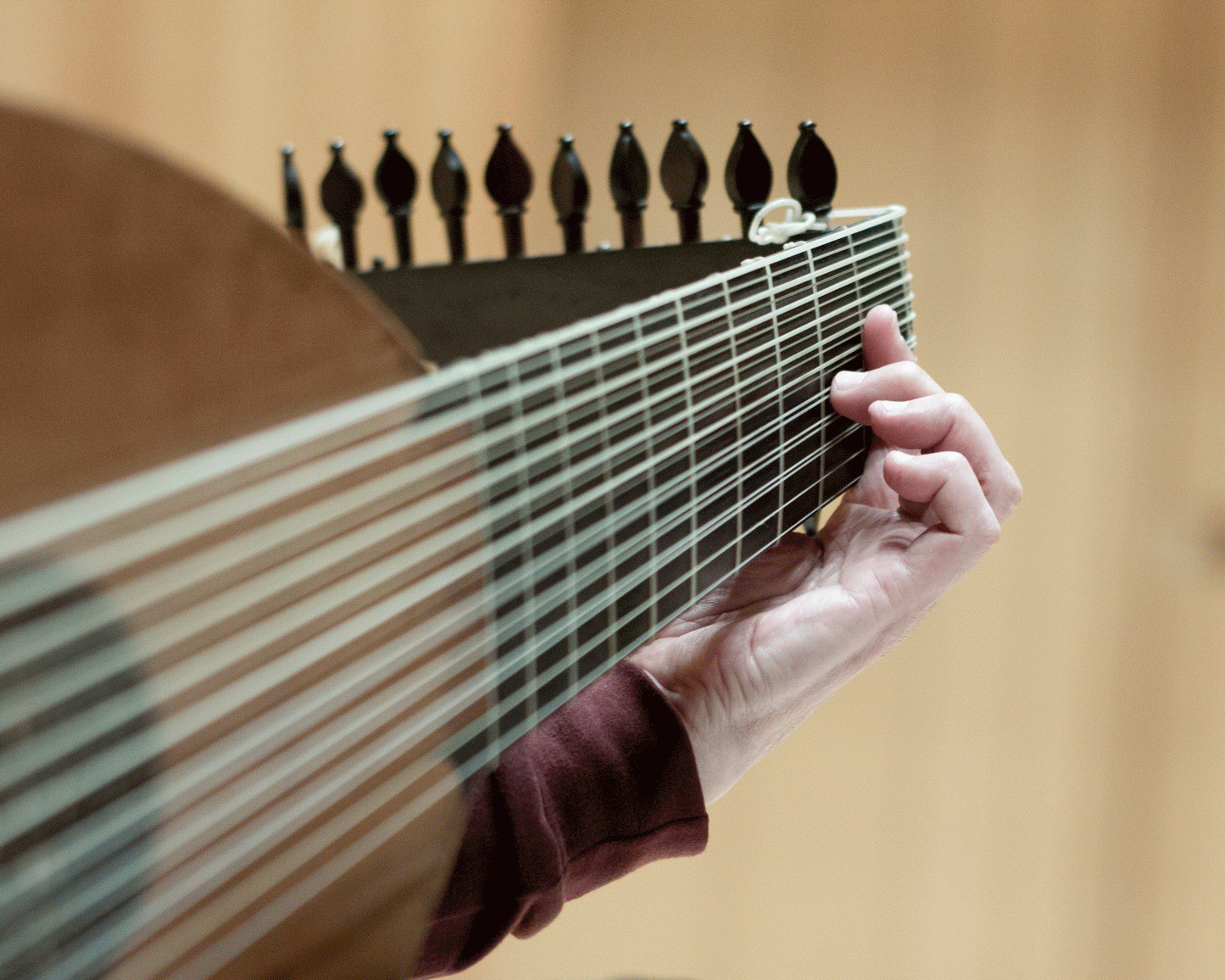
The original lute used for this recording is not from Vienna. It was built in Ingolstadt, Germany by Laurentius Greiff in 1611. It was originally a renaissance lute, and was rebuilt into an 11-course French baroque lute in 1673. It was then kept in a castle near the Austrian border until the end of the 20th century. There might be a chance that one of the many lutenists who gathered in Vienna in the 17th century played on this lute. I think this somewhat nostalgic idea goes along with the atmosphere of the works gathered on this CD.
Toyohiko Satoh, Arao 2018
Informationen zur Aufnahme
Recorded November 14-16, 2017
Location: Kirishima International Concert Hall “みやまコンセール” (Japan)
Balance engineer & recording producer: Jonas Niederstadt
Corporate Design: Tim+Tim, timandtim.com
Cover photography: Marion Denis
Booklet photography: Jonas Niederstadt
Translations: Miki Satoh / Jonas Niederstadt
Produced by Jonas Niederstadt
© 2018 Carpe Diem Records
Presse / Rezensionen
American Record Guide
„Dies ist ein wunderschönes Programm, das der Wiener Lautenmusik des Hochbarocks gewidmet ist – Musik, die zwischen den letzten Jahrzehnten des 17. und den ersten Jahrzehnten des 18. Jahrhunderts komponiert wurde. Jacques-Alexandre de Saint-Luc (1663–ca. 1710), dessen Suite in fis-Moll Satoh hier spielt, ist der einzige der vier Lautenisten, die in diesem Programm vertreten sind, der jemals für König Ludwig XIV. gearbeitet hat, unter den großen Lautenisten, die in Versailles spielten. Dennoch scheint der Großteil der Musik in diesem Programm von der französischen Lautenschule beeinflusst zu sein. Die melancholische Suite in e-Moll von François (Adam Franz) Ginter (1671–1706) trägt mit ihren ausdrucksstarken Appoggiaturen und anderen raffinierten Figurationen den Stil der zeitgenössischen französischen Musik. Das Programm umfasst außerdem die Suite in G von Johann Georg Weichenberger (1676–1740) und eine anonyme „Siciliana” aus dem 18. Jahrhundert.
Toyohiko Satohs Spiel ist subtil und voller Gefühl. Die Emotion seiner bewegenden Hommage an François Ginter scheint sich auf sein Spiel zu übertragen. Das Tempo der Musik, die Art und Weise, wie er bestimmte harmonische Progressionen und Wendungen beibehält, und die Art und Weise, wie er eine Melodie weiterführt, scheinen die Seele ihres Schöpfers zu erreichen." © 2019 American Record Guide
Scherzo-Magazin
„Toyohiko Satoh muss man mittlerweile nicht mehr vorstellen. Er ist allen als einer jener japanischen Musiker bekannt, die fast von Anfang an Teil der Gruppe junger Pioniere waren, die das Verständnis der Barockmusik für immer verändert haben. Ob als Solist oder als Teil des Basso continuo einer Reihe spezialisierter Ensembles, er blickt auf eine lange und solide Karriere als Aufnahmekünstler zurück, die er nun, da er seine blühenden Jahre hinter sich hat, gelegentlich mit einigen einzigartigen Veröffentlichungen ergänzt. In diesem Fall hat er einige sehr ungewöhnliche Musikstücke von Musikern ausgewählt, die Ende des 17. und in der ersten Hälfte des 18. Jahrhunderts im kaiserlichen Wien lebten.
Der erste davon ist Adam Franz Ginter (1671-1706), ein Wiener Sänger, der im Alter von 15 Jahren kastriert wurde und auch einige Kompositionen für Laute hinterlassen hat, wie die hier ausgewählte Suite, die einzige seiner Kompositionen, die vollständig erhalten geblieben ist und die Komplexität und Tiefe offenbart. Der Belgier Jacques-Alexandre de Saint-Luc (1663–ca. 1710) kam bereits als berühmter Musiker nach Wien und genoss dort wohlverdiente Popularität. Seine eher leichte Musik wurde sehr geschätzt, aber das hier ausgewählte Werk, das mit einem Tombeau beginnt, das genau dem Andenken an Ginter gewidmet ist, ist eher nachdenklich und intim. Johann Georg Weichenberger war Lautenist – und auch Buchhalter in der kaiserlichen Verwaltung –, wurde in Graz geboren und besaß einen bemerkenswerten Sinn für Melodien, der sich in der hier ausgewählten Suite perfekt widerspiegelt. Das Album schließt mit einem wunderschönen anonymen Tanzsatz (Siciliano), den Satoh wie den Rest des Albums mit zurückhaltender Emotion, Gelassenheit, Tiefe und Musikalität interpretiert, die alle das Ergebnis seiner reichen Erfahrung als Interpret sind. Ein sehr schönes Album, das Liebhaber von Zupfmusik zu schätzen wissen werden." © 2019 Scherzo