


La Rhétorique des Dieux
La Rhétorique des Dieux
Verfügbarkeit für Abholungen konnte nicht geladen werden
Erschienen am:
Katalognummer: CD-16331
Share


Mehr Infos zum Album
tracklist
Tracklist von "La Rhétorique des Dieux"
Suite A major 組曲Aメジャー
01. Prélude プレリュード 1:26
02. Allemande ‘Andromede’ アルマンド「アンドロメダ」 3:15
03. Courante ‘La Coquette virtuosa’ クーラント「貞潔な浮気女」2:33
04. Gigue ‘Atalante’ ジグ「アタランテ」1:43
05. Chaconne en Rondeau ロンド風シャコンヌ5:11
Suite D major 組曲Dメジャー
06. Pavane ‘La Dedicasse’ パヴァーヌ「献辞」4:53
07. Courante ‘Minerve’ クーラント「ミネルウァ」2:37
08. Sarabande サラバンド2:49
09. Gigue ‘La Panegirique’ ジグ「賛辞」2:29
Suite F major 組曲Fメジャー
10. Allemande ‘Appolon’ アルマンド「雄弁家アポロン」3:52
11. Courante クーラント & ドゥブル4:03
12. Sarabande ‘Diane au bois’ サラバンド「森のディアーナ」3:57
13. Canarie カナリー3:45
Suite A minor 組曲Aマイナー
14. Prélude プレリュード1:25
15. Allemande ‘Orphée’ アルマンド「オルぺウス」4:21
16. Courante ‘L’Homicide’ クーラント「悩殺美人」3:15
17. Sarabande サラバンド3:24
18. Gigue ‘Eco’ ジグ「エコー」2:26
19. ‘La Resolution des amis du S’Lenclos sur sa mort’ 友人ランクロの死への解答 4:27
Booklet-Text
La Rhétorique des Dieux
The music of this solo album originates from a manuscript compiled around 1652, titled La Rhétorique des Dieux (The Eloquence of the Gods). The title refers to Greek and Roman mythology. Most of the pieces are composed by Denis Gaultier (1603–1672), and a few by his cousin Ennemond Gaultier (1575?–1651). I imagine that the creator of this collection (maybe Denis Gaultier’s patron) attempted to draw a connection between Gaultier’s mid-17th century music and the roots of European culture; Greece and Rome.
The parchment manuscript has a magnificent preface in the form of a sonnet and contains stunning images. The most striking feature of the music of this collection is the absence of many of the ornamentations typical of 17th-century French lute music. Almost none of the pieces have ornaments, and quite a few do not even have titles. It may be natural to assume that this collection is unfinished. However, I felt a rather subtle “simplicity that leads to the heart” or, as they say in Japan, the spirit of nothingness, which is the essence of Zen. Maybe the creator of the collection felt too intimidated to add embellishments to the already marvelous compositions and wanted to present the works in their purest form.
To begin with, I would like to take a closer look at track no. 15 of this recording, Allemande Orphée. Orpheus is a bard in Greek mythology and a master of the lyre. Shortly after his marriage, the lyre virtuoso Orpheus loses his beloved wife, Eurydice. Unable to forget her, he uses his lyre-playing to descend to the underworld to bring her back. The king of the underworld, moved by his performance, allows Eurydice to return to earth on the condition that Orpheus does not turn around to look at her until they both reach the upper world. As Orpheus nears the exit, he becomes anxious when he does not hear footsteps behind him and turns around. At that moment, Eurydice gets pulled back into the depths of the underworld. Returned to earth, Orpheus continued to play his lyre and sang songs of lamentation until his death, and the lyre was placed in the sky by Zeus. This story is similar to the tale of Izanagi and Izanami in the Japanese Kojiki compiled by Ohno Yasumaro in 712 AD. Similar legends are probably found all over the world. The Allemande Orphée contains a famous melody from Lachrimae (known as Flow my tears in lute songs) by John Dowland (1563–1626), the greatest lute master in Europe around 1600. The melody is difficult to recognize when played with ornamentation (see example p.14). The lyrics of Flow my tears could be interpreted as a lamentation of Orpheus returning to earth from the underworld.
Of course, not all of the compositions in this collection are of sorrowful nature. Track no. 2 is named Andromeda, a woman from Greek mythology who later became a stellar constellation. Atalante, a swift-footed female hunter known for her beauty, appears in track no.4. The god of art Apollo appears in track no. 10, and track no.18 is named Echo, an oread who fell in love with the beautiful young man Narcissus. She received a punishment that prevented her from speaking her own words and forced her to repeat the last part of any sentence spoken by anybody else. Out of roman mythology, we have the god of art Minerva in track no.7 and the goddess of the moon, Diane, in track no.12.
Track no.3 La Coquette virtuosa is a wonderfully lush and secular piece. The style is similar to the Volte, a very slow-tempo dance popular at the French court in the early 17th century. Track no.16 Courante L’Homicede is similarly jocular. Some are more personal compositions, such as the last track no.19 La Resolution des amis du S’Lenclos sur sa mort. Track no.6 Pavane La Dedicasse and no. 9 Gigue La Panegirique have footnotes mentioning that these pieces are expressions of Gaultier’s reverence for the gods.
This approach of referring to deities beyond time and culture would have been similar to the ancient Japanese Shinto practice. Such a phenomenon was rare during the Christian monotheistic period in Europe, especially in Catholic France. Because I saw the Zen mind of nothingness in this music, I chose to ornament only the repetitions of most pieces. The two preludes without repetition are performed entirely without ornamentation. Strangely enough, I get a better impression of the music when playing it without embellishments, as I can recognize the essence and origin of the composition. I added a P.R. (petite reprise) at the end of most pieces and played the last few bars without ornamentation again.
It used to be a mystery to me why most of these 17th-century French pieces are so short. My doubts dissolved after I started playing them as slowly as possible. If one plays at a slow tempo and expresses each note with nuance and timing, these pieces are not at all short, and it makes little sense to invent even longer compositions. I consider this to be the point where the 17th century French “Style Brisée” differs fundamentally from the later “Gallant style” with its many sequences (repetitive progressions).
The eight million gods of the Japanese Shinto tradition are not only sacred, but also symbolize the pleasures and pains of life. However, if one person is to live their life in a certain way, it is necessary to have a certain direction. There is a saying, Issen koushin ni ataru, which translates to With a single arrow, hit the goal of life in the middle of the heart. In other words, it means to follow what you believe and feel throughout your life. I expect this to be a common philosophy among educated people, especially artists, regardless of whether they are from the East or the West.
The Japanese buddhist practice Zazen implies sitting quietly in an upright posture, observing oneself, pouring heart and soul into a single task, discarding attachments and assumptions and being able to perceive with a mind free from distractions. This mind might be the first step in looking at (and playing) a piece of this music without embellishment. And then, I believe that to perform it beautifully and embellished becomes the “art of eloquence”.
Postscript:
La Rhétorique des Dieux contains twelve parts, each named after one of the Greek modes. However, there is no music for the Lydian mode (scale starting from F). The reason may be that the interval between the keynote and the fourth note in this melody is an augmented interval called the “chord of evil” in medieval Europe. Be that as it may, when I look at the pieces assigned to the other melodies, I do not fully understand the meaning of their association. Furthermore, if the collection were to refer to Greek and Roman culture, the Pythagorean tuning, a tuning method devised by Pythagoras in the 8th century B.C. should be used. This tuning method was only understood in Europe about 2,000 years after its invention (around the 10th century A.D.). However, the Pythagorean tuning system was not used anymore in 17th century Europe because the relationship between # and b in this tuning system is the exact opposite. I have attempted to perform these pieces in Pythagorean tuning. It is practically impossible, though, when looking at the music of Denis Gauthier and other lute players of that era. This aspect of La Rhétorique des Dieux remains a question I have not been able to resolve, but this also makes this collection unique.
Toyohiko Satoh
Arao, February 2023
Informationen zur Aufnahme
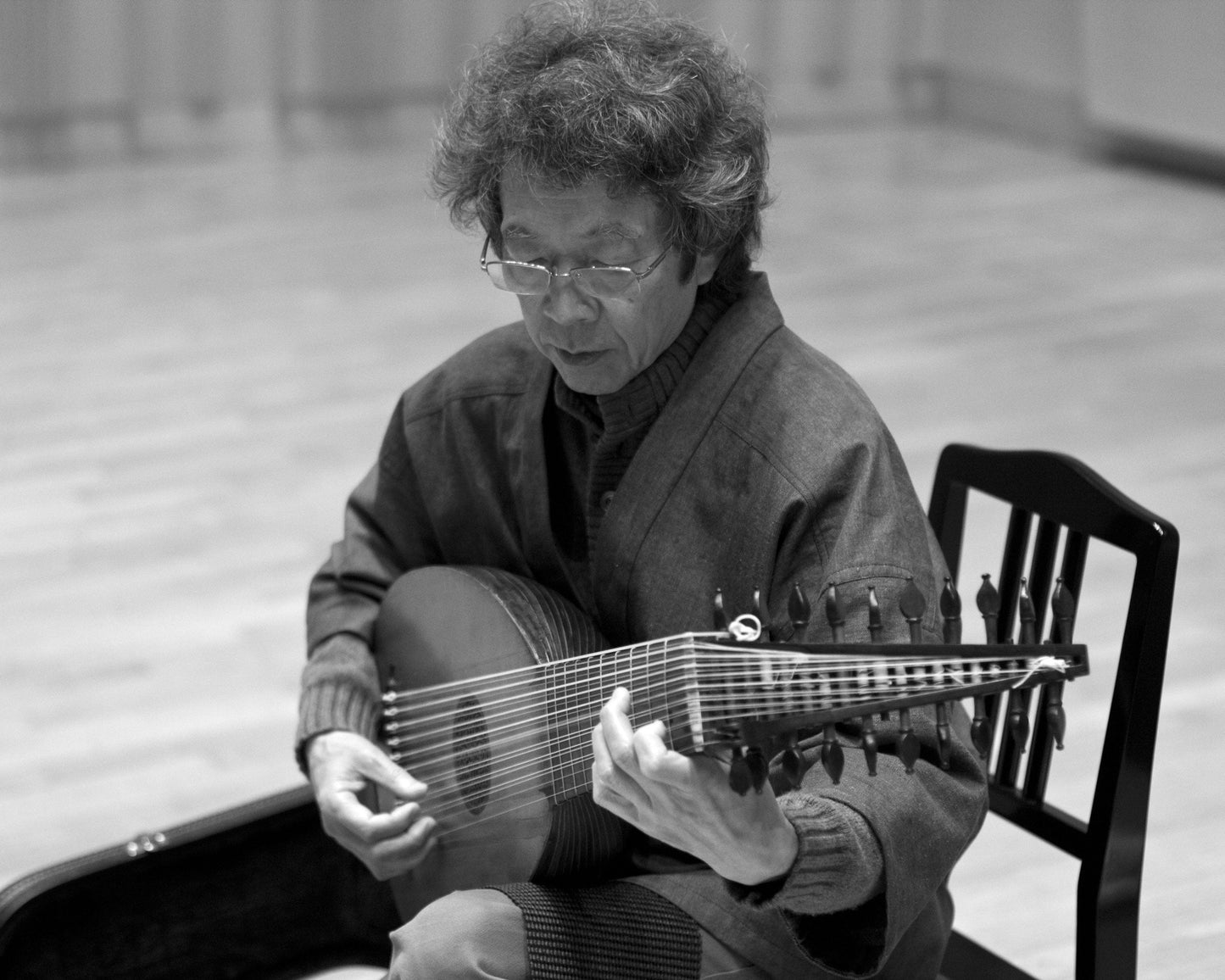
Toyohiko Satoh plays an original baroque lute by Laurentius Greiff from 1611.
Recorded November 14–17, 2022
Location: 炎の博記念堂 文化ホール (Fire Memorial Hall), Arita, Saga (Japan)
Balance engineer & recording producer: Jonas Niederstadt
Cover calligraphy: Shoukei Dokutan 独湛性螢 (1628–1706)
Booklet photography: Jonas Niederstadt
English Translation: Miki Satoh
Produced by Jonas Niederstadt
© 2023 Carpe Diem Records
Presse / Rezensionen
- 5 stars: 2 (100%)
- 4 stars: 0 (0%)
- 3 stars: 0 (0%)
- 2 stars: 0 (0%)
- 1 star: 0 (0%)
Master!!!
I am always on the lookout for small labels with extraordinary artists, production values and aesthetics. Discovering particular artists outside of the mainstream promises hours of pleasure listening and reading liner notes which often turn into brief essays. Carpe Diem is such a label and I am happy to support it with my custom.