


J.S. Bach: Cello Suites I II V
J.S. Bach: Cello Suites I II V
Verfügbarkeit für Abholungen konnte nicht geladen werden
Gyöngy Erödi – Barockcello
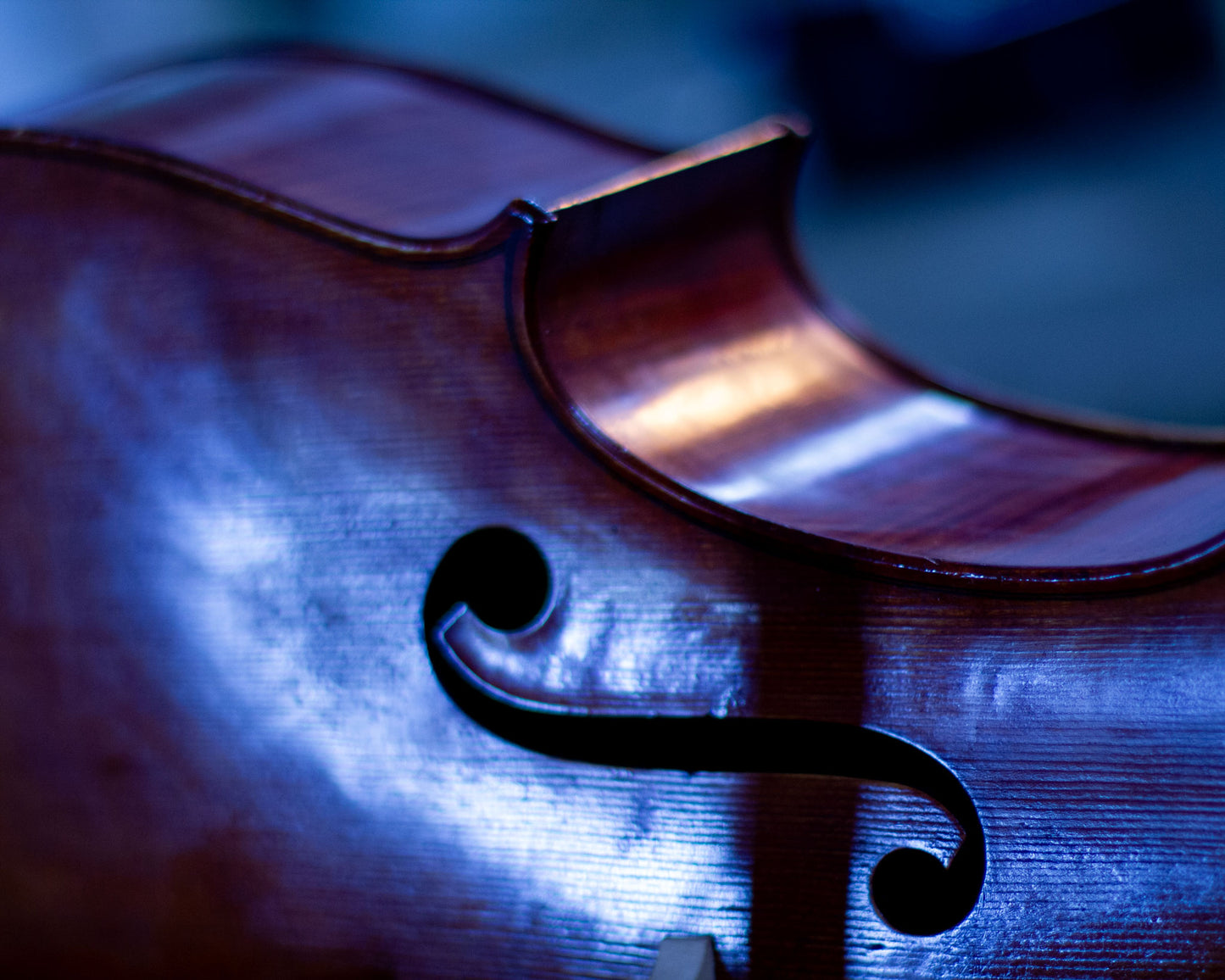
Drei Suiten für Violoncello von J. S. Bach, gespielt von Gyöngy Erödi auf einem barocken Violoncello in der unglaublichen Akustik einer kleinen Kapelle in den österreichischen Bergen. Eine ganz besondere, tief spirituelle und persönliche Darbietung dieser ikonischen Meisterwerke.
Musikvideo
Hier spielt Gyöngy Erödi die Sarabande C-Moll in der Aufnahmekirche dieses Albums:
Erschienen am:
Katalognummer: CD-16318
Share


Mehr Infos zum Album
tracklist
Tracklist von "J.S. Bach: Cello Suites I II V"
Suite II in D Minor BWV 1008
01. Prelude 3:24
02. Allemande 3:14
03. Courante 3:10
04. Sarabande 4:32
05. Menuet I + II 3:02
06. Gigue 3:05
Suite I in G Major BWV 1007
07. Prelude 3:01
08. Allemande 3:58
09. Courante 2:54
10. Sarabande 2:13
11. Menuet I + Improvisation* + II + I 8:20
12. Gigue 1:45
Suite V in C Minor “Discordable” BWV 1011
13. Prelude 6:56
14. Allemande 5:13
15. Courante 2:25
16. Sarabande 2:40
17. Gavotte I + II 4:44
18. Gigue 2:09
Total time 66:58
*Improvisation by Gyöngy Erödi
Booklet-Text
Suites for Violoncello Solo by J. S. Bach
Silent and largely unknown for more than 200 years after their creation, Bach’s six suites for solo violoncello were recorded for the first time between 1936-1939 by the legendary Pablo Casals. In the 80 years since then, the suites inspired not only generations of cellists, but also other instrumentalists from tubists to marimba players to perform and record their own versions. Based on interpretation, historical background, research of instrumentation and performance practice, these recordings offer a colourful variety of different perspectives. In fact, one might wonder whether there is anything left that has not been researched, associated with or inspired by these pieces.
Bach’s cello suites, composed some 300 years ago, have a quality of mystery. First, there is no exact dating of their creation partly due to the absence of a manuscript by J. S. Bach. One of the two earliest surviving manuscripts is by Bach’s second wife Anna Magdalena (the main source for my recording). The missing original score leaves musicologists without evidence about where, for whom, for what purpose and for what kind of a violoncello they were written. Furthermore, there are disputes surrounding areas such as articulation, bowings and even authorship, a topic of the latest debates among academics.
Wonderfully, this lack of data leads to the very essence of the music, which, as I see it, is free of time and space. This means, that the meaning of the suites can only be fully understood by experiencing them in the moment and not by acquiring more information about them. Their past and future, being intangible, merge in the moment of now, when they are being played and heard. In the present, this resonating music is a medium of eternal human experience and emotion that connects us to ourselves and to each other. The deeper, unconscious sense of these pieces can only be gained by our sensory perception of vibrating sound: the reason why these particular works remain relevant today.
I consider research as a necessary virtue of a professional baroque cellist. Thus, I used both academic knowledge and all embodied wisdom I have gained over decades of practice and performing for the creation of this recording. Yet, there is another aspect of performance which I hold to be of great importance: capturing the essence of a particular moment in a recording. To this end, the authentic noises of spring that infiltrated the chapel during the sessions have been left untouched. Several other acoustical sounds also became part of the soundtrack, such as finger-tapping, breathing, string-buzzing and the natural echo in the room. Similarly, my “cello-drumming” within the passacaglia improvisation in the G Major Menuet (done with palms hitting the cello at various points), renders the natural unchanged acoustic phenomenon in the chapel. The intention was to avoid a “perfect” recording, fully cleaned up of intrusive noises, as precisely those extraneous sounds provide the essence of the moment in which the music was created. As a result, this recording provides the mysterious sense of a unique interpretation caught at a particular moment in time, with all the attendant resonances of the location in which it was played. It captures the atmosphere of a live performance.
In the presence of the moment, the suites are timeless. However, they are not free of structure. Each suite is comprised of a prelude and five dance movements, each with a completely different character and story. In my view, these stories speak about the complexity and passions of human life in a most dramatic way. According to baroque rhetoric as I see it, they express the polarity of our world: light and darkness, day and night, life and death, fire and water, joy and sorrow, laughter and tears, female and male; two parts of one whole are introduced with a broad palette of sound-colours that range from a breath to an earthquake.
This vivid speaking quality of the suites enthused me to transform Bach’s music into my own words. Thus, I have written a short story or poem for each of the 18 movements. Instead of creating program music in a strict sense, I have chosen an intuitive and free form of narrative. My intention was to describe the images and emotions conjured up in me by the music. Just to mention two examples on the recording, both the D Minor and C Minor Sarabandes begin with a trembling sound instead of a straight tone. This phenomenon, voiced by my bow stroke and recurring also later, mirrors my feeling of utter sadness and inner crying. Similarly, I sensed a direct connection between my own breathing in its natural three phrases and the ever-returning pulse of three beats in the G Major Sarabande. My vision for each movement is just one of endless other possibilities. Thus, I hope these story-images will inspire listeners to find their own personal reflections.
Gyöngy Erödi
Suite in D Minor BWV 1008
1. Prelude
Magnificent dance of life, how everything turns and moves, just like the swirl of dervishes in trance! Oh, wonderful state of unconscious mind, the joy of ease and rapture of dizziness…spin me, whirl me, and turn me until we are both breathless! Wonderful rush, I beg you, stay! …
I never want to wake up.
2. Allemande
Once upon a time, there was an insignificant, tiny little particle of sand. It lived on the bottom of the sea and swam with millions of other pieces of sand wherever the waters took them. It travelled happily among its kind and never wondered about where it was going to go next. One day, caught by a strong wave, it was sucked into a tight place. Suddenly all went dark. For a moment, the grain thought that it was afraid, but slowly, a warm touch started to caress it. This gentle stroke felt safe and very comforting. What was more, its new home wrapped it with further layers all the time, so that the sand had the sensation of growing and getting stronger every day. Until one day, its home was caught by a fisherman. When he opened the shell, instead of what had been an intruder, he saw a shiny little white pearl.
3. Courante
The movement of walking always made him happy. How lovely it was, to simply feel one foot leaving the ground, then letting it linger in the air, so that it could gently touch the surface again! Being fully aware of the contact with the earth that supported his body, John wanted to feel rooted to the earth and to life. He was young, in love and had a daughter he adored. She would turn eight next week: how time was passing… just like him, it never stopped moving forward. The swing of his hips resonated in his lungs and his heart pulsed with joy.
Reaching the top of the hill, he slowed down his steps. This was his favorite view of the city. From that high up, he could see the castle, the island, all seven bridges and the magnificent river. “What a vast amount of water flows here on its way from the Black Forest to the Black Sea!” he thought. Here he decided to stop, and leaning over the railing, he stretched to catch some fresh air.
In his forward motion his right shoelace got entangled in something. As he bent down to free it (led by intuition rather than by thought), a swirl of wind from behind pushed him off balance. Everything happened within a split second: he lost control of his body, tripped over something hard and sharp, and the next thing he noticed was the motion of falling. He did not panic and neither did he try to stop it happening. He knew he did not have a chance: on this side the hill was at its wildest and steepest; nothing but rocks, and 140 metres high.
Somehow, the sensation of the cold air´s rushing by his ears gave him an absolute wonder at this unknown movement. For a second, (or was it a whole minute?) John was in bliss. He experienced a bodily freedom he never felt in his life. So, this is how it was to become uprooted from the earth? Suddenly, as the horizon opened and he saw the colourful waves of the river, John remembered Sophie. His heart was gripped by sadness: would she know how much he will miss her? He closed his eyes, as the big road appeared below.
4. Sarabande
In the stillness, there was no noise.
No movement and no feeling,
Trembling, soundless weeping.
In the stillness, there was no noise.
Silent tears touched her cheeks
As all colours disappeared.
In this world, nobody cared,
Silent tears touched her cheeks.
5. Menuet I – II - I
I want to scream
Out of pain
I want to scream out
Of pain
I want to scream out of
Pain
I will never leave you alone
I will never leave you
I will never leave
You
To scream
Out of pain
I
Alone
6. Gigue
Had she made a mistake and knocked on the wrong door? She checked everything a dozen times. It was the right street, the right house and door: Sophie even recognized her own name under the bell. Still, she was locked out, and it was after midnight. She felt afraid: was she in danger? Although the park was deserted, she started to hear slight noises and increased her speed. In the dark, unknown shadows appeared out of nowhere, and once she even heard steps from behind. Still, the loudest sound she was aware of was her heart beating like mad.
Sophie started running, out of fear, but as she flew past trees, bushes, benches and playgrounds, unexpectedly, the speed gave her an exciting new sensation of freedom. Laughing and crying at the same time, she did not stop until she was completely exhausted. Standing in front of the house where she grew up, everything suddenly seemed different. A realization came, scary but true: she could not enter the door here, because it wasn’t hers any more. She had to find her own gateway. Even if she needed to get to the other side of the globe, Sophie would not stop until she had found it. And then, she could enter the gate without a key and walk beyond it into her own path.
Suite in G Major BWV 1007
7. Prelude
A seed falls to the earth
With rain and sun, a new birth
Just happens.
Pop! The seed bursts
And a sprout spurts
Out of it.
Ssshhhh…can you hear
The sprout’s tap near
The surface?
Pphhhh…there it goes:
Towards the sun grows
A tiny green stem.
Sizzling and fizzling
Move the new, tingling,
Shiny blades of grass.
As the meadow spreads
Fresh and vibrant, let’s
hear its sound ring!
8. Allemande
What a miraculous substance water is!
It has the most yielding soft touch, yet,
It washes away rocks and forms continents.
Carrying icebergs, extinguishing fire,
It destroys and saves lives.
It eases and stops our breath.
Water, in the form of tears,
Speaks of joys, sorrows,
and earthly delights.
9. Courante
One arm after another
Splashes through the smooth water,
As it meets the surface.
What a tickly sensation
Our legs feel in such motion,
when resistance disappears!
This is like a lovely dance
With the waves in total trance
The swimming body turns.
This journey has no end
Moving forward we spend
Most of our timeless lives.
10. Sarabande
Breathing in, holding the breath, breathing out…
The chest fills with air, the abdomen rises, shoulders ascend
Trillions of atomic particles rush through the body
Blood flows from toes to fingertips and to the top of the head
All cells twist and twirl until the tickling sensation reaches the brain.
In the moment of tension as the lungs are filled with air
It feels like one has just reached the top of a mountain.
Belly, breasts and upper body keep the inner pressure
As all muscles grow and intensify through stress.
Finally, a great relief happens, as the body collapses in exhalation:
Release of the torso, air rushing out, shoulders fall.
In this total rest, the entire organism can now let go,
At peace, fully aware of this perpetual cycle.
11. Menuet I – Impro – II - I
Round and round
Goes the wheel
Penelope
Turns it still.
Round and round
Turns the thread
That every night
She will shred.
Oh, my love!
Oh, my light!
Ariadne,
Change my plight!
Take the thread
Show the way
Out of this maze,
Night and day!
Round and round
Goes the wheel
Penelope
Turns it still.
Round and round
Turns the thread
That every night
She will shred.
12. Gigue
She was pressing the scroll to her left cheek, examining the cello. I gently moved her hands, which held the scroll, to the middle, to aid her in getting the best perspective. She looked at me and gave an amused, hearty laugh.
“You are so kind to help me, but I am afraid appearances can be deceiving. My ideal view differs from yours: because you see, I only use my left eye…the right one is of glass!”
Suite in C Minor “Discordable” BWV 1011
13. Prelude
Before the beginnings of all things, there was silence. In the dark and void, there was neither form nor shape. In this silence breathed the One Great Spirit of the Universe. Gradually, the Spirit became aware of the darkness and of its own breathing which was resonating through everything. With that came a new, unknown sensation: an emotion swept through its being. It was a longing, connected to a vision of shapes, colours, movement, shadows and a blinding whiteness that felt so powerful that the Great Spirit started to breathe faster. Its continuous respiration, filled with sighs, moved with an incredible increase of speed, reverberating and spinning through emptiness, until the silence exploded. At this moment, there was time, there was space and there was light: The Beginning.
The Spirit rejoiced as the Universe expanded: there were galaxies, planets, stars; all connected to its pounding perpetual pulse. Some of these waves created a small, fragile planet that began resonating by itself. Slowly, this planet invited water, air, earth and fire. And in the midst of the planet’s waters, a small bubble could at once feel the Great Spirit’s longing. Sensing this emotion moved the bubble so much that it started wobbling with joy. And because of this tiny bubble’s little dance, other bubbles joined in, and the excitement spread, and other living beings grew in the waters, crawled out of them and inspired a dance on dry land and in the air. Thousands of other kinds of creatures appeared, in all different sizes, colours and forms. They all turned, revolved and rolled in the rhythm of the universal breath. And the One Great Spirit felt another unknown beat within: it was the pulse of its own heart, filled and bursting with happiness.
14. Allemande
He flew off the cliff with a slow and magnificent start.
As he spread his proud wings, the body settled in the air and the eagle began to fly.
The sun shone gently, and a soft breeze rustled his feathers.
Underneath was a spectacular clear lake where his sharp eyes could see through the waves to the very sandy bottom. In a split second, he dived down and caught a tiny silver fish in his beak. Then he took off and continued his proud and majestic voyage, disappearing behind clouds on the horizon.
15. Courante
Up and down, back and forth
This is how a seesaw goes!
Just as we are in the air
High up over all, we dare
To hang on just a second, where
The turning happens to our chair.
Then with mesmerizing speed
We are falling down and need
To prepare our dangling feet
Ready for the final leap.
Up and down, back and forth
This is how a seesaw goes!
16. Sarabande
It was, as if
All of a sudden
All stars
Were extinguished.
All planets
Came to a halt
All birds stopped singing
Even the air stood still.
It was, as if
All of a sudden
All hope
Was gone.
The only sound was
The heart beating
Until it broke
In half.
17. Gavotte I – II - I
The lizard lived under the biggest rock on the stony side of the otherwise green and earthy hill. He was quite small and had a beautiful emerald and brown skin. Every time he left his hole to run around on the nearby rocks in the blinding sunlight, his skin reflected shiny sparkles into the air. He was stunningly good-looking and knew it. In fact, Tarrotarro, for that was his name, was extremely vain. He was the god of the lizards and a long, long time ago, he separated humans into men and women. He was quite proud of that achievement. Although originally being one, those two always found something to fight about. Very soon though, they made peace with each other, then argued and reconciled again. Tarrotarro would sit on the top of his rock and watch males and females repeating their theatre over and over again. He found this very entertaining and would sometimes roll with laughter about the trivial matters that triggered humans to quarrel.
One day, as a young traveller climbed to the top of Tarrotarro’s hill, he saw the lizard observing what happened in the human world.
“Who are you who sits on top of the world and amuses himself about people`s lives?” asked the young traveller.
“I am Tarrotarro, the lizard god” said Tarrotarro, turning to his left side to show his emerald-coloured shiny side to his visitor.
“You should be ashamed of yourself!” cried the young man.
“Why?” asked Tarrotarro, turning to his right side to showcase his sparkly brown skin, not at all ashamed of himself. On the contrary, he was very proud of his attractive colours.
“We humans must bear a long, laborious and strenuous life, full of hardship, suffering, pain and hopelessness!” blurted out the young fellow, completely unaware of the lizard’s flaunting. “We never know what the next day will bring, are completely in the hands of the weather god for our crops and have to bury our own dead! And as if that would not be enough trouble already, we have the female who never understands anything, comes up with the strangest ideas about feelings and dreams, but always gets lucky at the end, stumbling upon the answers by pure coincidence!”
“Look at me carefully,” whispered Tarrotarro as he began spinning around vigorously in small circles. It was as if he would constantly try to catch his own long gorgeous tail but would never quite succeed at it. “What do you think I am doing?”
“You are revolving around yourself, trying to catch your tail” answered the young fellow.
“Am I two then,” asked Tarrotarro, “me, and the tail?”
“No, you and your tail are one” answered the traveller.
“It is the same as your human life” said the lizard. “In a never-ending cycle of struggle, you try to catch the female and she tries to escape you. But both hunting and hiding involve the same motion: running. She will always try to run away, and you will never catch her. You are together one living being, just as I am one with my tail. But I have decided to give you both a gift. With it you will be able to transform your suffering of fear and pain.”
“Will it also stop our suffering, god of the lizards?” asked the young man.
“No, but with it you will be able to accept it. My present to you is the ability to express and share your passion with other humans. The minute you share it with others, the weight of the pain is halved.”
“What is it?” asked the traveller, feeling hopeful for the first time in his life.
“It is the gift of Art…” answered Tarrotarro.
18. Gigue
Try to imagine time as the ever-evolving movement of a single moment into the next one.
It is as if by pressing an invisible button, you could stop the clock from ticking forward. Seconds,
Minutes, and hours pass by within you, but nothing changes in your outside reality.
Everything freezes, and as you step out of the moment you can see it from the outside.
Take your time as you observe the image of this split second that looks like a photograph:
It captures all actions, feelings and sensations in a single reflection, just like one peek in the
Mirror. Draw a breath and you will see the next vision, and again, the next; so that an
Eternal succession of glimpses appears, creating the sensation of change and movement: time.
Informationen zur Aufnahme
Baroque violoncello after an original by G. B. Guadagnini 1745, copy by Kai Thomas Roth, Bowlish, 2004
Baroque bow after an oil painting “The Cabal” attributed to John Baptist Medina, 1661, Nostell Priory (GB), by Hans Reiners, 2000 (for BWV 1008)
Baroque bow, copy of early 18th-century model, by Pieter Affourtit, 2003 (for BWV 1007)
Baroque bow, by Pierre Patigny, 2003 (for BWV 1011)
Recorded May 7-11, 2014
Recording location: Kalvarienbergkapelle St. Peter, Waldburg (Österreich)
Balance engineer & recording producer: Jonas Niederstadt
Corporate Design: Tim+Tim, timandtim.com
Cover photography: Leif Marcus
Booklet photography: Jonas Niederstadt
All texts © 2018 Gyöngy Erödi
© 2018 Carpe Diem Records