


Akira Ifukube: Gilyak Songs
Akira Ifukube: Gilyak Songs
Couldn't load pickup availability
Chiyomi Yamada - soprano
Reiko Yamada - piano
About the album
Piano songs by the Japanese composer Akira Ifukube (1914–2006), interpreted by Chiyomi Yamada, voice, and Reiko Yamada, piano.
Ifukube, who also composed the theme song of “Godzilla”, wrote these magical pieces based on traditional songs from native tribes of northern Japan. The sound and style of this music are somewhere between western contemporary and eastern traditional music, creating a unique fusion of musical and aesthetic elements.
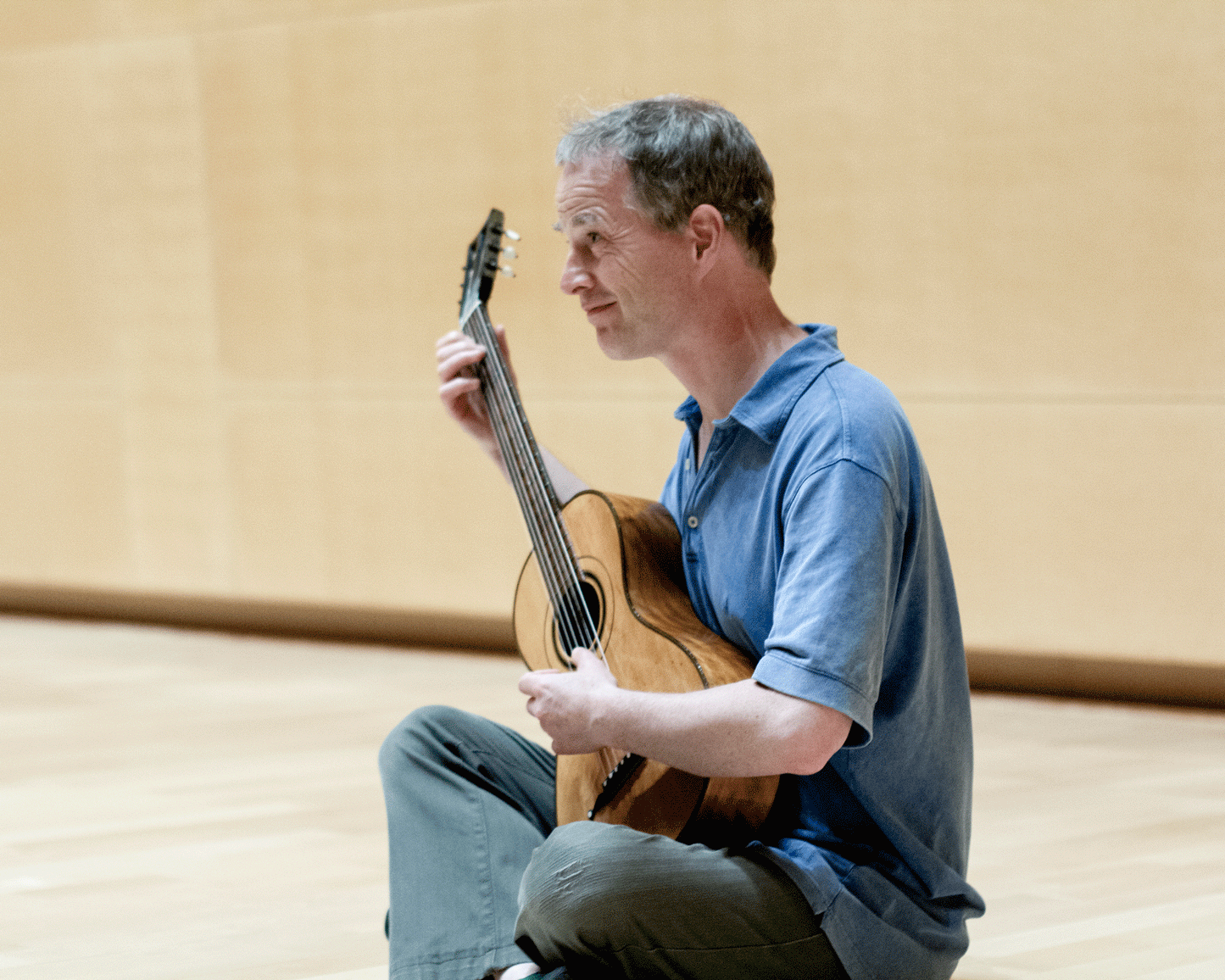
The piano songs are complemented with an epic piece for classical guitar solo by Ifukube, played by the Dutch guitarist David van Ooijen.
Release date:
Catalogue number: CD-16316
Share


More album information
tracklist
Tracklist of "Akira Ifukube: Gilyak Songs"
Ancient folk songs of Gilyak Tribes (1946) ギリヤーク族の古き吟誦歌
Lyrics: Akira Ifukube 伊福部昭 詩
1. ai ai gomteira アイ アイ ゴムテイラ 02:08
2. takkar 彼方の河び 04:52
3. ujunğajujana 苔桃の果拾ふ女の歌 04:50
4. lokoru: ja 熊祭に行く人を送る歌 06:03
5. Tōka, Cantilena Ballabile sul Mode 古代日本旋法による踏歌 19:47
Antico di Giappone (1967)
Three lullabies among the native tribes サハリン島土蛮三つの揺籃歌
on the island of Sakhalin in the 伝承詩
original tongues (1949)
6. bu:lu: bu:lu: (Kilin tribes) ブールー ブールー(キーリン族)06:02
7. buppun lu: (Gilyak tribes) ブップン ルー(ギリヤーク族)03:57
8. umpri ja: ja: (Oroke tribes) ウンプリ ヤーヤー(オロッコ族)02:07
Total time 49:49
booklet text
Akira Ifukube (1914–2006) is known as the composer of the theme song of the former hit movie “Godzilla”. The pianist Reiko Yamada, who lives in the U.S., has been in touch with his music for more than ten years. Encouraged by her husband, a baroque violinist, she came over all the way to Japan to meet me, an early music singer, bringing the composers “Gilyak songs” with her. This was actually the first time that I even heard of Ifukube. Ifukube’s musical work possesses the grandness and power of the monster Godzilla itself, and this is certainly true also for these songs. I doubted that this music would be suitable for my voice. Nonetheless, I was strangely intrigued by the idea of singing it and felt I had to make it possible somehow.
What makes his music so powerful? In ancient times, people in Japan celebrated festivals (祭 = Matsuri) to dance, play and sing together in order to become one with the universe. Sake (rice wine) was a sacred thing to get closer to the gods and communicate with them. Songs and dances were always performed together. People stamped the ground, stretched out their arms and legs and raised their voices to resonate with the vibrations of the universe. This was their prayer. Shintoism understands the heart as a nonphysical vibration. Without that heart vibration, nothing can come forth. Everything physical that exists on this earth is regarded as born from the waves of the heart, that is, from the hearts of the gods. Our ancestors have thankfully offered prayers to all objects that manifest these vibrations of the divine. Perhaps the mystical grandness of Ifukube’s music connects to him being rooted in a spiritual tradition dating back as far as the Jomon period (14.000–300 b.c.). The songs of this album, which were inspired by traditional folk songs of ancient Asian people, are neither historical music nor Japanese or Western music. Instead, they represent these ancient people’s prayers as well as Ifukube’s own devotions.
The 16th Century saw the emergence of a Western society which rapidly advanced in science and economic growth and regarded civilization and nature as conflicting concepts. It was in that time that composers developed harmony as a vertical musical structure determined by cadence and form. The Western music education system, which was based on solid theory and notation, was imported into Japan through the United States at the beginning of the 19th century when the country opened to the west after the 200 year-long “Sakoku” (“closed country”) period. The stories of how in these first years schoolchildren struggled singing the Do-Re-Mi scale along to the piano seems hard to believe nowadays, but they are true. In order to become compatible with the so-called “civilized” Western culture, the policies of the Meiji government enforced the teaching of Western music and a complete neglect of traditional Japanese music education. Eventually, the traditional music with its subtle pitches became strange to the Japanese ears after being continually exposed to the equal temperament of the Western piano. The performers were told that technique was the foundation of music, which consequently led to a separation of body and mind. Musicians were expected to perform in bigger halls and to play expressively with beauty and precision, and always in equal temperament, in order to please and impress the audience rather than themselves. It became difficult to still perceive the subtle nuances between the written notes. In the 20th Century, composers who wrote Japanese songs based on Western music theory complained about the fact that singers were actually unable to grasp the narration of the lyrics, and would instead get caught up in interpreting only the written notes.
After studying music on his own, Ifukube used Western instruments and notation as a medium for his compositional art. He worked in forestry in northern Japan when he was young, and there he got in touch with people of the Ainu tribe. This contact with ancient traditions also inspired his personal musical style. It is assumed that Ifukube is a descendant of the priest family of the Shinto shrine of Izumo, which dates way back into the mythological times of Japan and has always stayed true to its Eastern spiritual heritage even in times of strong Western influence during the Meiji period. Against this background, I find it regrettable that Ifukube’s work has so far never been interpreted in a non-Western way. He was interested in Western early music as well, and I guess this was because he could instinctively feel an inherent connection to the traditional music of the East. Let us go back in time to the era of early music, of the Gregorian chant and even further to the traditions of modal chants which were still passed on orally. This music did not have start or end points but rather consisted of ever repeating variations of rich and complex textures, resonating with the grand movements of the universe itself. These infinitely delicate proportions can never be counted, nor be expressed in written notes. Traditional Western modal music was still aiming towards harmonizing with and giving oneself freely to the natural order of the universe. From this point of view, all traditional music is linked through universal vibrations, regardless of its geographical origins on this planet.
The past years, whenever studying Ifukube’s songs, I felt this music would become meaningful only when performed in a modal way. The actual challenge for me was not to cope with the grandness of his music, as most people might think. Rather, my endeavor is to understand these songs from the modal perspective of traditional music and to tap into the limitless inner world of Ifukube.
At the age of 23, I moved to the Netherlands in order to study European early music. I did not speak the language well and did actually not know much about music yet. One day I carefully stepped into a classroom of the music conservatory. I heard some beautiful voices singing acapella. They were directed by Dr. Steward with the movement of her hands, and the sound instantly touched me deeply. This was my first experience with modal music. Back then, I promised myself to someday apply this technique to my own singing. To sing the songs of Ifukube today completes the circle for me. I deeply wish that this performance of his music can facilitate a sense of oneness in our modern society, which has largely lost its spiritual tradition.
Chiyomi Yamada, Arao, March 2018
recording information
Recorded July 11-13, 2017
Recording location: Kirishima International Concert Hall “みやまコンセール” (Japan)
Balance engineer & recording producer: Jonas Niederstadt
Corporate Design: Tim+Tim, timandtim.com
Cover photography: Simon Keckeisen
Translation of song texts: Junko Nagiyama
Translation of liner notes: Miki Satoh, Jonas Niederstadt
Booklet photography: Jonas Niederstadt
© 2018 Carpe Diem Records